USTC complex geometry seminar
This is the homepage of a complex geometry seminar organized by Mingchen Xia at USTC, Hefei. Unless otherwise specified, all talks take place in Room 1124, Material Science Research Building (Section C).
If you wish to visit USTC and give a talk, please contact Mingchen. Anyone who has never worked in the French government is welcome.
Forthcoming talks
Speaker: Ludvig Svensson, Chalmers Tekniska Högskola
Title: Gibbs polystability of Fano manifolds
Time: Mar. 19, 2026 (Thursday) 14:30~15:30, at USTC Shanghai institute for advanced studies.
Abstract: I will talk about joint work with R. Andreasson and R. J. Berman on the extension of the probabilisitc framework for constructing Kähler–Einstein metrics, involving random point processes, due to Berman, to the case of (log) Fano manifolds with non-discrete automorphism group.
I will begin by giving an overview of the probabilistic approach. I will discuss the case of canonically polarized manifolds which has been settled, and go on to talk about Fano manifolds with discrete automorphism group, where the unique existence of a Kähler–Einstein metric is conjecturally equivalent to the (algebraic) notion of Gibbs stability.
In a recent paper, we introduce the notion of Gibbs polystability, and conjecture that it is equivalent to the existence of a Kähler–Einstein metric on a general Fano manifold. Furthermore, we conjecture that the unique such metric with vanishing moment emerges in the large N-limit when sampling N points on X. This moment condition is defined with respect to a moment map induced by the action of a fixed maximal compact subgroup of the autromorphism group. This and other conjectures follow from an overarching conjectural large deviation principle for the large N-limit.
I will discuss the one-dimensional case, where we are able to prove many of the conjectures. Lastly, if time permits, I will comment on some applications of our results for log Fano curves.
Speaker: Xu Wang, Norwegian University of Science and Technology (NTNU)
Title: Ross-Witt Nyström correspondence and Ohsawa-Takegoshi extension
Time: Apr. 16, 2026 (Thursday) 14:30~15:30, at USTC Shanghai institute for advanced studies.
Abstract: We obtain a general Ohsawa-Takegoshi extension theorem by using the Ross-Witt Nyström correspondence picture and Berndtsson’s theorem in \cite{Bern20}. In the test configuration (C∗-degeneration) case, our approach gives a quick proof of the Ohsawa-Takegoshi extension theorem without taking limit or using singular weight, which is very different from the Ohsawa-Chen-Blocki-Guan-Zhou approach and the Berndtsson-Lempert approach. Another advantage of our approach is that it fits better to the sharp estimate for the weighted Bergman kernel on compact manifold. Applications include a sharp lower bound of the Bergman kernel for compact Riemann surfaces and a non-vanishing theorem in terms of (weighted) Okounkov bodies.
Past talks
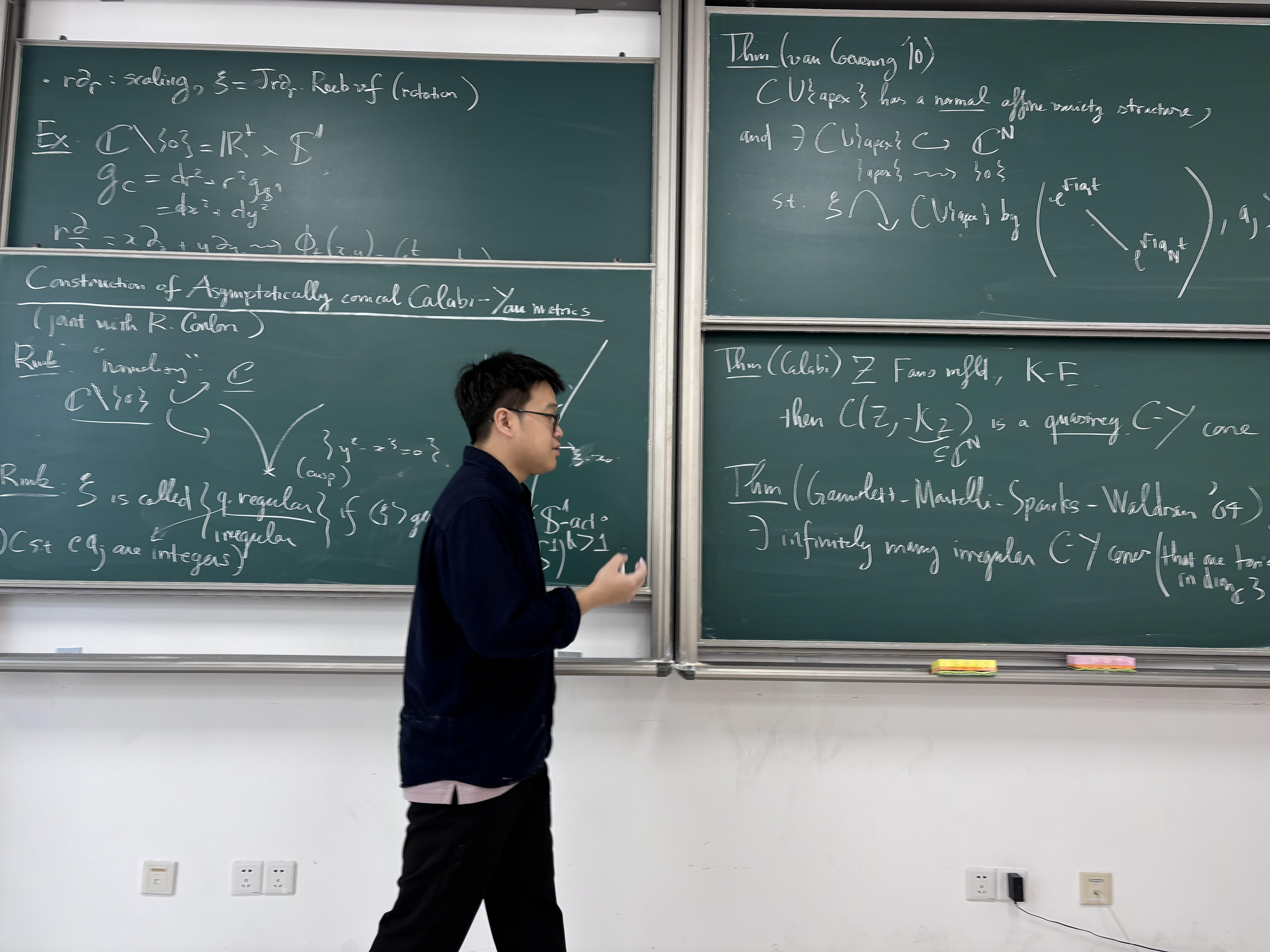
Speaker: Trung Nghiem, Université Claude Bernard Lyon 1
Title: An effective construction of asymptotically conical Calabi–Yau metrics
Time: Jan. 9, 2026 (Friday) 9:30~10:20
Abstract: An asymptotically conical Calabi–Yau manifold is a Ricci-flat Kähler manifold whose shape, when zoomed out towards infinity, looks like a Calabi–Yau cone. A recent work of Conlon–Hein shows that an AC Calabi–Yau manifold is obtained either by algebraic deformations or crepant resolution in a reversible and exhaustive process. In terms of the metric on the cone, the behavior of the AC Calabi–Yau metric is said to be quasi-regular or irregular. Examples of the latter are notoriously rare in the literature: in fact the only such example before our work was built by Conlon–Hein using ad-hoc computations; but there had been no explicit way to obtain them, and an open question in their paper was whether there exist more metrics of the same kind. In my talk, I’ll present an effective strategy to construct new irregular AC Calabi–Yau manifolds via Altmann’s deformation theory of isolated toric Calabi–Yau cones. This is a joint work with Ronan Conlon (University of Texas, Dallas).
Speaker: Pietro Mesquita-Piccione, University of Gothenburg
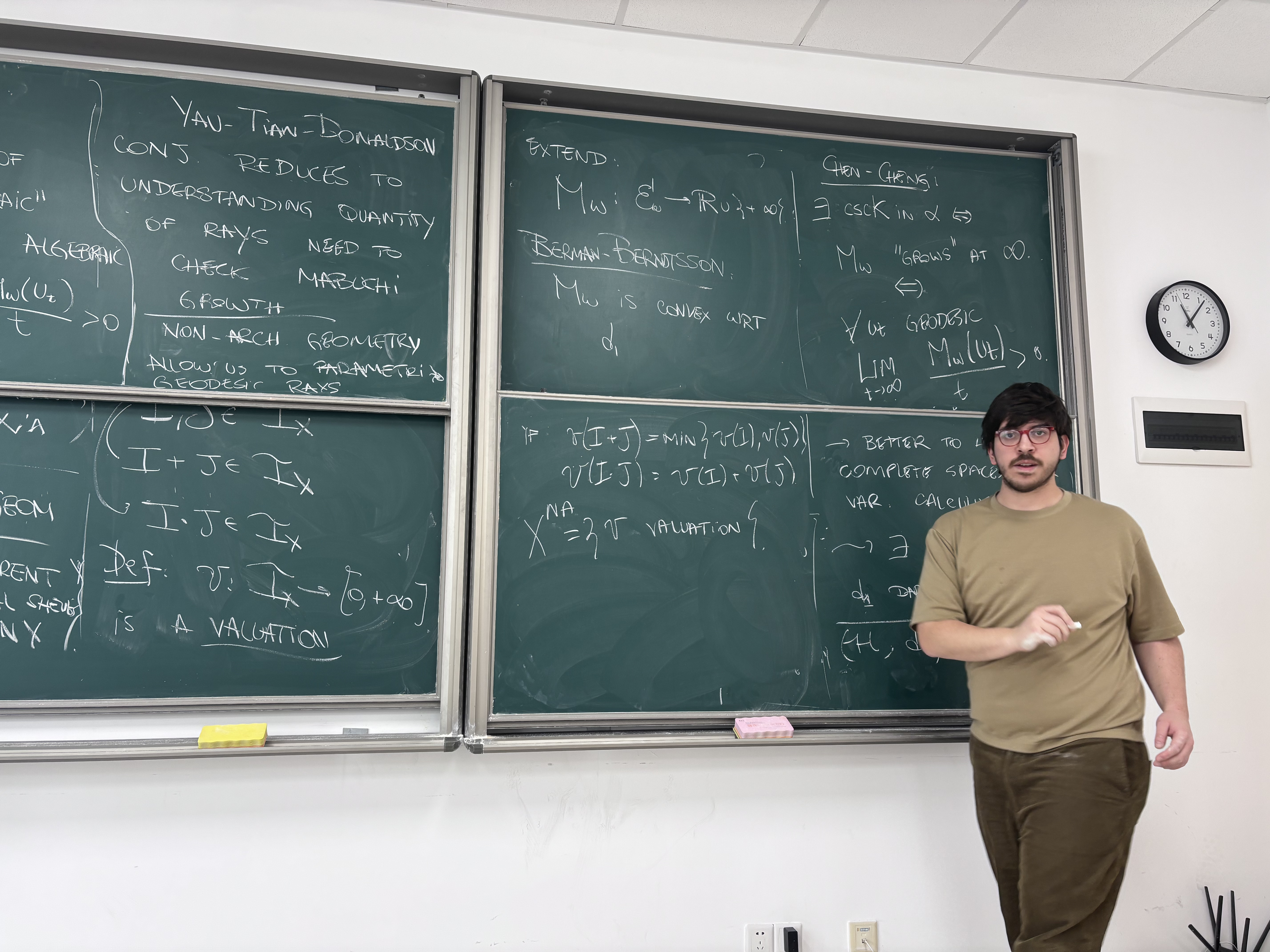
Title: A non-Archimedean approach to the Yau-Tian-Donaldson conjecture
Time: Jan. 9, 2026 (Friday) 10:30~11:20
Abstract: In Kähler Geometry, the Yau–Tian–Donaldson conjecture relates the differential geometry of compact Kähler manifold with an algebro-geometric notion called K-stability. I will start with a brief overview of the topic, and then I will discuss a possible non-Archimedean approach to solve this conjecture, generalizing a result of Chi Li to the transcendental setting.
Speaker: Ying Wang, University of Michigan
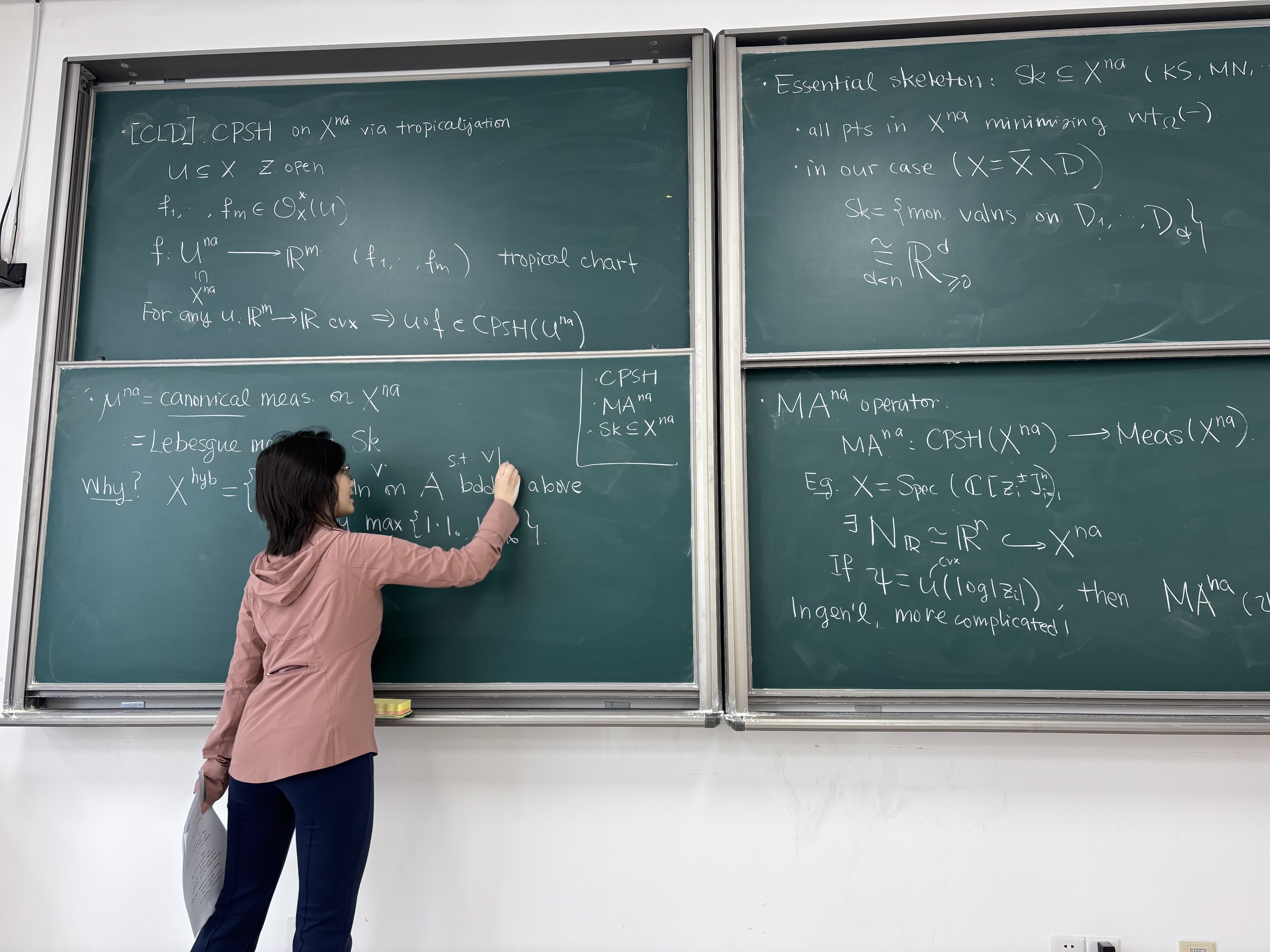
Title: Non-Archimedean Calabi–Yau potentials on certain affine varieties
Time: Dec. 18, 2025 (Thursday) 10:00~11:00
Abstract: We solve a non-Archimedean Monge-Ampère equation on the Berkovich analytification of a complex log Calabi-Yau pair whose dual complex is a standard simplex, answering a question of Collins-Li and offering a non-Archimedean analog of Ricci-flat metric potentials on complex affine varieties. This work builds on the solution to a complex Monge–Ampère equation obtained by Collins–Li and Collins–Tong–Yau.
We also show the suitably rescaled limits of the complex potentials coincide with their non-Archimedean counterparts in some situations, strengthening their connections.
Speaker: Genglong Lin, BIMSA
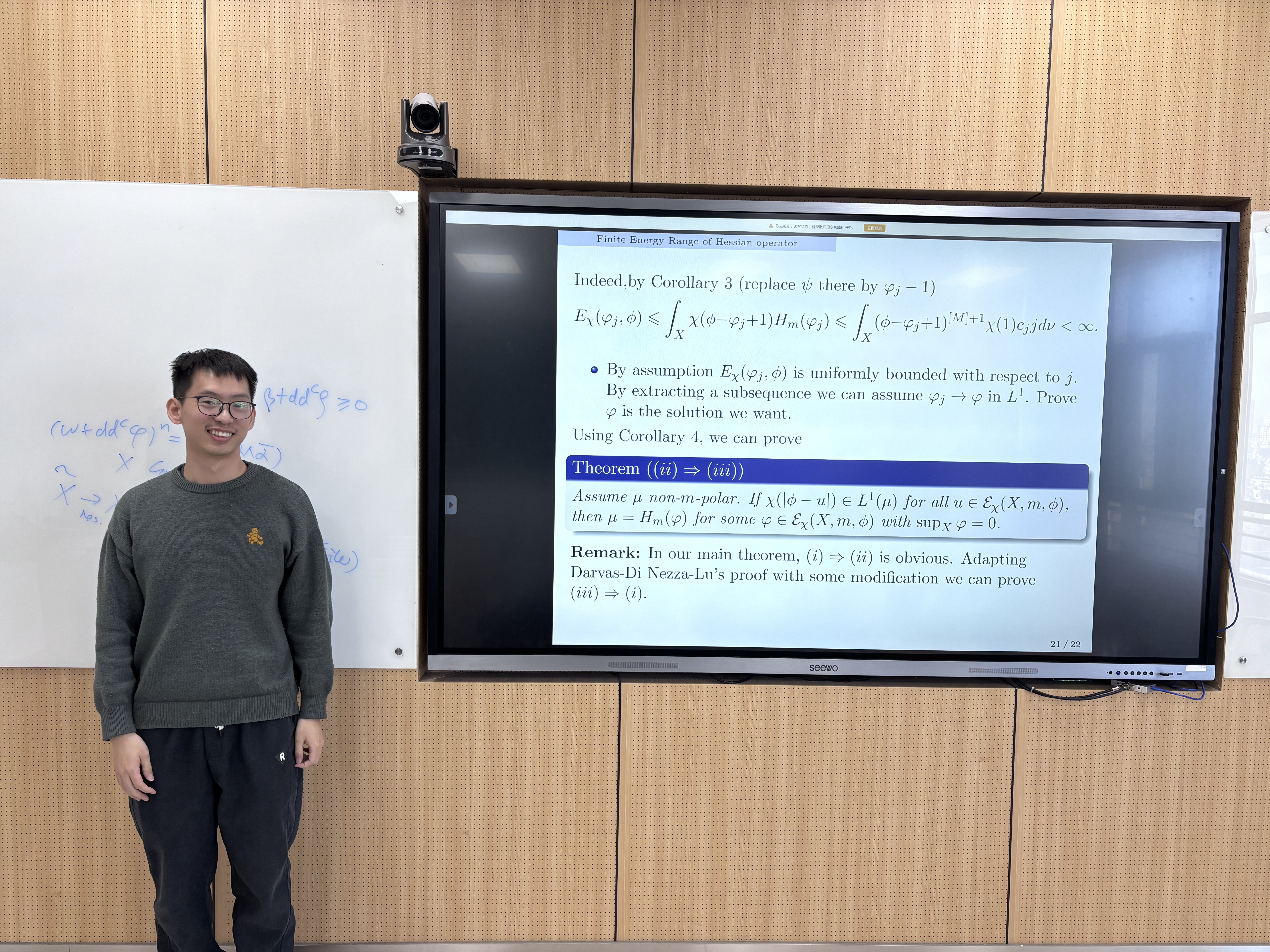
Title: Degenerate Hessian type equations on compact Hermitian manifolds
Time: Nov. 28, 2025 (Friday) 10:45~11:45
Abstract: In this talk we will discuss my recent progress on a class of degenerate Monge–Ampère equations in a nef class on compact Hermitian manifolds. The method combines with a series work of Darvas–Di Nezza–Lu. Secondly, we will talk about the finite energy range of Hessian equations on compact Kähler manifold. The proof is different from Darvas–Di Nezza–Lu’s. Partially based on joint work with Yinji Li and Xiangyu Zhou.
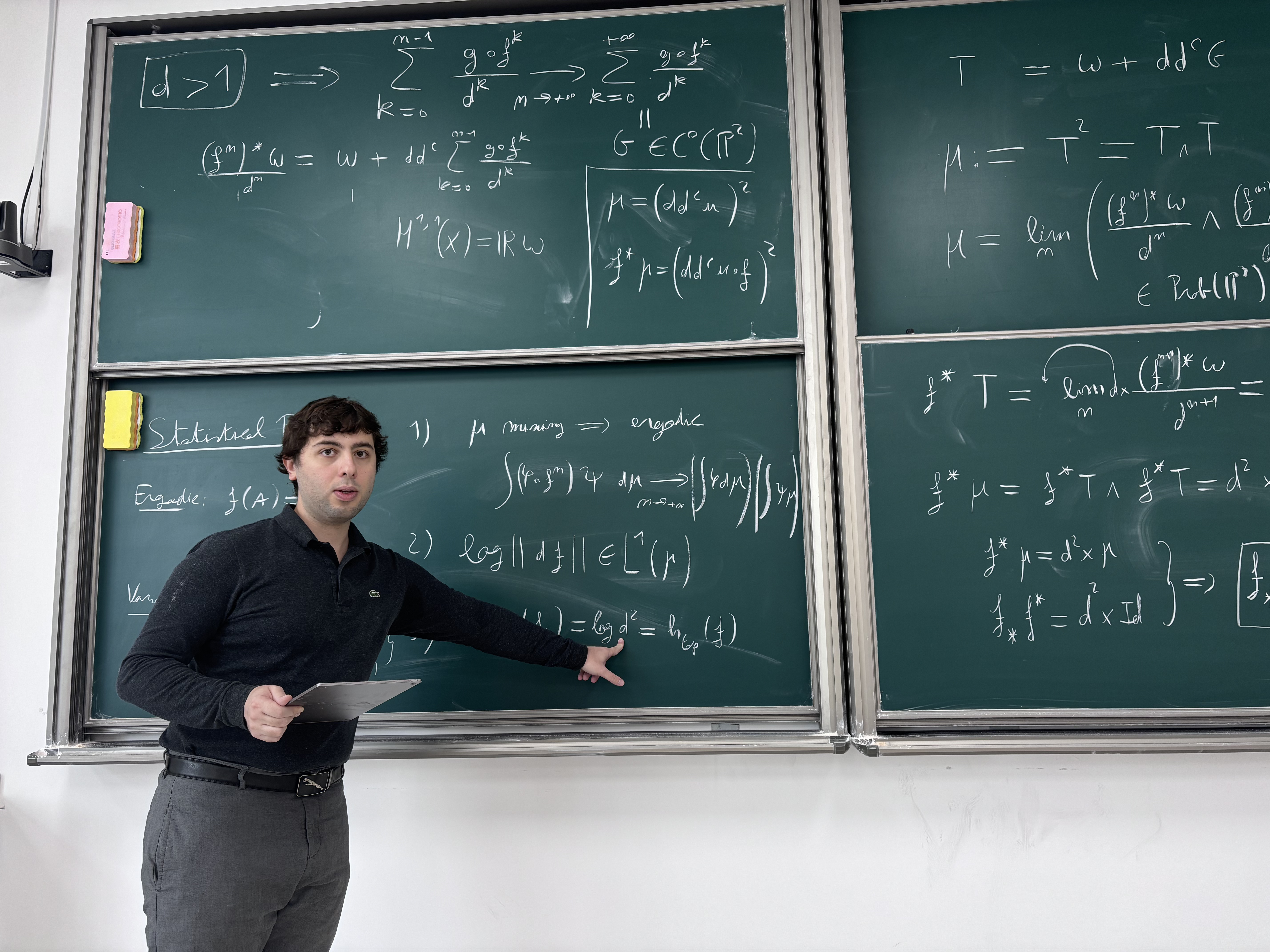
Speaker: Virgile Tapiero, IMFP
Title: Normal forms and Lyapunov exponents of endomorphisms of the complex projective plane
Time: Nov. 13, 2025 (Thursday) 10:00~11:00
Abstract: Let f be an endomorphism of the complex projective plane P^2 of degree d>1. There exists a unique probability measure μ of maximal entropy (equal to log d^2) for f. It is ergodic and admits Lyapunov exponents L_1 ≥ L_2. A fundamental result due to J.-Y. Briend and J. Duval (1999) states that the Lyapunov exponents of μ are bounded below by a constant depending only on the degree d of f, more precisely, they are bounded below by (log d)/2. The case of equality L_1 = L_2 = (log d)/2 was characterized by several authors, who showed that this happens if and only if μ is absolutely continuous with respect to the Lebesgue measure.
μ is also a Monge-Ampère mass: μ = T ∧ T the autointersection of the Green current T of f. R. Dujardin proved (2012) that μ « Trace(T) implies L_2 = (log d)/2. He also addressed the question of the reverse property. In this talk, we will focus on the case L_1 > L_2 = (log d)/2. I will explain how to prove that L_2 = (log d)/2 implies μ « Trace(T), answering Dujardin’s question. The techniques involved are based on pluripotential theory, ergodic theory, and the use of normal forms for the dynamics.
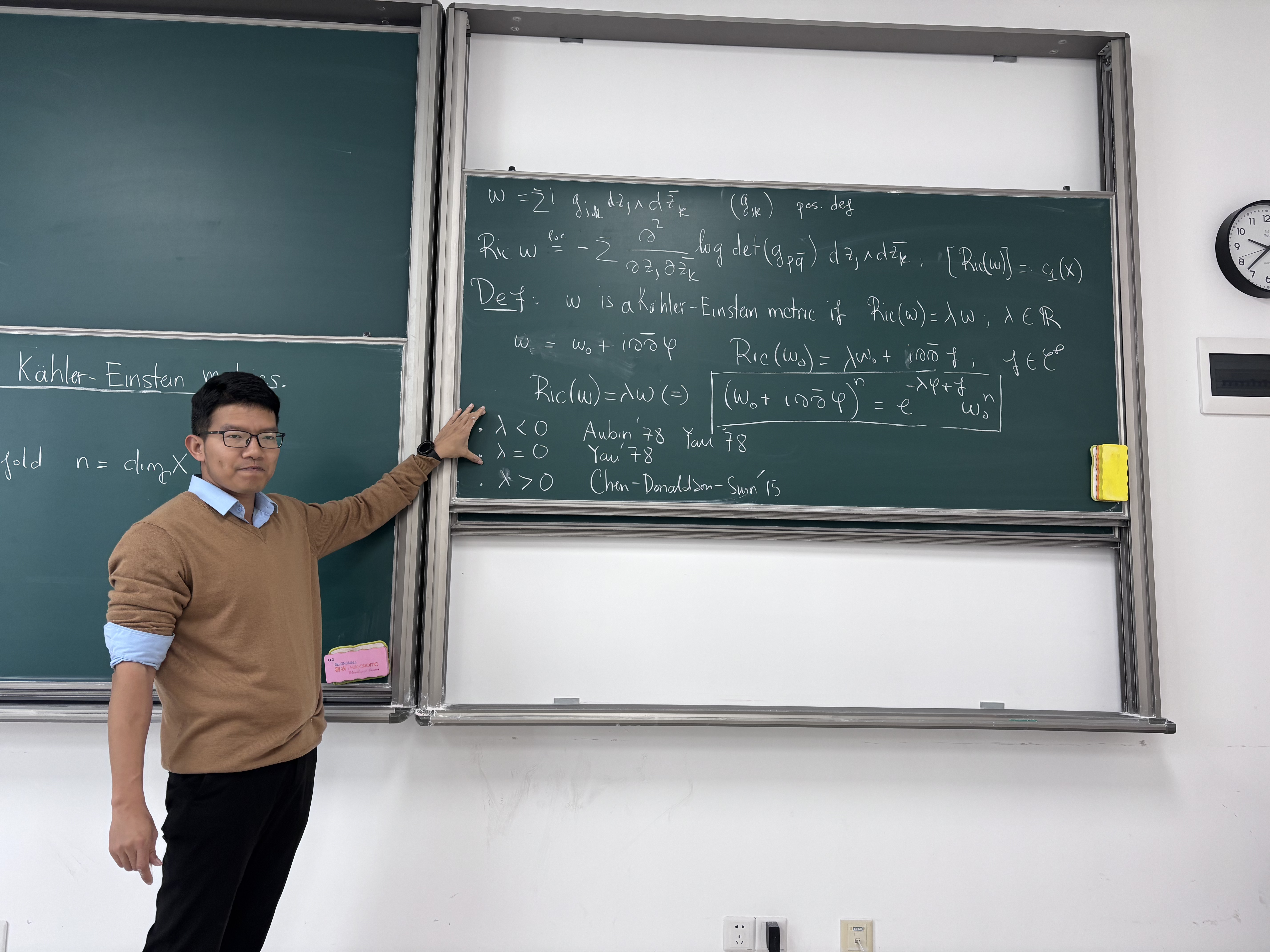
Speaker: Quang-Tuan Dang, Tsinghua University
Title: Degeneration of conic Kähler–Einstein metrics in big classes
Time: Nov. 5, 2025 (Wednesday) 9:30~10:30
Abstract: Let X be a compact Kähler manifold and D a simple normal crossing divisor on $X$ such that K_X+D is merely big. I will present a recent joint work with Duc-Viet Vu in which we establish the weak convergence of conical Kähler–Einstein metrics of negative curvature to a singular Kähler-Einstein metric in the class c_1(K_X+D). This partially answers a question posed by Biquard and Guenancia.
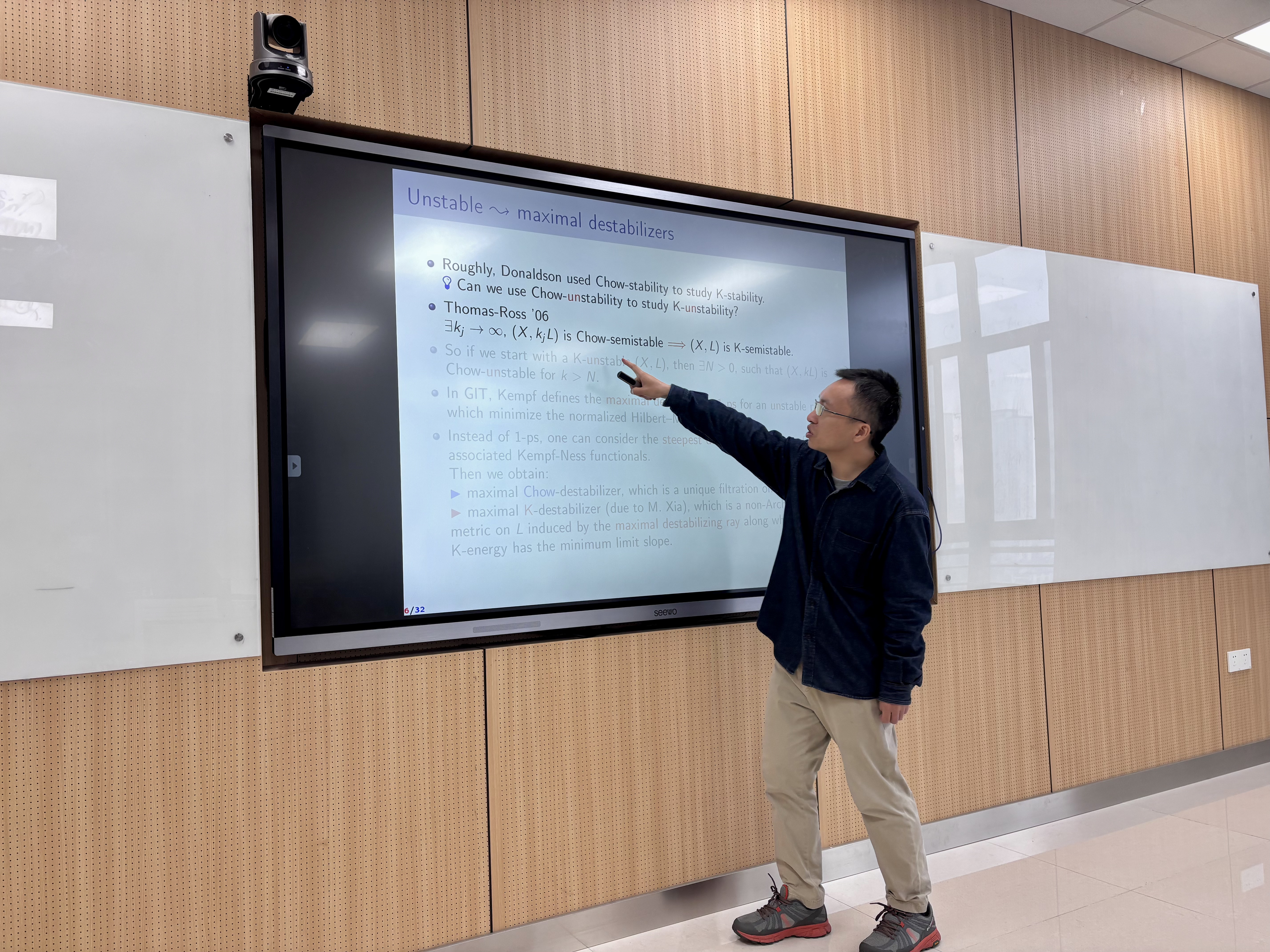
Speaker: Yi Yao, Hunan University
Title: Maximal destabilizers for Chow and K-stability
Time: Oct. 30, 2025 (Thursday) 10:40~11:30
Abstract: When Kahler manifold (X, L) admits cscK metrics, Donaldson uses the balanced metrics to quantize the cscK metrics. In the opposite case, if (X, L) is K-unstable, then the Kodaira embedding of X via |kL| would be Chow-unstable when k is large enough. In this case, we have a maximal K-destabilizer due to Xia and Li, and a sequence of maximal Chow-destabilizers due to Kempf. A natural question is whether the latter will converge to the former in a certain sense. We propose a variational approach based on Boucksom-Jonsson’s non-Archimedean pluripotential theory. We shall start with the toric setting, where things become very concrete.
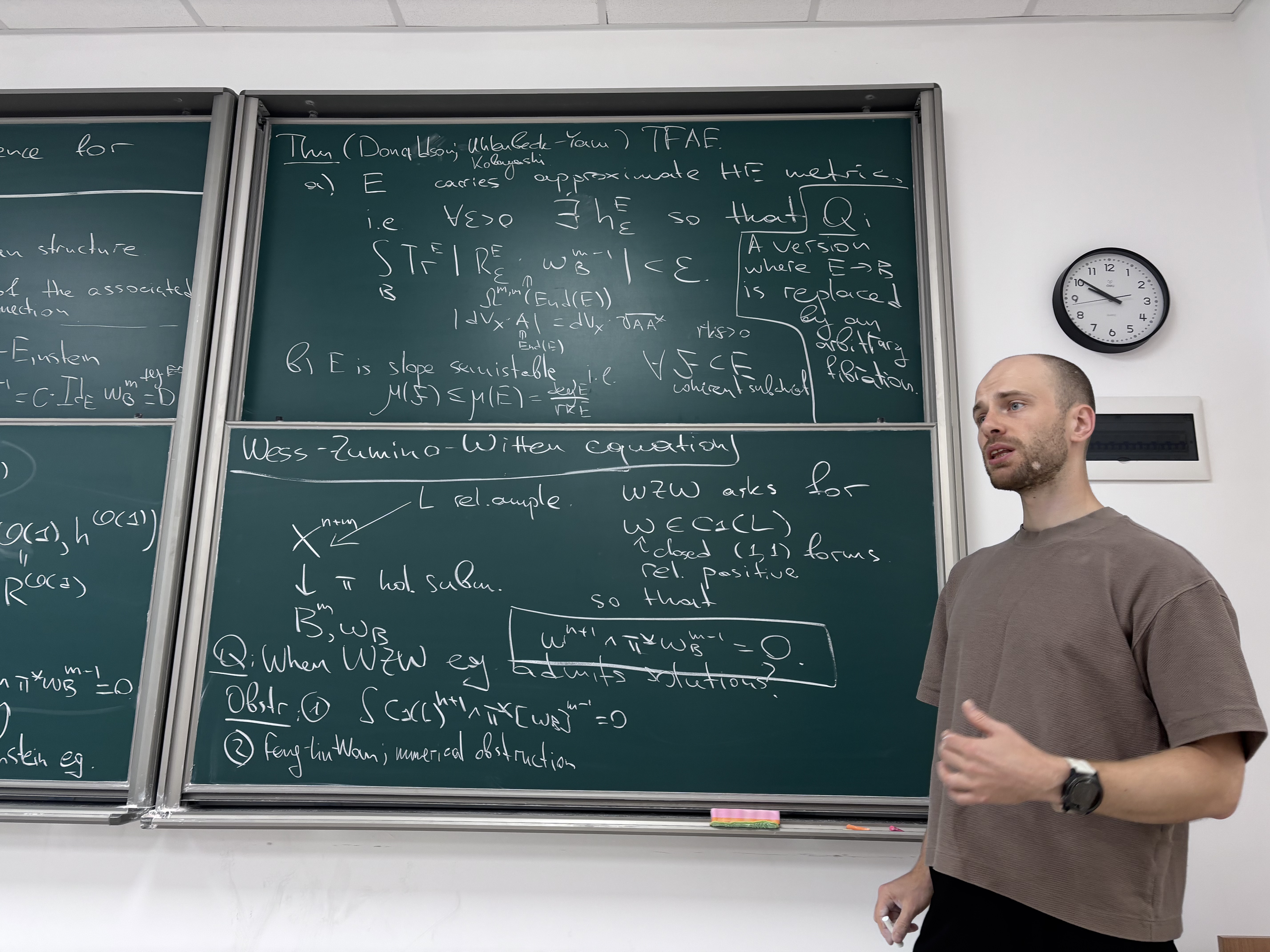
Speaker: Siarhei Finski, École Polytechnique
Title: Kobayashi–Hitchin correspondence for polarized fibrations
Time: Oct. 30, 2025 (Thursday) 9:30~10:20
Abstract: A Hermitian metric on a holomorphic vector bundle is said to be Hermite-Einstein if its mean curvature is proportional to the identity operator. The Kobayashi-Hitchin correspondence (or the Donaldson-Uhlenbeck-Yau theorem) asserts that a holomorphic vector bundle admits a Hermite-Einstein metric if and only if it satisfies the algebraic condition of slope polystability.
In this talk, I will describe a recent extension of the Kobayashi-Hitchin correspondence to general fibrations beyond holomorphic vector bundles. Specifically, for a polarized family of complex projective manifolds, we examine the so-called Wess-Zumino-Witten (WZW) equation, which specializes to the Hermite-Einstein equation, when the polarized fibration is associated with a projectivization of a holomorphic vector bundle. We establish that the existence of approximate solutions to this equation is equivalent to the asymptotic semistability of the direct image sheaves associated with high tensor powers of the polarizing line bundle.
Speaker: Yan He, Norwegian University of Science and Technology (NTNU)
Title: Ross–Witt Nyström Correspondence and Ohsawa–Takegoshi extension theorem
Time: Oct. 16, 2025 (Thursday) 13:30~14:30
Abstract: In this talk, I introduce the correspondence between analytic test curves and the geodesic rays in the space of Kähler potentials by Legendre transform and how this gives a better L2 estimate in the Ohsawa–Takegoshi theorem.

Speaker: Jiyuan Han, Westlake University
Title: On the existence of weighted-cscK metrics
Time: Oct. 10, 2025 (Friday) 10:00~11:00
Abstract: Weight-cscK metrics provide a universal framework for the study of canonical metrics, e.g, extremal metrics, Kähler Ricci soliton metrics, µ-cscK metrics. In joint works with Yaxiong Liu, we prove that on a Kahler manifold X, the G-coercivity of weighted Mabuchi functional implies the existence of weighted-cscK metrics. In particular, there exists a weighted-cscK metric if X is a projective manifold that is weighted K-stable for models. We will also discuss some progress on singular varieties.

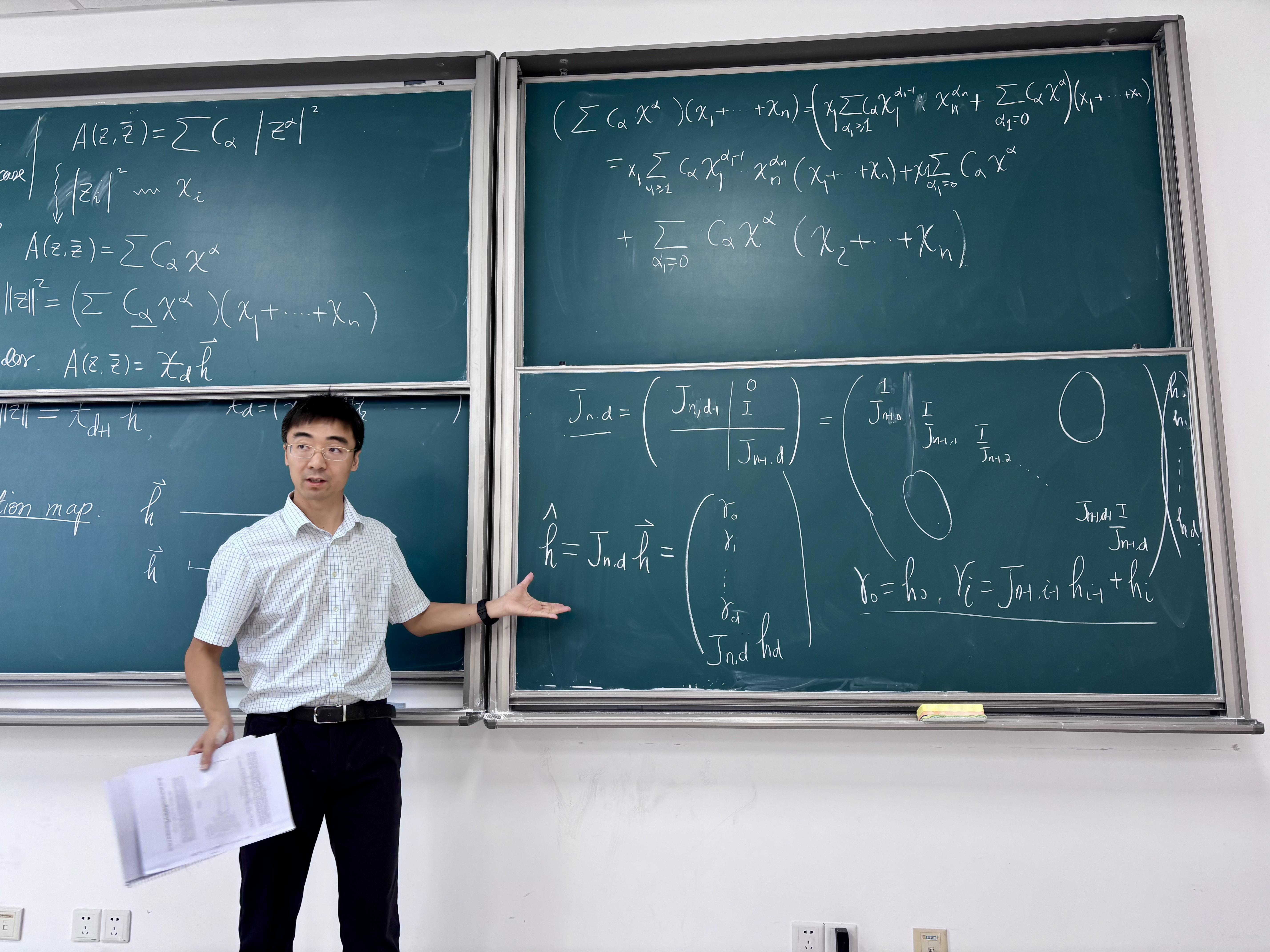
Speaker: Zhiwei Wang, Beijing Normal University
Title: Recent progress on the SOS conjecture
Time: Sep. 19, 2025 (Friday) 10:00~11:00
Abstract: In this talk, we will introduce our recent progress on the study of the SOS conjecture (proposed by Ebenfelt), which is closely related to the Huang-Ji-Yin gap conjecture in the study of rational proper maps between the complex unit balls. This is based on joint work with Chenlong Yue and Professor Xiangyu Zhou.
Speaker: Zhangchi Chen, East China Normal University
Title: Around the unique ergodicity of holomorphic foliations
Time: Sep. 11, 2025 (Thursday) 10:00~11:00
Abstract: Holomorphic foliations are geometric structures to foliate high dimensional complex manifolds with low dimensional ones (called leaves). The key problem in this area is to study the density and the distribution of leaves. Fornaess-Dinh-Nguyen-Sibony proved that in compact Kahler surfaces, foliations with only hyperbolic singularities admits unique ergodicity. In particular, if the foliation does not direct any positive closed currents, then there is a unique (up to scaling) positive harmonic current directed by it. As a consequence, each leaf is dense and has the same distribution in the sense of Nevanlinna currents. In this talk I will introduce the basic concepts about holomorphic foliations, hyperbolic singularities, harmonic currents. I will review the unique ergodicity, and talk about my result on the Lelong number of directed harmonic currents. Finally, I will talk about some open problems.
