 Pome
PomeExample 21.13.12.C51FE704A3B3 In this case, $\Sigma $ is the fan in 21.13.13 consisting of three $2$-dimensional cones $\sigma _1$, $\sigma _2$ and $\sigma _3$; three $1$-dimensional cones $\sigma _4$, $\sigma _5$ and $\sigma _6$; one $0$-dimensional cone $\sigma _0$.
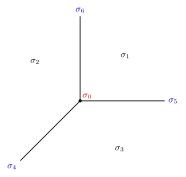
85FCE3A7A73121.13.13 The fan $\Sigma $ of $\mathbb {P}^2$. The three rays $\sigma _4,\sigma _5,\sigma _6\in \Sigma (1)$ subdivide $N_{\mathbb {R}}$ into three full-dimensional cones $\sigma _1,\sigma _2,\sigma _3\in \Sigma (2)$; the origin is the unique cone of dimension zero.The fan $\Sigma $ is just the fan of $X=\mathbb {P}^2$. Under the orbit-cone correspondence, we have
In particular, $\Sigma (1)=\{ \sigma _4,\sigma _5,\sigma _6\} $. We shall take
In other words,
Note that the ray generators are given by
It follows that
Therefore, $P_ D$ is just the polytope in 21.13.14.
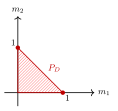
16FDB2620E8621.13.14 The polytope $P_ D$.In this case, the Cartier data for $2$-dimensional cones are given as follows:
while the remaining Cartier data are determined by (21.13.4).
In this case, $L=\mathcal{O}_ X(D)=\mathcal{O}_{\mathbb {P}^2}(1)$. Hence the line bundle $L$ is ample.
We also observe that
Comments
Corrections, questions, and mathematical discussion are welcome. Sign in with GitHub to comment. Comments are public.