Let $X$ be a connected compact Kähler manifold of dimension $n$ and $\theta $ be a smooth closed real $(1,1)$-form on $X$ representing a big cohomology class.
Recall that the notion of model potentials is defined in definition 16.3.18.
Definition 17.12.1.C8399F09D86D A test curve $\Gamma $ in $\mathrm{PSH}(X,\theta )$ consists of a real number $\Gamma _{\max }$ together with a map $(-\infty ,\Gamma _{\max })\rightarrow \mathrm{PSH}(X,\theta )$ denoted by $\tau \mapsto \Gamma _{\tau }$ satisfying the following conditions:
D665BBFA648A
The map $\tau \mapsto \Gamma _{\tau }$ is concave and decreasing;
\[ \int _ X \left(\theta +\mathrm{dd}^{\mathrm{c}}\Gamma _{-\infty }\right)^ n>0. \]
Let $\phi \in \mathrm{PSH}(X,\theta )_{>0}$ be a model potential. The set of test curves $\Gamma $ with $\Gamma _{-\infty }=\phi $ is denoted by $\mathrm{TC}(X,\theta ;\phi )$.
The union of all $\mathrm{TC}(X,\theta ;\phi )$'s for various model potentials $\phi \in \mathrm{PSH}(X,\theta )_{>0}$ is denoted by $\mathrm{TC}(X,\theta )_{>0}$.
By 2, $\sup _{X}\Gamma _{\tau }=0$ for each $\tau <\Gamma _{\max }$. So $\Gamma _{-\infty }\in \mathrm{PSH}(X,\theta )$ by proposition 5.14.2.
Thanks to corollary 13.13.12 and 3, there is $C<\Gamma _{\max }$ so that whenever $\tau <C$, we have $\Gamma _{\tau }\in \mathrm{PSH}(X,\theta )_{>0}$. Then it follows that $\Gamma _{-\infty }$ is a model potential by proposition 16.4.9.
Remark 17.12.3.3D73AB2E32CB Sometimes it is convenient to extend $\Gamma _{\tau }$ to $\tau \geq \Gamma _{\max }$ as well. This can be done as follows: for $\tau >\Gamma _{\max }$, we set $\Gamma _{\tau }\equiv -\infty $. For $\tau =\Gamma _{\max }$, we set
Note that $\Gamma _{\tau }\in \mathrm{PSH}(X,\theta )$ by corollary 5.17.5.
In general, for any $x\in X$, the map $\tau \mapsto \Gamma _{\tau }(x)$ falls into one of the following three categories:
A67F5048890E
$\Gamma _{\tau }(x)\equiv -\infty $;
E2DED6E870B0
$\Gamma _{\tau }(x)>-\infty $ for all $\tau \leq \Gamma _{\max }$;
F51FF55AD767
there is $\tau (x)\in (-\infty ,\Gamma _{\max }]$ so that $\Gamma _{\tau }(x)>-\infty $ for all $\tau \in (-\infty ,\tau (x))$, and $\Gamma _{\tau }(x)=-\infty $ for all $\tau \geq \tau (x)$.
The last two possibilities are illustrated in 17.12.4.
9BE4C00F2E1517.12.4 The last two pointwise possibilities for $\tau \mapsto \Gamma _\tau (x)$.
Note that 2 is the generic situation. It occurs whenever $x\notin \{ \Gamma _{\Gamma _{\max }}=-\infty \} $. In particular, when this situation occurs, $(-\infty ,\Gamma _{\max })\ni \tau \mapsto \Gamma _{\tau }(x)$ is finite concave, and hence continuous. As a consequence, for any $\tau \in (-\infty ,\Gamma _{\max })$, we have
Proposition 17.12.9.B7CD1B90CFDA Let $\Gamma \in \mathrm{TC}(X,\theta )_{>0}$. Then the map
\[ [-\infty ,\Gamma _{\max })\rightarrow \mathbb {R},\quad \tau \mapsto \log \int _ X \theta _{\Gamma _{\tau }}^ n \]
is continuous and concave on $(-\infty ,\Gamma _{\max })$.
Proof.
The concavity of this function follows from theorem 13.13.5 and theorem 13.13.11. The continuity at $-\infty $ is a consequence of corollary 13.13.12. The continuity on $(-\infty ,\Gamma _{\max })$ follows from the fact that finite concave functions on open intervals are continuous.
$\square$
Definition 17.12.10.69529F41AA18 Let $\phi \in \mathrm{PSH}(X,\theta )_{>0}$ be a model potential.
A test curve $\Gamma \in \mathrm{TC}(X,\theta ;\phi )$ is said to be bounded if for $\tau $ small enough, $\Gamma _{\tau }=\phi $. The subset of bounded test curves in $\mathrm{TC}(X,\theta ;\phi )$ is denoted by $\mathrm{TC}^{\infty }(X,\theta ;\phi )$. In this case, we write
When $\phi =V_{\theta }$, we write $\mathbf{E}$ instead of $\mathbf{E}^{\phi }$.
The subset of test curves with finite energy in $\mathrm{TC}(X,\theta ;\phi )$ is denoted by $\mathrm{TC}^1(X,\theta ;\phi )$.
Example 17.12.13.1A17E2EECB2D Given $\varphi \in \mathrm{PSH}(X,\theta )$, there is a canonically associated test curve $\Gamma ^{\varphi }\in \mathrm{TC}^{\infty }(X,\theta ;V_{\theta })$: Set $\Gamma ^{\varphi }_{\max }=0$ and
Note that $\Gamma ^{\varphi }$ is indeed a test curve, as follows from proposition 16.4.2. Indeed, the concavity and monotonicity in $\tau $ follow from proposition 16.4.2, and $\Gamma ^\varphi _{-\infty }=V_\theta $ has positive mass.
We first observe that the notion of test curves does not really depend on the choice of $\theta $ within its cohomology class.
Proposition 17.12.14.B015D2EA4B4F Let $\theta '$ be another smooth closed real $(1,1)$-form on $X$ representing the same cohomology class as $\theta $. Let $\phi \in \mathrm{PSH}(X,\theta )_{>0}$ be a model potential. Let $\phi '\in \mathrm{PSH}(X,\theta ')_{>0}$ be the unique model potential satisfying $\phi \sim \phi '$.
These bijections satisfy the obvious cocycle conditions.
Proof.
Choose $g\in C^{\infty }(X)$ such that $\theta '=\theta +\mathrm{dd}^{\mathrm{c}}g$. Given any $\Gamma \in \mathrm{TC}(X,\theta ;\phi )$, we observe that $\Gamma '\colon (-\infty ,\Gamma _{\max })\rightarrow \mathrm{PSH}(X,\theta ')$ defined as
lies in $\mathrm{TC}(X,\theta ';\phi ')$. In fact, the concavity and monotonicity of $\Gamma '$ follow from proposition 16.4.2. Moreover, applying proposition 16.4.9 to the increasing net obtained as $\tau \to -\infty $ gives
Moreover, the choice of $g$ is irrelevant since for any other choice of $g$, say $g'$, we have
\[ \Gamma _{\tau }-g\sim \Gamma _{\tau }-g' \]
for all $\tau <\Gamma _{\max }$. The inverse construction is obtained by replacing $g$ with $-g$. The boundedness condition is clearly preserved. Finally, by proposition 16.3.10, for every $\tau <\Gamma _{\max }$,
and the same holds for $\phi $ and $\phi '$. Hence the finite energy condition is preserved. The cocycle condition is immediate from the uniqueness of the model representative in a fixed singularity type.
$\square$
Proposition 17.12.15.2059587BD91B Let $\pi \colon Y\rightarrow X$ be a proper bimeromorphic morphism from a Kähler manifold $Y$. Then the pointwise pull-back induces a bijection
Proof.
The bijectivity on the underlying potentials follows from proposition 5.17.8. The compatibility with model potentials follows from proposition 16.4.1. These two facts also preserve concavity, monotonicity and the value of $\Gamma _{-\infty }$, hence give the asserted bijection of test curves.
$\square$
Next we verify the closedness of a test curve as a family of concave functions, so that no pathology arises in the Legendre transforms considered below. The notion of closedness is recalled in definition 21.11.15.
Proposition 17.12.16.7AF1F81E928C Let $\Gamma $ be a test curve in $\mathrm{PSH}(X,\theta )$. For each $x\in X$, the map $\mathbb {R} \ni \tau \mapsto \Gamma _{\tau }(x)$ is a closed concave function. Moreover, the map is proper as long as $\Gamma _{\Gamma _{\max }}(x)\neq -\infty $.
Proof.
We prove closedness. Fix $x\in X$. Assume that $\Gamma _{\tau }(x)\neq -\infty $ for some $\tau \in \mathbb {R}$. We only need to argue the upper semicontinuity of $\tau \mapsto \Gamma _{\tau }(x)$. The upper semicontinuity is clear at $\tau \geq \Gamma _{\max }$, so we are reduced to prove the following:
for any $\tau <\Gamma _{\max }$. Take $\tau ''\in (\tau ,\Gamma _{\max })$. Outside the polar locus of $\Gamma _{\tau ''}$, we know that (17.12.17) holds by continuity of real-valued concave functions. So (17.12.17) holds everywhere by proposition 5.14.6.
The final assertion follows from properness of a finite closed concave function on its effective domain.
$\square$
Definition 17.12.18.37432F25600E Let $\Gamma \in \mathrm{TC}(X,\theta )_{>0}$ and $\omega $ be a smooth closed real positive $(1,1)$-form. Then we define $P_{\theta +\omega }[\Gamma ]\in \mathrm{TC}(X,\theta +\omega )_{>0}$ as follows:
for every $\tau <\Gamma _{\max }$, and hence $P_{\theta +\omega }[\Gamma ]_\tau $ is a model potential by corollary 16.3.20. Thus $P_{\theta +\omega }[\Gamma ]\in \mathrm{TC}(X,\theta +\omega )_{>0}$.
Proposition 17.12.19.724BF0CAE002 Let $\Gamma \in \mathrm{TC}(X,\theta )_{>0}$ and $\omega $ be a closed real smooth positive $(1,1)$-form on $X$. Then
 Pome
Pome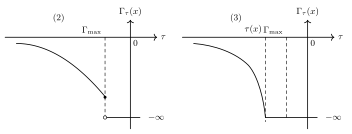
Comments
Corrections, questions, and mathematical discussion are welcome. Sign in with GitHub to comment. Comments are public.