A complex space is assumed to be reduced, Hausdorff and paracompact here.
Definition 9.10.2.F30317C89D08 A prime divisor over an irreducible complex space $Z$ is a connected smooth hypersurface $E\subseteq X'$, where $X'\rightarrow Z$ is a proper bimeromorphic morphism with $X'$ smooth. Such a morphism $X'\rightarrow Z$ is also called a resolution of $Z$. The center of the prime divisor is defined as the image of $E$ in $Z$.
Two prime divisors $E_1\subseteq X'_1$ and $E_2\subseteq X'_2$ over $Z$ are equivalent if there is a common resolution $X''\rightarrow Z$ dominating both $X_1'$ and $X_2'$ such that the strict transforms of $E_1$ and $E_2$ coincide.
The set $Z^{\operatorname{div}}$ is the set of pairs $(c,E)$, where $c\in \mathbb {Q}_{>0}$ and $E$ is an equivalence class of a prime divisor over $Z$. For simplicity, we will denote the pair $(c,E)$ by $c\operatorname{ord}_ E$, although one should not really think of this object as a valuation unless $Z$ is projective and irreducible.
Note that a prime divisor on $Z$ does not always define a prime divisor over $Z$ if $Z$ is singular.
Definition 9.10.3.4BA9DE7FEF24 A complex space $X$ is unibranch if for all $x\in X$, the local ring $\mathcal{O}_{X,x}$ is unibranch.
See [Tag 0BPZ, stacks-project] for the notion of unibranch local rings. In [CAS], the same notion is known as local irreducibility. We prefer the name unibranchness, because the corresponding terminology in algebraic geometry is standard and goes back to Grothendieck [(0.23.2.1), EGAIV1].
The notion of unibranchness coincides with the usual one when $\mathcal{X}$ is an algebraic variety:
Proposition 9.10.4.1A7FEC3124D0 Let $\mathcal{X}$ be a reduced scheme of finite type over $\mathbb {C}$, and let $\mathcal{X}^{\mathrm{An}}$ be the associated complex space. Then $\mathcal{X}^{\mathrm{An}}$ is unibranch in the sense above if and only if $\mathcal{X}$ is unibranch in the algebraic sense (see [Tag 0BQ2, stacks-project]).
This is [Remark 2.7, Xia23Mabuchi] in the arXiv version.
Proof.
Let $x\in \mathcal{X}(\mathbb {C})$. Then we claim that $\mathcal{X}$ is unibranch at $x$ if and only if $\mathcal{X}^{\mathrm{An}}$ is unibranch at $x$. By GAGA, there is a natural morphism of ringed spaces $(\mathcal{X}^{\mathrm{An}},\mathcal{O}_{\mathcal{X}^{\mathrm{An}}})\rightarrow (\mathcal{X},\mathcal{O}_{\mathcal{X}})$. Then since $\mathcal{O}_{\mathcal{X},x}$ is excellent, $\mathcal{X}$ is unibranch at $x$ if and only if $\widehat{\mathcal{O}_{\mathcal{X},x}}=\widehat{\mathcal{O}_{\mathcal{X}^{\mathrm{An}},x}}$ is integral ([Théorème 18.9.1, EGAIV4]). The latter implies that $\mathcal{O}_{\mathcal{X}^{\mathrm{An}},x}$ is unibranch by [Chapitre 5, Exercise 2.8, AC]. Running the same argument the other way round, we conclude that $\mathcal{O}_{\mathcal{X},x}$ is unibranch if and only if $\mathcal{O}_{\mathcal{X}^{\mathrm{An}},x}$ is.
$\square$
Theorem 9.10.5 (Zariski's main theorem).E707851D5DBA Let $\pi \colon Y\rightarrow X$ be a proper bimeromorphic morphism between complex spaces. Assume that $X$ is unibranch. Then $\pi $ has connected fibers.
We follow [Proof of Théorème 1.7, Dem85].
Proof.
Let $Z\subseteq X$ be the smallest nowhere dense analytic subset such that $\pi $ is an isomorphism over $X\setminus Z$. Assume that the fiber $F=\pi ^{-1}(x)$ over some $x\in X$ is disconnected. Since $\pi $ is proper, $F$ is compact. Choose a decomposition $F=F_1\sqcup F_2$ into two non-empty disjoint compact open subsets of $F$, and choose disjoint open neighborhoods $W_1,W_2$ of $F_1,F_2$ in $Y$. Since proper maps are closed, after shrinking an open neighborhood $U$ of $x$, we may assume that
\[ \pi ^{-1}(U)\subseteq W_1\cup W_2. \]
Thus $\pi ^{-1}(U)$ is disconnected.
Since $X$ is unibranch, we may shrink $U$ further so that $U$ is irreducible. Then $U\setminus Z$ is connected (cf. [Chapter 9, §1.2, CAS]). Since $\pi $ is bimeromorphic, every irreducible component of $Y$ maps onto an irreducible component of $X$. Hence $\pi ^{-1}(Z)$ contains no irreducible component of $Y$ and is nowhere dense. On the other hand, write
\[ \pi ^{-1}(U)=V_1\sqcup V_2 \]
as a union of two non-empty disjoint open subsets. Each $V_ i$ meets $\pi ^{-1}(U\setminus Z)$: otherwise $V_ i$ would be a non-empty open subset of $Y$ contained in the nowhere dense analytic subset $\pi ^{-1}(Z)$, which is impossible. Hence
\[ \pi ^{-1}(U\setminus Z) = \bigl (V_1\cap \pi ^{-1}(U\setminus Z)\bigr ) \sqcup \bigl (V_2\cap \pi ^{-1}(U\setminus Z)\bigr ) \]
is disconnected. This contradicts the fact that $\pi \colon \pi ^{-1}(U\setminus Z)\rightarrow U\setminus Z$ is an isomorphism and $U\setminus Z$ is connected.
$\square$
Definition 9.10.6.C9A9F3CE78E7 A modification of a compact complex space $X$ is a finite composition of blow-ups with smooth centers.
We say a modification $\pi '\colon Z\rightarrow X$ dominates another $\pi \colon Y\rightarrow X$ if there is a morphism $g\colon Z\rightarrow Y$ of complex spaces making the following diagram commutative:
The modifications of $X$ together with the domination relation form a directed set.
Theorem 9.10.8 (Hironaka's Chow lemma).3CD8BF9158DD Suppose that $X$ is a compact complex space. Then every proper bimeromorphic morphism to $X$ can be dominated by a modification.
This follows from the proof of [Corollary 2, Hir75].
Theorem 9.10.9.8F66FA207B82 Let $X$ be a compact complex space. Then there is a modification $\pi \colon Y\rightarrow X$ such that $Y$ is smooth.
See [BM97, Wlo09].
Corollary 9.10.10.178E0605C99D Let $X$ be an irreducible compact complex space and $E$ be a prime divisor over $X$. Then there is a modification $\pi \colon Y\rightarrow X$ such that $Y$ is smooth and $E$ can be realized as a prime divisor on $Y$.
Proof.
Choose a smooth model $X'\rightarrow X$ on which $E$ is realized. By theorem 9.10.8, this proper bimeromorphic morphism is dominated by a modification $Y\rightarrow X$. After further resolving the pair if necessary, we may assume that $Y$ is smooth and that the strict transform of $E$ on $Y$ is smooth. This strict transform realizes the same prime divisor over $X$.
$\square$
 Pome
Pome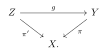
Comments
Corrections, questions, and mathematical discussion are welcome. Sign in with GitHub to comment. Comments are public.