Pome

9.10 Pluripotential theory on unibranch spaces5131A8B4E30A

5131A8B4E30A

This appendix explains how much of the pluripotential theory developed in the body of the book extends from compact Kähler manifolds to compact unibranch Kähler spaces. The unibranch hypothesis is the natural generality in which plurisubharmonic functions descend through resolutions and the basic envelope formalism remains meaningful. Some constructions, especially the trace operator of section 20.2, require extra care in the singular setting; we record here the precise statements needed in the main text.

9.10.1 Complex spaces089901B2844A

A complex space is assumed to be reduced, Hausdorff and paracompact here.

Definition 9.10.2.F30317C89D08 A prime divisor over an irreducible complex space $Z$ is a connected smooth hypersurface $E\subseteq X'$, where $X'\rightarrow Z$ is a proper bimeromorphic morphism with $X'$ smooth. Such a morphism $X'\rightarrow Z$ is also called a resolution of $Z$. The center of the prime divisor is defined as the image of $E$ in $Z$.

Two prime divisors $E_1\subseteq X'_1$ and $E_2\subseteq X'_2$ over $Z$ are equivalent if there is a common resolution $X''\rightarrow Z$ dominating both $X_1'$ and $X_2'$ such that the strict transforms of $E_1$ and $E_2$ coincide.

The set $Z^{\operatorname{div}}$ is the set of pairs $(c,E)$, where $c\in \mathbb {Q}_{>0}$ and $E$ is an equivalence class of a prime divisor over $Z$. For simplicity, we will denote the pair $(c,E)$ by $c\operatorname{ord}_ E$, although one should not really think of this object as a valuation unless $Z$ is projective and irreducible.

Note that a prime divisor on $Z$ does not always define a prime divisor over $Z$ if $Z$ is singular.

Definition 9.10.3.4BA9DE7FEF24 A complex space $X$ is unibranch if for all $x\in X$, the local ring $\mathcal{O}_{X,x}$ is unibranch.

See [Tag 0BPZ, stacks-project] for the notion of unibranch local rings. In [CAS], the same notion is known as local irreducibility. We prefer the name unibranchness, because the corresponding terminology in algebraic geometry is standard and goes back to Grothendieck [(0.23.2.1), EGAIV1]. The notion of unibranchness coincides with the usual one when $\mathcal{X}$ is an algebraic variety:

Proposition 9.10.4.1A7FEC3124D0 Let $\mathcal{X}$ be a reduced scheme of finite type over $\mathbb {C}$, and let $\mathcal{X}^{\mathrm{An}}$ be the associated complex space. Then $\mathcal{X}^{\mathrm{An}}$ is unibranch in the sense above if and only if $\mathcal{X}$ is unibranch in the algebraic sense (see [Tag 0BQ2, stacks-project]).

This is [Remark 2.7, Xia23Mabuchi] in the arXiv version.

Proof. Let $x\in \mathcal{X}(\mathbb {C})$. Then we claim that $\mathcal{X}$ is unibranch at $x$ if and only if $\mathcal{X}^{\mathrm{An}}$ is unibranch at $x$. By GAGA, there is a natural morphism of ringed spaces $(\mathcal{X}^{\mathrm{An}},\mathcal{O}_{\mathcal{X}^{\mathrm{An}}})\rightarrow (\mathcal{X},\mathcal{O}_{\mathcal{X}})$. Then since $\mathcal{O}_{\mathcal{X},x}$ is excellent, $\mathcal{X}$ is unibranch at $x$ if and only if $\widehat{\mathcal{O}_{\mathcal{X},x}}=\widehat{\mathcal{O}_{\mathcal{X}^{\mathrm{An}},x}}$ is integral ([Théorème 18.9.1, EGAIV4]). The latter implies that $\mathcal{O}_{\mathcal{X}^{\mathrm{An}},x}$ is unibranch by [Chapitre 5, Exercise 2.8, AC]. Running the same argument the other way round, we conclude that $\mathcal{O}_{\mathcal{X},x}$ is unibranch if and only if $\mathcal{O}_{\mathcal{X}^{\mathrm{An}},x}$ is. $\square$

Theorem 9.10.5 (Zariski's main theorem).E707851D5DBA Let $\pi \colon Y\rightarrow X$ be a proper bimeromorphic morphism between complex spaces. Assume that $X$ is unibranch. Then $\pi $ has connected fibers.

We follow [Proof of Théorème 1.7, Dem85].

Proof. Let $Z\subseteq X$ be the smallest nowhere dense analytic subset such that $\pi $ is an isomorphism over $X\setminus Z$. Assume that the fiber $F=\pi ^{-1}(x)$ over some $x\in X$ is disconnected. Since $\pi $ is proper, $F$ is compact. Choose a decomposition $F=F_1\sqcup F_2$ into two non-empty disjoint compact open subsets of $F$, and choose disjoint open neighborhoods $W_1,W_2$ of $F_1,F_2$ in $Y$. Since proper maps are closed, after shrinking an open neighborhood $U$ of $x$, we may assume that

\[ \pi ^{-1}(U)\subseteq W_1\cup W_2. \]

Thus $\pi ^{-1}(U)$ is disconnected.

Since $X$ is unibranch, we may shrink $U$ further so that $U$ is irreducible. Then $U\setminus Z$ is connected (cf. [Chapter 9, §1.2, CAS]). Since $\pi $ is bimeromorphic, every irreducible component of $Y$ maps onto an irreducible component of $X$. Hence $\pi ^{-1}(Z)$ contains no irreducible component of $Y$ and is nowhere dense. On the other hand, write

\[ \pi ^{-1}(U)=V_1\sqcup V_2 \]

as a union of two non-empty disjoint open subsets. Each $V_ i$ meets $\pi ^{-1}(U\setminus Z)$: otherwise $V_ i$ would be a non-empty open subset of $Y$ contained in the nowhere dense analytic subset $\pi ^{-1}(Z)$, which is impossible. Hence

\[ \pi ^{-1}(U\setminus Z) = \bigl (V_1\cap \pi ^{-1}(U\setminus Z)\bigr ) \sqcup \bigl (V_2\cap \pi ^{-1}(U\setminus Z)\bigr ) \]

is disconnected. This contradicts the fact that $\pi \colon \pi ^{-1}(U\setminus Z)\rightarrow U\setminus Z$ is an isomorphism and $U\setminus Z$ is connected. $\square$

Definition 9.10.6.C9A9F3CE78E7 A modification of a compact complex space $X$ is a finite composition of blow-ups with smooth centers.

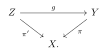
We say a modification $\pi '\colon Z\rightarrow X$ dominates another $\pi \colon Y\rightarrow X$ if there is a morphism $g\colon Z\rightarrow Y$ of complex spaces making the following diagram commutative:

8D4BB1A6524D 9.10.7
Mathematical diagram from the source

The modifications of $X$ together with the domination relation form a directed set.

This follows from the proof of [Corollary 2, Hir75].

Theorem 9.10.9.8F66FA207B82 Let $X$ be a compact complex space. Then there is a modification $\pi \colon Y\rightarrow X$ such that $Y$ is smooth.

See [BM97, Wlo09].

Corollary 9.10.10.178E0605C99D Let $X$ be an irreducible compact complex space and $E$ be a prime divisor over $X$. Then there is a modification $\pi \colon Y\rightarrow X$ such that $Y$ is smooth and $E$ can be realized as a prime divisor on $Y$.

Proof. Choose a smooth model $X'\rightarrow X$ on which $E$ is realized. By theorem 9.10.8, this proper bimeromorphic morphism is dominated by a modification $Y\rightarrow X$. After further resolving the pair if necessary, we may assume that $Y$ is smooth and that the strict transform of $E$ on $Y$ is smooth. This strict transform realizes the same prime divisor over $X$. $\square$

9.10.11 Plurisubharmonic functions04B4AD1F512D

Let $X$ be a complex space.

Definition 9.10.12.FCF157D7001A A function $\varphi \colon X\rightarrow [-\infty ,\infty )$ is plurisubharmonic if

  1. 96254565568F

    $\varphi $ is not identically $-\infty $ on any irreducible component of $X$, and

  2. E2E28DC114D3

    for any $x\in X$, there is an open neighborhood $V$ of $x$ in $X$, a domain $\Omega \subseteq \mathbb {C}^ N$, a closed immersion $V\hookrightarrow \Omega $ and a plurisubharmonic function $\tilde{\varphi }\in \mathrm{PSH}(\Omega )$ such that $\varphi |_ V=\tilde{\varphi }|_ V$ under this immersion.

The set of plurisubharmonic functions on $X$ is denoted by $\mathrm{PSH}(X)$.

Similarly, if $\theta $ is a smooth closed2 real $(1,1)$-form on $X$, then a function $\varphi \colon X\rightarrow [-\infty ,\infty )$ is $\theta $-plurisubharmonic if for any $x\in X$, there is an open neighborhood $V$ of $x$ in $X$, a domain $\Omega \subseteq \mathbb {C}^ N$, a closed immersion $V\hookrightarrow \Omega $ and a smooth function $g$ on $\Omega $ such that $\theta =(\mathrm{dd}^{\mathrm{c}}g)|_ V$ and $g|_ V+\varphi |_ V\in \mathrm{PSH}(V)$.

Theorem 9.10.13 (Fornaess–Narasimhan).48473380B913 Let $\varphi \colon X\rightarrow [-\infty ,\infty )$ be a function. Assume that $\varphi $ is not identically $-\infty $ on any irreducible component of $X$. Then the following are equivalent:

  1. C2704BBBABCF

    $\varphi $ is psh;

  2. 917F8CC8F375

    $\varphi $ is usc and for any morphism $f\colon \Delta \rightarrow X$ from the open unit disk $\Delta $ in $\mathbb {C}$ to $X$ such that $f^*\varphi $ is not identically $-\infty $, the pull-back $f^*\varphi $ is subharmonic.

See [FN80].

Theorem 9.10.14 (Grauert–Remmert).C69D2F0ABA4F Let $X$ be a unibranch3 complex space, let $Z$ be an analytic subset in $X$, and let $\varphi \in \mathrm{PSH}(X\setminus Z)$. Then the function $\varphi $ admits an extension to $\mathrm{PSH}(X)$ in the following two cases:

  1. C2D00AE1EE6E

    The set $Z$ has codimension at least $2$ everywhere.

  2. EC2A3ADCF9E6

    The set $Z$ has codimension at least $1$ everywhere and $\varphi $ is locally bounded from above on an open neighborhood of $Z$.

In both cases, the extension is unique and is given by

B66F47F11DC8 9.10.15
\begin{equation} \varphi (x)=\varlimsup _{X\setminus Z\ni y\to x}\varphi (y),\quad x\in X. \end{equation}
The proof given below combines [Théorème 1.7, Dem85] and [GR56].1

Proof. We first prove the uniqueness, which is a local problem on $X$. Let $\psi $ denote the function defined by the right-hand side of (9.10.15). If $\eta \in \mathrm{PSH}(X)$ is an extension of $\varphi $, then upper semicontinuity gives $\eta \geq \psi $. Conversely, take $z\in Z$ and a holomorphic map $f\colon \Delta \rightarrow X$ such that $f(0)=z$ and $f(\Delta )\not\subset Z$. From the subharmonicity of $f^*\eta $ and (9.10.15), we find that

\[ \eta (z)=f^*\eta (0)=\varlimsup _{\Delta ^* \ni w\to 0}f^*\eta (w)\leq \varlimsup _{X\setminus Z\ni y\to z}\varphi (y)=\psi (z), \]

where the second equality follows from theorem 5.14.10. Thus $\eta =\psi $, and uniqueness follows.

Having established the uniqueness of the extension, the existence also becomes a local problem. So we can freely shrink $X$ around any point in $Z$ in the proof.

2 Let $\pi \colon Y\rightarrow X$ be a resolution of singularities. By the smooth version of the extension theorem theorem 5.14.10, we know that $\pi ^*\varphi $ admits a unique extension to a psh function on $Y$, which we denote by $\eta $. Note that all fibers of $\pi $ are connected since $X$ is unibranch, thanks to theorem 9.10.5. Furthermore, the fibers are compact, since $\pi $ is proper. The restriction of $\eta $ to each fiber is psh or identically $-\infty $, hence is constant by the maximum principle applied to a resolution. It therefore descends to an upper semicontinuous function $\psi $ on $X$, and $\psi |_{X\setminus Z}=\varphi $.

We verify that $\psi $ is plurisubharmonic using theorem 9.10.13. Let $f\colon \Delta \rightarrow X$ be a holomorphic map. We assume that $f^*\psi \not\equiv -\infty $. It suffices to show that $f^*\psi $ is subharmonic at $0\in \Delta $. After replacing $\Delta $ by a finite ramified cover if necessary, the germ of $f$ lifts to $Y$. Indeed, consider the proper projection

\[ \Delta \times _ X Y\longrightarrow \Delta . \]

Choose an irreducible analytic curve in $\Delta \times _ X Y$ passing through a point over $0$ and dominating $\Delta $; after shrinking $\Delta $ and normalizing this curve, we obtain a finite ramified cover of the disk. After replacing $\Delta $ by a smaller disk, there are an integer $k>0$ and a holomorphic map $f'\colon \Delta \to Y$ such that

\[ f(t^ k)=\pi (f'(t)). \]

Therefore, $\psi (f(t^ k))=\eta (f'(t))$ near $0$. Since subharmonicity descends under the finite map $t\mapsto t^ k$, it follows that $f^*\psi $ is subharmonic near $0$.

1 By the local description of complex spaces [Section 3.4, CAS], we may assume that there is a domain $\Omega \subseteq \mathbb {C}^ n$, a finite $s$-sheet branched covering $\Phi \colon X\rightarrow \Omega $ with branched locus contained in a proper analytic subset $V\subseteq \Omega $. We may assume that $X$ is connected, $n\geq 1$.

It suffices to show that $\varphi $ is locally bounded from above near $Z$, since then 2 applies. Suppose that this fails. Then we can find $z\in Z$ and $x_ i\in X\setminus Z$ ($i\geq 1$) converging to $z$ such that

\[ \lim _{i\to \infty } \varphi (x_ i)=\infty . \]

Using (9.10.15) around each $x_ i$, we may further assume that $x_ i\in X\setminus (\Phi ^{-1}(\Phi (Z)\cup V))$.

Let $L$ be a complex line passing through $\Phi (z)$ intersecting $(\Phi (Z)\cup V)\cap \overline{B}$ only at $\Phi (z)$, where $B\Subset B'\Subset \Omega $ are two small open balls centered at $\Phi (z)$. Since $\Phi $ is finite, $\Phi (Z)$ still has codimension at least $2$ in $\Omega $. Hence, for each $i$, the set of directions of lines through $\Phi (x_ i)$ meeting $B'\cap \Phi (Z)$ is contained in a proper analytic subset of the projective space of directions. We can therefore choose lines $L_ i$ through $\Phi (x_ i)$ converging to $L$ such that $L_ i\cap (B'\cap \Phi (Z))=\varnothing $. Moreover, since $\Phi (x_ i)\notin V$, no such $L_ i$ is contained in $V$, and hence $L_ i\cap (B'\cap V)$ is discrete. Then $\Phi $ restricts to a branched covering over $B'\cap L_ i$ for all $i\geq 1$. Adding a constant to $\varphi $, we may assume that $\varphi |_{\Phi ^{-1}(L\cap \partial B)}<0$. We can then find an open neighborhood $U$ of $\Phi ^{-1}(L\cap \partial B)$ so that $\varphi |_ U<0$. For large $i$, we have $\Phi ^{-1}(L_ i\cap \partial B)\subseteq U$ and $\Phi (x_ i)\in B$. Put

\[ C_ i\coloneqq \Phi ^{-1}(L_ i\cap B'). \]

Thus $C_ i$ is a one-dimensional complex space contained in $X\setminus Z$. Since $\Phi |_{C_ i}$ is finite over $L_ i\cap B'$, the inverse image $C_ i\cap \Phi ^{-1}(\overline B)$ is compact, and its boundary is contained in $\Phi ^{-1}(L_ i\cap \partial B)$.

Passing to the normalization of each irreducible component of $C_ i$, the pull-back of $\varphi $ is subharmonic. The one-dimensional maximum principle therefore gives

\[ \varphi (x_ i)\leq \sup _{\Phi ^{-1}(L_ i\cap \partial B)}\varphi <0, \]

which is a contradiction. $\square$

Corollary 9.10.16.2DA8FD7B7A99 Let $\pi \colon Y\rightarrow X$ be a proper bimeromorphic morphism between compact Kähler spaces. Let $\theta $ be a smooth closed real $(1,1)$-form on $X$. Assume that $X$ is unibranch. Then the pull-back induces a bijection

\[ \pi ^*\colon \mathrm{PSH}(X,\theta )\xlongrightarrow {\sim }\mathrm{PSH}(Y,\pi ^*\theta ). \]

Proof. Injectivity follows from the surjectivity of $\pi $. For surjectivity, let $u\in \mathrm{PSH}(Y,\pi ^*\theta )$. The assertion is local on $X$, so after subtracting a local potential of $\theta $ we may assume that $\theta =0$.

By theorem 9.10.5, the fibers of $\pi $ are connected. The restriction of $u$ to any compact fiber is psh, hence is constant by the maximum principle. Thus $u$ descends to a function $v$ on $X$. Since $\pi $ is proper, $v$ is upper semicontinuous.

It remains to check that $v$ is psh. By theorem 9.10.13, it suffices to test on holomorphic disks. Let $f\colon \Delta \rightarrow X$ be a holomorphic disk such that $f^*v\not\equiv -\infty $. As in the proof of theorem 9.10.14, after a finite ramified cover $\rho \colon \Delta \rightarrow \Delta $, the germ of $f\circ \rho $ lifts to $Y$. The pull-back $(f^*v)\circ \rho $ is therefore subharmonic, so $f^*v$ is subharmonic. Hence $v\in \mathrm{PSH}(X)$, and the general $\theta $-psh case follows by adding back the local potentials. $\square$

9.10.17 Extensions of the results in the smooth settingCE1C14C908CB

Let $X$ be an irreducible unibranch compact Kähler space of dimension $n$. Let $\theta $ be a closed real smooth $(1,1)$-form on $X$. We say the cohomology class $\{ \theta \} $ is big if for any proper bimeromorphic morphism $\pi \colon Y\rightarrow X$ from a compact Kähler manifold $Y$, $\{ \pi ^*\theta \} $ is big. This definition is independent of the choice of $\pi $.

The non-pluripolar products can be defined exactly as in section 13.1 and the results in that chapter hold mutatis mutandis.

The results in section 16.1 can also be easily extended. The definition of the $P$-envelope remains unchanged. As for the $\mathcal{I}$-envelope, we define

Definition 9.10.18.3BD14AE7D7C8 Given $\varphi \in \mathrm{PSH}(X,\theta )$, we define $P_{\theta }[\varphi ]_{\mathcal{I}}\in \mathrm{PSH}(X,\theta )$ as the unique element with the following property: If $\pi \colon Y\rightarrow X$ is a proper bimeromorphic morphism from a compact Kähler manifold $Y$, then

\[ \pi ^*P_{\theta }[\varphi ]_{\mathcal{I}}=P_{\pi ^*\theta }[\pi ^*\varphi ]_{\mathcal{I}}. \]
It follows from corollary 9.10.16 and proposition 16.6.10 that $P_{\theta }[\varphi ]_{\mathcal{I}}$ is independent of the choice of $\pi $ and is well-defined. The other results can be easily extended.

section 17.10 and section 16.7 can be extended without big changes. The only exception is theorem 16.9.59, where we do not have the notion of multiplier ideal sheaves. So we do not know how to extend this theorem.

section 18.1 can be extended except for subsection 18.1.44 for the same reason as above.

If $Y\subseteq X$ is an irreducible analytic subspace not contained in $X^{\operatorname{Sing}}$, then the trace operator of section 20.2 can be extended to this setting by using an embedded resolution. In general, due to the lack of Demailly regularization on singular spaces, we do not know how to define the trace operator.

section 17.11 can be easily extended.

section 19.1 is easy to extend since the partial Okounkov bodies are bimeromorphically invariant in the sense of theorem 19.5.26.

section 20.1 is unchanged, since we always take projective limits with respect to all models in that section.

section 21.13 can be extended using the toric resolution [Theorem 11.1.9, CLS11].

section 22.1 can be extended except for the parts involving the trace operator.

section 18.28 can be easily extended by considering a resolution.

Cite this page

Comments

Corrections, questions, and mathematical discussion are welcome. Sign in with GitHub to comment. Comments are public.