Let $X$ be a connected compact Kähler manifold and $Y\subseteq X$ be an irreducible analytic subset.
We prove a few elementary properties of the trace operator.
Proposition 20.2.21.F2C3DD7D449E Let $\varphi ,\psi \in \mathrm{QPSH}(X)$, $\lambda >0$. Assume that $\nu (\varphi ,Y)=\nu (\psi ,Y)=0$. Then we have the following:
C2434E03D2CC
Suppose that $\varphi \preceq _{\mathcal{I}}\psi $. Then $\operatorname{Tr}_ Y(\varphi )\preceq _ P \operatorname{Tr}_ Y(\psi )$.
2C348D36BD1E
We have
\[ \operatorname{Tr}_ Y(\varphi +\psi )\sim _ P \operatorname{Tr}_ Y(\varphi )+\operatorname{Tr}_ Y(\psi ). \]
11F393C1BB1A
We have
\[ \operatorname{Tr}_ Y(\lambda \varphi )\sim _ P \lambda \operatorname{Tr}_ Y(\varphi ). \]
4C6B27F676F6
We have
\[ \operatorname{Tr}_ Y(\varphi \lor \psi )\sim _ P \operatorname{Tr}_ Y(\varphi )\lor \operatorname{Tr}_ Y(\psi ). \]
As a consequence of 1, the $P$-equivalence class of $\operatorname{Tr}_ Y(\varphi )$ depends only on the $\mathcal{I}$-equivalence class of $\varphi $.
Proof.
Take a closed smooth real $(1,1)$-form $\theta $ on $X$ such that $\theta _{\varphi }$, $\theta _{\psi }$ are both Kähler currents. Let $(\varphi _ j)_ j$ and $(\psi _ j)_ j$ be quasi-equisingular approximations of $\varphi $ and $\psi $ in $\mathrm{PSH}(X,\theta )$ respectively. We may assume that $\varphi _ j\leq 0$ and $\psi _ j\leq 0$ for all $j\geq 1$.
1 We choose the quasi-equisingular approximations compatibly. By theorem 5.18.11, we may take $\varphi _ j$ and $\psi _ j$ with analytic singularities of types
\[ \left(2^{-j},\mathcal I(2^ j\varphi )\right), \quad \left(2^{-j},\mathcal I(2^ j\psi )\right), \]
respectively. Since $\varphi \preceq _{\mathcal I}\psi $, we have
\[ \mathcal I(2^ j\varphi )\subseteq \mathcal I(2^ j\psi ) \]
for every $j$. Hence $\varphi _ j\preceq \psi _ j$ for every $j$. Restricting to $\widetilde{Y}$, we get $\varphi _ j|_{\widetilde{Y}}\preceq \psi _ j|_{\widetilde{Y}}$. Passing to the $d_ S$-limits by proposition 16.9.44, we obtain
\[ \operatorname{Tr}_ Y(\varphi )\preceq _ P\operatorname{Tr}_ Y(\psi ). \]
Restricting to $\widetilde{Y}$ and passing to the $d_ S$-limits by proposition 16.9.44, we obtain
\[ \operatorname{Tr}_ Y(\varphi )\preceq _ P \operatorname{Tr}_ Y(\psi ). \]
2 It follows from theorem 16.9.45 that $\varphi _ j+\psi _ j\xrightarrow {d_ S}P_{\theta }[\varphi ]_{\mathcal{I}}+P_{\theta }[\psi ]_{\mathcal{I}}$. However, by proposition 16.6.27 and proposition 18.1.17, we have
\[ P_{\theta }[\varphi ]_{\mathcal{I}}+P_{\theta }[\psi ]_{\mathcal{I}}\sim _ P P_{2\theta }[\varphi +\psi ]_{\mathcal{I}}. \]
Therefore, by proposition 16.9.6, corollary 18.1.14 and proposition 5.18.2, $(\varphi _ j+\psi _ j)_ j$ is a quasi-equisingular approximation of $\varphi +\psi $. We conclude using theorem 16.9.45.
3 Let $(\lambda _ j)_ j$ be an increasing sequence of positive rational numbers with limit $\lambda $. Then $(\lambda _ j\varphi _ j)_ j$ is a quasi-equisingular approximation of $\lambda \varphi $. Since $\lambda _ j/\lambda \to 1$, 16.9.25 gives
\[ d_ S\left((\lambda _ j/\lambda )\varphi _ j|_{\widetilde{Y}},\varphi _ j|_{\widetilde{Y}}\right)\to 0. \]
After scaling the background class, 16.9.41 shows that $\lambda _ j\varphi _ j|_{\widetilde{Y}}$ and $\lambda \varphi _ j|_{\widetilde{Y}}$ have the same $d_ S$-limit. The assertion follows.
4 By proposition 16.9.42, we have
\[ \varphi _ j\lor \psi _ j\xrightarrow {d_ S} P_{\theta }[\varphi ]_{\mathcal{I}}\lor P_{\theta }[\psi ]_{\mathcal{I}}. \]
By proposition 16.6.27 and proposition 18.1.17, we have
\[ P_{\theta }[\varphi ]_{\mathcal{I}}\lor P_{\theta }[\psi ]_{\mathcal{I}}\sim _ P P_{\theta }[\varphi \lor \psi ]_{\mathcal{I}}. \]
Therefore, our assertion follows exactly as in the proof of 2.
$\square$
The trace operator is continuous along $d_ S$-convergent decreasing sequences.
Proposition 20.2.22.58627BFD2457 Let $(\varphi _ j)_{j\in I}$ be a decreasing net in $\mathrm{QPSH}(X)$. Assume that there exists a closed real smooth $(1,1)$-form $\theta $ such that $\varphi _ j\in \mathrm{PSH}(X,\theta )$ for each $j\in I$. Assume that $\varphi _ j\xrightarrow {d_ S}\varphi \in \mathrm{QPSH}(X)$ and $\nu (\varphi ,Y)=0$. Then
\[ \operatorname{Tr}_ Y(\varphi _ j)\xrightarrow {d_ S}\operatorname{Tr}_ Y(\varphi ). \]
In view of corollary 18.1.14, the trace operator preserves the property of being a quasi-equisingular approximation, thereby solving the problem in example 20.2.2.
Proof.
It is enough to prove the sequential assertion. Indeed, suppose that the net statement fails. Then there is $\delta >0$ such that for every $i_0\in I$ one can find $i\geq i_0$ with
\[ d_ S(\operatorname{Tr}_ Y(\varphi _ i),\operatorname{Tr}_ Y(\varphi ))\geq \delta . \]
Using also $\varphi _ i\xrightarrow {d_ S}\varphi $, we may choose an increasing sequence $i_ j\in I$ such that
\[ d_ S(\varphi _{i_ j},\varphi )<j^{-1},\quad d_ S(\operatorname{Tr}_ Y(\varphi _{i_ j}),\operatorname{Tr}_ Y(\varphi ))\geq \delta . \]
The sequence $(\varphi _{i_ j})_ j$ is decreasing and converges to $\varphi $ in $d_ S$, contradicting the sequential assertion.
Thus we assume that $(\varphi _ j)_{j\geq 1}$ is a decreasing sequence and that $\varphi _ j\xrightarrow {d_ S}\varphi $.
Take a Kähler form $\omega $ on $X$ so that $\varphi _ j,\varphi \in \mathrm{PSH}(X,\omega )_{>0}$. Replacing $\varphi _ j$ by $P_{\omega }[\varphi _ j]$, we may then assume that $(\varphi _ j)_ j$ is a decreasing sequence of model potentials. By proposition 16.9.47, we have
\[ P_{\omega }[\varphi ]=\inf _{j\geq 1}\varphi _ j. \]
By proposition 16.9.6, we may assume from now on that
\[ \varphi =\inf _{j\geq 1}\varphi _ j. \]
After adding a Kähler form to $\omega $, we may assume that $\omega _{\varphi }$ is a Kähler current.
For each $j\geq 1$, choose a quasi-equisingular approximation $(\varphi _ j^ k)_{k\geq 1}$ of $\varphi _ j$ in $\mathrm{PSH}(X,\omega )$. Using the standard construction in theorem 5.18.11, we may choose these approximations compatibly in $j$, so that for each fixed $k$,
\[ \varphi _{j+1}^ k\preceq \varphi _ j^ k \]
We shall choose an increasing sequence of integers $k_ j$ and put
\[ \eta _ j\coloneqq \varphi _ j^{k_ j}. \]
The sequence $(k_ j)_ j$ is chosen inductively: Choose $k_1>1$, for $j>1$, we choose $k_ j$ large enough so that
1BA5628DE09C
$k_{j}\geq k_{j-1}$;
C590440C99EE
$d_{S,\omega }(\eta _ j,P_{\omega }[\varphi _ j]_{\mathcal{I}})\leq 1/(j-1)$;
5061729EE0BF
$d_{S,\omega |_{\widetilde{Y}}}(\eta _ j|_{\widetilde{Y}},\operatorname{Tr}_ Y^{\omega }(\varphi _ j))<1/(j-1)$.
It follows from the compatibility in $j$ and from $k_ j\geq k_{j-1}$ that $(\eta _ j)_ j$ is decreasing in singularity types. Indeed,
\[ \eta _{j+1}=\varphi _{j+1}^{k_{j+1}}\preceq \varphi _{j+1}^{k_ j}\preceq \varphi _ j^{k_ j}=\eta _ j. \]
By theorem 16.9.49, we have
\[ P_{\omega }[\varphi _ j]_{\mathcal{I}}\xlongrightarrow {d_ S} P_{\omega }[\varphi ]_{\mathcal{I}}. \]
By 2 and corollary 18.1.14, we have $\eta _ j\xrightarrow {d_ S} P_{\omega }[\varphi ]_{\mathcal{I}}$. Observe that by proposition 16.9.47,
\[ P_{\omega }[\varphi ]_{\mathcal{I}}=\inf _{j>0} P_{\omega }\left[\eta _ j\right]. \]
By proposition 16.6.22, for each $j>0$, $P_{\omega }[\eta _ j]$ has analytic singularities. By theorem 16.9.59, $(P_{\omega }[\eta _ j])_ j$ is a quasi-equisingular approximation of $P_{\omega }[\varphi ]_{\mathcal{I}}$. Therefore, by definition of the trace operator and proposition 20.2.21 1,
\[ \eta _ j|_{\widetilde{Y}}\xrightarrow {d_ S} \operatorname{Tr}_ Y(\varphi ). \]
It follows from 3 that
\[ \operatorname{Tr}_ Y(\varphi _ j)\xrightarrow {d_ S}\operatorname{Tr}_ Y(\varphi ). \]
We conclude the proof.
$\square$
Example 20.2.23.531FFD6D4B64 The trace operator is not continuous along increasing sequences. Let us consider the case $X=\mathbb {P}^2$ with coordinates $(z_1,z_2)$ on $\mathbb {C}^2\subseteq X$. Let $\omega _{\mathrm{{FS}}}$ denote the Fubini–Study metric. The subvariety $Y\cong \mathbb {P}^1$ is defined by $z_2=0$. Consider an increasing sequence $(\varphi _ j)_ j$ in $\mathrm{PSH}(X,\omega _{\mathrm{FS}})$, whose potentials near $(0,0)$ are given by
\[ \log |z_1|^2\lor \left( j^{-1}\log |z_2|^2\right)+\mathcal{O}(1). \]
The pointwise restriction of these potentials to $Y$ are given locally by
\[ \log |z_1|^2+\mathcal{O}(1). \]
On the other hand, locally
\[ \log |z_1|^2\lor \left( j^{-1}\log |z_2|^2\right)\to 0 \]
almost everywhere as $j\to \infty $. So the trace operator is not continuous along the sequence $(\varphi _ j)_ j$.
Lemma 20.2.24.DDEF49346283 Let $\pi \colon Z\rightarrow X$ be a proper bimeromorphic morphism, where $Z$ is a connected Kähler manifold. Assume that $W$ (resp. $Y$) is an irreducible analytic subset of $Z$ (resp. $X$) such that the restriction $\Pi \colon W\rightarrow Y$ of $\pi $ is defined and is bimeromorphic, so that we have the following commutative diagram
Then for any $\varphi \in \mathrm{QPSH}(X)$ with $\nu (\varphi ,Y)=0$, we have
3B7501D970A6
20.2.25
\begin{equation} \widetilde{\Pi }^*\operatorname{Tr}_{Y}(\varphi )\sim _ P\operatorname{Tr}_ W(\pi ^*\varphi ). \end{equation}
Proof.
We first observe that by Zariski's main theorem, $\nu (\pi ^*\varphi ,W)=0$. So the right-hand side of (20.2.25) makes sense.
Step 1. Assume that $\varphi $ has analytic singularities. It suffices to apply example 20.2.15 to reformulate (20.2.25) as
\[ \widetilde{\Pi }^*(\varphi |_{\widetilde{Y}})\sim _ P(\pi ^*\varphi )|_{\widetilde{W}}. \]
In fact, the strict equality holds, which is nothing but the functoriality of pullbacks.
Step 2. Next we handle the general case. Choose a smooth closed real $(1,1)$-form $\theta $ such that $\theta _{\varphi }$ is a Kähler current. Take a quasi-equisingular approximation $(\varphi _ j)_ j$ of $\varphi $ in $\mathrm{PSH}(X,\theta )$. By corollary 18.1.15, $(\pi ^*\varphi _ j)_ j$ is a quasi-equisingular approximation of $\pi ^*\varphi $. From Step 1, we know that for each $j$,
\[ \widetilde{\Pi }^*\operatorname{Tr}_{Y}(\varphi _ j)\sim _ P\operatorname{Tr}_ W(\pi ^*\varphi _ j). \]
Letting $j\to \infty $, the right-hand side converges to $\operatorname{Tr}_ W(\pi ^*\varphi )$ by the definition of the trace operator. On the left-hand side, the $d_ S$-convergence of $\operatorname{Tr}_ Y(\varphi _ j)$ to $\operatorname{Tr}_ Y(\varphi )$, together with 16.8.26 and corollary 16.9.11, implies (20.2.25).
$\square$
Proposition 20.2.26.DB90B2D3ADEB Let $\varphi \in \mathrm{QPSH}(X)$ with $\nu (\varphi ,Y)=0$. Assume that $Y$ is smooth. Then for any $\lambda >0$, we have
E9AC29FB30B6
20.2.27
\begin{equation} \mathcal{I}(\lambda \operatorname{Tr}_ Y(\varphi ))\subseteq \operatorname{Res}_ Y\mathcal{I}(\lambda \varphi ). \end{equation}
Proof.
Take a Kähler form $\omega $ on $X$ such that $\omega _{\varphi }$ is a Kähler current.
Let $(\varphi _ j)_ j$ be a quasi-equisingular approximation of $\varphi $ in $\mathrm{PSH}(X,\omega )$.
For each $j\geq 1$, we have
\[ \operatorname{Tr}_ Y(\varphi ) \preceq _ P \varphi _ j|_ Y. \]
Indeed, $\operatorname{Tr}_ Y(\varphi )$ is $P$-equivalent to the decreasing $d_ S$-limit of the restrictions $\varphi _ j|_ Y$, hence it is more singular than each $\varphi _ j|_ Y$.
For any $\lambda '>\lambda >0$, we can find $j>0$ so that
\[ \mathcal{I}(\lambda ' \varphi _ j)\subseteq \mathcal{I}(\lambda \varphi ). \]
By corollary 16.8.14 and theorem 5.16.26, we have
\[ \mathcal{I}(\lambda ' \operatorname{Tr}_ Y(\varphi ))\subseteq \mathcal{I}(\lambda ' \varphi _ j|_ Y)\subseteq \operatorname{Res}_ Y\mathcal{I}(\lambda '\varphi _ j)\subseteq \operatorname{Res}_ Y\mathcal{I}(\lambda \varphi ). \]
Thanks to the strong openness theorem theorem 5.16.21, we conclude (20.2.27).
$\square$
Lastly, we turn our attention to global sections. For this we will need the following global Ohsawa–Takegoshi extension theorem for the trace operator:
Theorem 20.2.28.71AECE2E70ED Let $L$ be a big line bundle on $X$ and let $\theta $ be a closed real smooth $(1,1)$-form on $X$ representing $c_1(L)$. Suppose that $\varphi \in \mathrm{PSH}(X,\theta )$ and $\theta _{\varphi }$ is a Kähler current. Assume that $Y$ is smooth and $\nu (\varphi ,Y)=0$. Let $T$ be a holomorphic line bundle on $X$. Then there exists $k_0$ such that for all $k \geq k_0$ and $s \in \mathrm{H}^0(Y, T|_ Y\otimes L|_ Y^ k\otimes \mathcal{I}(k \operatorname{Tr}_ Y^{\theta }(\varphi )))$, there exists an extension $\tilde s \in \mathrm{H}^0(X, T\otimes L^ k \otimes \mathcal{I}(k\varphi ))$.
It is of interest to know whether one can control the $L^2$-norm of $\tilde{s}$ in the above result.
Proof.
Fix a Kähler form $\omega $ on $X$ and a Hermitian metric $h_ T$ on $T$. We may assume that $Y\neq X$ and that $\theta _{\varphi } \geq 3\delta \omega $ for some $\delta >0$. Let $(\varphi _ j)_ j$ be the decreasing quasi-equisingular approximation of $\varphi $ in $\mathrm{PSH}(X,\theta )$. We can assume that $\theta _{\varphi _ j} \geq 2\delta \omega $ for all $j\geq 1$. Also, there exists $\epsilon _0 >0$ such that $\theta _{(1+\epsilon )\varphi _ j} \geq \delta \omega $ for any $\epsilon \in (0,\epsilon _0)$. Take $k_0=k_0(\delta ,h_ T)$ as in theorem 5.20.16.
We fix $k \geq k_0$ and $s \in \mathrm{H}^0(Y, T|_ Y\otimes L|_ Y^ k\otimes \mathcal{I}(k\operatorname{Tr}_ Y^{\theta }(\varphi )))$. By theorem 5.16.21, there exists $\epsilon \in (0,\epsilon _0)$ such that $s \in \mathrm{H}^0(Y, T|_ Y\otimes L|_ Y^ k\otimes \mathcal{I}(k(1+\epsilon )\operatorname{Tr}_ Y^{\theta }(\varphi )))$.
Since $\operatorname{Tr}_ Y^{\theta }(\varphi ) \preceq _ P \varphi _ j|_ Y$, corollary 16.8.14 implies that $s \in \mathrm{H}^0(Y, T|_ Y\otimes L|_ Y^ k\otimes \mathcal{I}(k(1+\epsilon )\varphi _ j|_ Y))$. By theorem 5.20.16, there exists $\tilde s_ j \in \mathrm{H}^0(X, T\otimes L^ k \otimes \mathcal{I}(k(1+\epsilon )\varphi _ j))$ such that $\tilde s_ j|_ Y =s$, for all $j$.
But by definition of quasi-equisingular approximation, we obtain that for high enough $j$ the inclusion $\mathcal{I}(k(1+\epsilon )\varphi _ j) \subseteq \mathcal{I}(k\varphi )$ holds. As a result, $\tilde s_ j \in \mathrm{H}^0(X, T\otimes L^ k \otimes \mathcal{I}(k\varphi ))$ for high enough $j$, finishing the argument.
$\square$
 Pome
Pome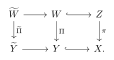
Comments
Corrections, questions, and mathematical discussion are welcome. Sign in with GitHub to comment. Comments are public.