Definition 19.5.7.31DAEE985011 When $T$ is a Kähler current with analytic singularities, we take a modification $\pi \colon Y\rightarrow X$ so that
141D51CBF55B
9AA6F51E3D18
19.5.8
\begin{equation} \pi ^*T=[D]+R, \end{equation}
where $D$ is an effective $\mathbb {Q}$-divisor on $Y$ and $R$ is a closed positive $(1,1)$-current with bounded potential, and
AE57180E327B
the lifting $(Z_{\bullet },g)$ of $Y_{\bullet }$ to $Y$ exists.
Define
326D63AB3B8C
19.5.9
\begin{equation} \Delta _{Y_{\bullet }}(T)\coloneqq \Delta _{Z_{\bullet }}(\{ R\} )g^{-1}+\nu _{Z_{\bullet }}([D])g^{-1}. \end{equation}
Proof.
Take another map $\pi '\colon Y'\rightarrow X$ with the same properties. We want to show that $\pi $ and $\pi '$ define the same $\Delta _{Y_{\bullet }}(T)$. We may assume that $\pi '$ dominates $\pi $ through $p\colon Y'\rightarrow Y$, so that we have a commutative diagram
We take $D$ and $R$ as in (19.5.8). Then
\[ \pi '^*T=[p^*D]+p^*R. \]
Write $(Z_{\bullet },g)$ and $(Z_{\bullet }',g')$ for the liftings of $Y_{\bullet }$ to $Y$ and $Y'$ respectively. We need to prove that
\[ \Delta _{Z_{\bullet }}(\{ R\} )g^{-1}+\nu _{Z_{\bullet }}([D])g^{-1}=\Delta _{Z_{\bullet }'}(\{ p^*R\} )g'^{-1}+\nu _{Z_{\bullet }'}([p^*D])g'^{-1}. \]
By theorem 19.5.4, applied to the class $\{ R\} $, we have
\[ \Delta _{Z'_\bullet }(\{ p^*R\} )=\Delta _{Z_\bullet }(\{ R\} )\, \operatorname{cor}(Z_\bullet ,p). \]
By proposition 19.3.14, applied to the divisor current $[D]$, we also have
\[ \nu _{Z'_\bullet }([p^*D])=\nu _{Z_\bullet }([D])\, \operatorname{cor}(Z_\bullet ,p). \]
Finally, proposition 19.3.17 gives
\[ g'=g\, \operatorname{cor}(Z_\bullet ,p). \]
Multiplying by $(g')^{-1}$ gives the desired equality.
$\square$
The above proof also describes the bimeromorphic behavior of $\Delta _{Y_{\bullet }}(T)$:
Lemma 19.5.11.F1FC05EF0A7C Let $T\in \mathcal{Z}_{+}(X,\alpha )$ be a Kähler current with analytic singularities. Let $\pi \colon Y\rightarrow X$ be a proper bimeromorphic morphism and $(W_{\bullet },g)$ be the lifting of $Y_{\bullet }$ to $Y$. Then
\[ \Delta _{W_{\bullet }}(\pi ^*T)=\Delta _{Y_{\bullet }}(T)g. \]
Lemma 19.5.12.5F65C388181A Assume that $T,S\in \mathcal{Z}_+(X,\alpha )$ are two Kähler currents with analytic singularities and $T\preceq S$. Then
\[ \Delta _{Y_{\bullet }}(T)\subseteq \Delta _{Y_{\bullet }}(S)\subseteq \Delta _{Y_{\bullet }}(\alpha ). \]
Moreover,
B544FB9D12E6
19.5.13
\begin{equation} \operatorname{vol}\Delta _{Y_{\bullet }}(T)=\frac{1}{n!} \int _ X T^ n. \end{equation}
Proof.
We first show that
\[ \Delta _{Y_{\bullet }}(T)\subseteq \Delta _{Y_{\bullet }}(S). \]
Using 19.5.11, we may assume that $T$ and $S$ have log singularities along effective $\mathbb {Q}$-divisors $E$ and $F$ respectively. By assumption, $E\geq F$. Replacing $T$ and $S$ by $T-[F]$ and $S-[F]$ respectively, we may assume that $F=0$, cf. (19.5.9).
In this case, we need to show that
\[ \Delta _{Y_{\bullet }}(\alpha )\supseteq \Delta _{Y_{\bullet }}(\alpha -\{ E\} )+\nu _{Y_{\bullet }}([E]), \]
which is obvious.
Next we prove that
\[ \Delta _{Y_{\bullet }}(T)\subseteq \Delta _{Y_{\bullet }}(\alpha ). \]
By 19.5.11 and theorem 19.5.4 again, we may assume that $T$ has log singularities. We take $D$ and $R$ as in (19.5.8). We need to show that
\[ \Delta _{Y_{\bullet }}(\alpha -\{ D\} )+\nu _{Y_{\bullet }}([D])\subseteq \Delta _{Y_{\bullet }}(\alpha ), \]
which is again obvious.
Finally, (19.5.13) follows immediately from theorem 19.5.4.
$\square$
 Pome
Pome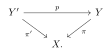
Comments
Corrections, questions, and mathematical discussion are welcome. Sign in with GitHub to comment. Comments are public.