Let $X$ be a connected compact Kähler manifold of dimension $n$.
Definition 19.3.5.46E1CFFE3502 A smooth flag $Y_{\bullet }$ on $X$ consists of a flag of connected closed submanifolds of $X$:
\[ X=Y_0\supseteq Y_1 \supseteq \cdots \supseteq Y_ n, \]
where $Y_ i$ has dimension $n-i$.
In this section, we will fix a smooth flag $Y_{\bullet }$ on $X$.
Definition 19.3.6.78704BB19535 Let $T$ be a closed positive $(1,1)$-current on $X$. We define the valuation of $T$ along $Y_{\bullet }$ as
\[ \nu _{Y_{\bullet }}(T)=\left(\nu _{Y_{\bullet }}(T)_1,\ldots ,\nu _{Y_{\bullet }}(T)_ n\right)\in \mathbb {R}_{\geq 0}^ n \]
by induction on $n$. When $n=0$, we define $\nu _{Y_{\bullet }}(T)$ as the unique point in $\mathbb {R}^0$. When $n\geq 1$, we define
\[ \nu _{Y_{\bullet }}(T)_1=\nu (T,Y_1); \]
Then for $i=2,\ldots ,n$, we define
\[ \nu _{Y_{\bullet }}(T)_ i=\nu _{Y_1\supseteq \cdots \supseteq Y_ n}\left(\operatorname{Tr}_{Y_1}(T-\nu (T,Y_1)[Y_1])\right)_{i-1}. \]
Proposition 19.3.7.FE522E15C1BA Let $T$ be a closed positive $(1,1)$-current on $X$. Then $\nu _{Y_{\bullet }}(T)\in \mathbb {R}_{\geq 0}^ n$ defined in definition 19.3.6 is independent of the choices of the trace operators in the definition. Moreover, $\nu _{Y_{\bullet }}(T)$ depends only on the $\mathcal{I}$-equivalence class of $T$.
Proof.
We will prove both statements at the same time by induction on $n\geq 0$. The cases $n=0,1$ are trivial.
Let us consider the case $n>1$ and assume that the result is known in dimension $n-1$. We first observe that $\nu _{Y_{\bullet }}(T)$ is independent of the choice of the trace operator: Different choices of $\operatorname{Tr}_{Y_1}(T-\nu (T,Y_1)[Y_1])$ are $\mathcal{I}$-equivalent by proposition 20.2.8. Therefore, by induction, its valuation is well-defined.
Next, let $T'$ be another closed positive $(1,1)$-current such that $T\sim _{\mathcal{I}}T'$. Using proposition 16.6.2, we know that $\nu (T,Y_1)=\nu (T',Y_1)$. Therefore,
\[ T- \nu (T,Y_1)[Y_1]\sim _{\mathcal{I}} T'-\nu (T',Y_1)[Y_1]. \]
It follows by induction that
\[ \nu _{Y_1\supseteq \cdots \supseteq Y_ n}\left(\operatorname{Tr}_{Y_1}(T-\nu (T,Y_1)[Y_1])\right)=\nu _{Y_1\supseteq \cdots \supseteq Y_ n}\left(\operatorname{Tr}_{Y_1}(T'-\nu (T',Y_1)[Y_1])\right). \]
This completes the proof.
$\square$
Example 19.3.8.534C64D15BE3 When $X$ is projective, and $D$ is a non-zero effective Cartier divisor, we have
\[ \nu _{Y_{\bullet }}([D])=\nu _{Y_{\bullet }}(D), \]
where the right-hand side is defined in 19.3.1.
Proposition 19.3.9.EF8E476D98F4 Let $T$, $S$ be closed positive $(1,1)$-currents on $X$, $\lambda \in \mathbb {R}_{\geq 0}$. Then
E67E9614A339
if $T\preceq _{\mathcal{I}} S$, we have
98CF17AA36AD
19.3.10
\begin{equation} \nu _{Y_{\bullet }}(T)\geq _{\mathrm{lex}}\nu _{Y_{\bullet }}(S). \end{equation}
BED1B9BF6DB3
We have the following additivity property:
61539109DEC3
19.3.11
\begin{equation} \nu _{Y_{\bullet }}(T+S)=\nu _{Y_{\bullet }}(T)+\nu _{Y_{\bullet }}(S),\quad \nu _{Y_{\bullet }}(\lambda T)=\lambda \nu _{Y_{\bullet }}(T). \end{equation}
Proof.
1 We make an induction on $n\geq 0$. The case $n=0,1$ is trivial. Assume that $n\geq 2$ and the case $n-1$ is known. Observe that $\nu (T,Y_1)\geq \nu (S,Y_1)$, if the inequality is strict, we are done. So let us assume that $\nu (T,Y_1)=\nu (S,Y_1)$. By proposition 20.2.21, we find that
\[ \operatorname{Tr}_{Y_1}\Bigl (T-\nu (T,Y_1)[Y_1]\Bigr )\preceq _ P\operatorname{Tr}_{Y_1}\Bigl (S-\nu (T,Y_1)[Y_1]\Bigr ). \]
Hence the same comparison holds for $\preceq _{\mathcal{I}}$ by corollary 16.8.14. By the inductive hypothesis, we conclude (19.3.10).
2 We make an induction on $n\geq 0$. The cases $n=0,1$ are trivial. Assume that $n\geq 2$ and the case $n-1$ is known. By proposition 5.16.8, we have
\[ \nu (T+S,Y_1)=\nu (T,Y_1)+\nu (S,Y_1),\quad \nu (\lambda T,Y_1)=\lambda \nu (T,Y_1). \]
By proposition 20.2.21, we have
\[ \begin{split} \operatorname{Tr}_{Y_1}\Bigl (T+S-\nu (T+S,Y_1)[Y_1]\Bigr )\sim _ P& \operatorname{Tr}_{Y_1}\Bigl (T-\nu (T,Y_1)[Y_1]\Bigr )\\ & +\operatorname{Tr}_{Y_1}\Bigl (S-\nu (S,Y_1)[Y_1]\Bigr ),\\ \operatorname{Tr}_{Y_1}\Bigl (\lambda T-\nu (\lambda T,Y_1)[Y_1]\Bigr )\sim _ P& \lambda \operatorname{Tr}_{Y_1}\Bigl (T-\nu (T,Y_1)[Y_1]\Bigr ). \end{split} \]
Since $\sim _ P$ implies $\sim _{\mathcal{I}}$ by corollary 16.8.14, the inductive hypothesis and the independence of the valuation from the trace representative conclude (19.3.11).
$\square$
Assume that $n>0$ for the remainder of this section.
Definition 19.3.12.E494C67EB4B8 Let $\pi \colon Z\rightarrow X$ be a proper bimeromorphic morphism where $Z$ is a Kähler manifold. We say that a smooth flag $W_{\bullet }$ on $Z$ is a lifting of $Y_{\bullet }$ to $Z$ if $\pi (W_ i)\subseteq Y_ i$ and the induced map $W_ i\to Y_ i$ is bimeromorphic for each $i=0,\ldots ,n$.
In this case, we define $\operatorname{cor}(Y_{\bullet },\pi )\in \operatorname{Aut}(\mathbb {Z}^ n_{\mathrm{lex}})$ inductively as follows: When $n=1$, we define $\operatorname{cor}(Y_{\bullet },\pi )=[1]$; when $n>1$, we set
63511F34173E
19.3.13
\begin{equation} \operatorname{cor}(Y_{\bullet },\pi )\coloneqq \begin{bmatrix} 1
& \nu _{W_1\supseteq \cdots \supseteq W_ n}\Bigl ((\pi ^*[Y_1]-[W_1])|_{W_1}\Bigr )
\\ 0
& \operatorname{cor}\Bigl (Y_1\supseteq \cdots \supseteq Y_ n,\pi |_{W_1}\colon W_1\rightarrow Y_1\Bigr )
\end{bmatrix}. \end{equation}
We observe that a lifting $W_{\bullet }$ of $Y_{\bullet }$ on $Z$ is unique if it exists: For each $i=0,\ldots ,n-1$, the component $W_{i+1}$ is necessarily the strict transform of $Y_{i+1}$ with respect to the bimeromorphic morphism $W_ i\rightarrow Y_ i$. We shall also say that $(W_{\bullet },\operatorname{cor}(Y_{\bullet },\pi ))$ is
the lifting of $Y_{\bullet }$ to $Z$.
Note that in (19.3.13), $(\pi ^*[Y_1]-[W_1])|_{W_1}$ can also be replaced by $\operatorname{Tr}_{W_1}((\pi ^*[Y_1]-[W_1])|_{W_1})$, since $\pi ^*[Y_1]-[W_1]$ has analytic singularities.
Proposition 19.3.14.D094DD00A592 Let $\pi \colon Z\rightarrow X$ be a proper bimeromorphic morphism, where $Z$ is a Kähler manifold. Let $W_{\bullet }$ be a lifting of $Y_{\bullet }$. Then for any closed positive $(1,1)$-current $T$ on $X$, we have
10.14
\begin{equation} \nu _{W_{\bullet }}(\pi ^*T)= \nu _{Y_{\bullet }}(T)\operatorname{cor}(Y_{\bullet },\pi ). \end{equation}
Proof.
We argue by induction on $n\geq 0$. The case $n=0$ is trivial. In general, assume that $n\geq 1$ and the result is proved in dimension $n-1$.
For simplicity, we write $\nu =\nu _{Y_{\bullet }}$ and $\nu '=\nu _{W_{\bullet }}$. Let $\mu $ (resp. $\mu '$) be the valuation of currents defined by the truncated flag $Y_1\supseteq \cdots \supseteq Y_ n$ (resp. $W_1\supseteq \cdots \supseteq W_ n$). Then we need to show that
579570889FCE
19.3.15
\begin{equation} \begin{split} & \begin{bmatrix} \nu '(\pi ^*T)_1
& \mu '\Bigl ( \operatorname{Tr}_{W_1}\bigl (\pi ^*T-\nu '(\pi ^*T)_1[W_1]\bigr )\Bigr )
\end{bmatrix}\\ =& \begin{bmatrix} \nu (T)_1
& \mu \Bigl (\operatorname{Tr}_{Y_1}\bigl (T-\nu (T)_1[Y_1]\bigr )\Bigr )
\end{bmatrix}\operatorname{cor}(Y_{\bullet },\pi ). \end{split} \end{equation}
By Zariski's main theorem theorem 9.10.5, $W_1\to Y_1$ is bimeromorphic and hence
\[ \nu '(\pi ^*T)_1=\nu (T,Y_1)\eqqcolon c. \]
By the inductive hypothesis, we have
92459CED0BC1
19.3.16
\begin{equation} \mu '\Bigl (\Pi ^{*} \operatorname{Tr}_{Y_1}(T-c[Y_1])\Bigr )=\mu \Bigl (\operatorname{Tr}_{Y_1}(T-c[Y_1])\Bigr )\operatorname{cor}\left(Y_1\supseteq \cdots \supseteq Y_ n,\Pi \right), \end{equation}
where $\Pi \colon W_1\rightarrow Y_1$ is the restriction of $\pi $. Since $\pi ^*[Y_1]=[W_1]+(\pi ^*[Y_1]-[W_1])$, 20.2.24 and proposition 20.2.21 give
\[ \begin{split} \operatorname{Tr}_{W_1}\bigl (\pi ^*T-c[W_1]\bigr )\sim _ P& \operatorname{Tr}_{W_1}\bigl (\pi ^*(T-c[Y_1])\bigr )\\ & +c \operatorname{Tr}_{W_1}\bigl (\pi ^*[Y_1]-[W_1]\bigr )\\ \sim _ P& \Pi ^{*}\operatorname{Tr}_{Y_1}\bigl (T-c[Y_1]\bigr )+c \operatorname{Tr}_{W_1}\bigl (\pi ^*[Y_1]-[W_1]\bigr ). \end{split} \]
So
\[ \mu '\Bigl (\operatorname{Tr}_{W_1}\bigl (\pi ^*T-c[W_1]\bigr )\Bigr )=\mu '\Bigl (\Pi ^{*}\operatorname{Tr}_{Y_1}\bigl (T-c[Y_1]\bigr )\Bigr )+c\mu '\Bigl (\operatorname{Tr}_{W_1}\bigl (\pi ^*[Y_1]-[W_1]\bigr )\Bigr ). \]
Combining the above with (19.3.16), we see that (19.3.15) follows.
$\square$
Proposition 19.3.17.8D2910CD1CEC Let $\pi \colon Z\rightarrow X$, $p\colon Z'\rightarrow Z$ be proper bimeromorphic morphisms with $Z$ and $Z'$ being Kähler manifolds. Assume that $Y_{\bullet }$ admits a lifting $W_{\bullet }$ (resp. $W_{\bullet }'$) to $Z$ (resp. $Z'$). Then
1C158885A628
19.3.18
\begin{equation} \operatorname{cor}(Y_{\bullet },\pi \circ p)=\operatorname{cor}(Y_{\bullet },\pi )\operatorname{cor}(W_{\bullet },p). \end{equation}
Proof.
We let $\pi '=\pi \circ p$. Then $W'_{\bullet }$ is also the lifting of $W_{\bullet }$ with respect to $p$.
We argue by induction on $n\geq 1$. The case $n=1$ is trivial. Assume that $n\geq 2$ and the case $n-1$ has been solved. Then by (19.3.13), the desired formula (19.3.18) can be reformulated as
\[ \begin{aligned} & \begin{bmatrix} 1
& \nu _{W_1'\supseteq \cdots \supseteq W_ n'}((\pi '^*[Y_1]-[W_1'])|_{W_1'})
\\ 0
& \operatorname{cor}(Y_1\supseteq \cdots \supseteq Y_ n,\pi '|_{W_1'}:W_1'\rightarrow Y_1)
\end{bmatrix}=\\ & \begin{bmatrix} 1
& \nu _{W_1\supseteq \cdots \supseteq W_ n}((\pi ^*[Y_1]-[W_1])|_{W_1})
\\ 0
& \operatorname{cor}(Y_1\supseteq \cdots \supseteq Y_ n,\pi |_{W_1}:W_1\rightarrow Y_1)
\end{bmatrix}\cdot \\ & \begin{bmatrix} 1
& \nu _{W_1'\supseteq \cdots \supseteq W_ n'}((p^*[W_1]-[W_1'])|_{W_1'})
\\ 0
& \operatorname{cor}(W_1\supseteq \cdots \supseteq W_ n,p|_{W_1'}:W_1'\rightarrow W_1)
\end{bmatrix}\end{aligned}. \]
By the inductive hypothesis, this is equivalent to
\[ \begin{split} \nu _{W_1'\supseteq \cdots \supseteq W_ n'}\left((\pi '^*[Y_1]-[W_1'])|_{W_1'}\right)= \nu _{W_1'\supseteq \cdots \supseteq W_ n'}\left((p^*[W_1]-[W_1'])|_{W_1'}\right)+\\ \nu _{W_1\supseteq \cdots \supseteq W_ n}\left((\pi ^*[Y_1]-[W_1])|_{W_1}\right)\operatorname{cor}\left(W_1\supseteq \cdots \supseteq W_ n,p|_{W_1'}:W_1'\rightarrow W_1\right), \end{split} \]
which, thanks to proposition 19.3.14, can be further rewritten as
\[ \begin{split} \nu _{W_1'\supseteq \cdots \supseteq W_ n'}\left((\pi '^*[Y_1]-[W_1'])|_{W_1'}\right)= \nu _{W_1'\supseteq \cdots \supseteq W_ n'}\left((p^*[W_1]-[W_1'])|_{W_1'}\right)+\\ \nu _{W_1'\supseteq \cdots \supseteq W_ n'}\left(p|_{W_1'}^*\left((\pi ^*[Y_1]-[W_1])|_{W_1} \right)\right). \end{split} \]
Indeed, as divisors on $W_1'$,
\[ (\pi '^*[Y_1]-[W_1'])|_{W_1'}=(p^*[W_1]-[W_1'])|_{W_1'}+p|_{W_1'}^*((\pi ^*[Y_1]-[W_1])|_{W_1}). \]
The desired equality is therefore exactly the additivity of the valuation, proposition 19.3.9.
$\square$
Theorem 19.3.19.B00AB5301F7A Let $\pi \colon Z\rightarrow X$ be a proper bimeromorphic morphism from a reduced complex space $Z$. Then there is a modification $W\rightarrow X$ dominating $Z\rightarrow X$ such that $Y_{\bullet }$ admits a lifting to $W$.
Recall that here, a modification means a finite composition of blowing-ups with smooth centers.
Proof.
By Hironaka's Chow lemma theorem 9.10.8, we may assume that $\pi $ is a modification.
We begin by setting $W_0=Z$. We will construct $W_ i$ inductively for each $i$. Assume that for $0\leq i<n$ a smooth partial flag $W_0\supseteq \cdots \supseteq W_ i$ has been constructed on a modification $\pi _ i:Z_ i\rightarrow Z$ so that $\pi \circ \pi _ i$ restricts to bimeromorphic morphisms $W_ j\rightarrow Y_ j$ for each $j=0,\ldots ,i$.
By Zariski's main theorem, $W_ i\rightarrow Y_ i$ is an isomorphism outside a codimension $2$ subset of $Y_ i$. We let $W_{i+1}$ be the strict transform of $Y_{i+1}$ in $W_ i$. The problem is that $W_{i+1}$ is not necessarily smooth.
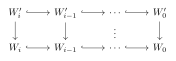
We will further modify $Z_ i$ and lift $W_1,\ldots , W_{i+1}$ in order to make the flag smooth. Take the embedded resolution of $(W_{j},W_{i+1})$, say $W_ j'\rightarrow W_ j$ for each $j=0,\ldots ,i$.
We have canonical embeddings $W_{i}'\hookrightarrow W_{i-1}'\hookrightarrow \cdots \hookrightarrow W_0'$ making the following diagram commutative:
Let $W_{i+1}'$ be the strict transform of $W_{i+1}$ in $W_ i'$. It suffices to define $\pi _{i+1}$ as the morphism $W_0'\rightarrow Z_ i\rightarrow Z$ and replace $W_0\supseteq \cdots \supseteq W_{i+1}$ by $W_0'\supseteq \cdots \supseteq W_{i+1}'$.
$\square$
We also include a more general version of definition
19.3.6 for currents on bimeromorphic models.
Definition 19.3.20.0887D96E8350 Let $\pi \colon Z\rightarrow X$ be a proper bimeromorphic morphism from a normal compact Kähler space, and let $S$ be a closed positive $(1,1)$-current on $Z$. Choose a proper bimeromorphic morphism $h\colon \widehat Z\rightarrow Z$ from a compact Kähler manifold such that $Y_{\bullet }$ admits a lifting $(W_{\bullet },g)$ to $\widehat Z$ with respect to $\pi \circ h$, where
\[ g=\operatorname{cor}(Y_{\bullet },\pi \circ h). \]
We define
9DE3455479DE
19.3.21
\begin{equation} \nu _{Y_{\bullet }}(S)\coloneqq \nu _{W_{\bullet }}(h^*S)g^{-1}\in \mathbb {R}^ n. \end{equation}
Note that it could happen that $\nu _{Y_{\bullet }}(S)\notin \mathbb {R}_{\geq 0}^ n$.
Lemma 19.3.22.24E66EB949E4 The definition in definition 19.3.20 is independent of the choice of $h$. Moreover, if $p\colon Z'\rightarrow Z$ is a proper bimeromorphic morphism from a normal compact Kähler space, then, with respect to the model $\pi \circ p\colon Z'\rightarrow X$,
\[ \nu _{Y_{\bullet }}(p^*S)=\nu _{Y_{\bullet }}(S). \]
Proof.
We first prove independence of the choice of $h$. Let $h_ i\colon \widehat Z_ i\rightarrow Z$, $i=1,2$, be two choices, and let $(W^ i_{\bullet },g_ i)$ be the corresponding liftings, with $g_ i=\operatorname{cor}(Y_{\bullet },\pi \circ h_ i)$. Choose a common modification over $Z$, $q_ i\colon U\rightarrow \widehat Z_ i$ such that $Y_{\bullet }$ admits a lifting $W_{\bullet }$ to $U$. Then $W_{\bullet }$ is also the lifting of $W^ i_{\bullet }$ with respect to $q_ i$. Put
\[ G_ i=\operatorname{cor}(W^ i_{\bullet },q_ i). \]
By proposition 19.3.14, proposition 19.3.17,
\[ \begin{aligned} \nu _{W_{\bullet }}\bigl (q_ i^*h_ i^*S\bigr ) \operatorname{cor}(Y_{\bullet },\pi \circ h_ i\circ q_ i)^{-1} & = \nu _{W^ i_{\bullet }}(h_ i^*S)G_ i(g_ iG_ i)^{-1} \\ & = \nu _{W^ i_{\bullet }}(h_ i^*S)g_ i^{-1}. \end{aligned} \]
Since $h_1\circ q_1=h_2\circ q_2$, the left-hand side is independent of $i$. This proves that (19.3.21) is well-defined.
For the birational invariance, choose a proper bimeromorphic morphism $q\colon \widehat Z\rightarrow Z'$ from a compact Kähler manifold such that $Y_{\bullet }$ admits a lifting to $\widehat Z$ with respect to $\pi \circ p\circ q$. Computing $\nu _{Y_{\bullet }}(p^*S)$ using $q$, and computing $\nu _{Y_{\bullet }}(S)$ using $p\circ q$, gives the same expression.
$\square$
 Pome
Pome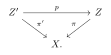
Comments
Corrections, questions, and mathematical discussion are welcome. Sign in with GitHub to comment. Comments are public.