Definition 19.3.5.46E1CFFE3502 A smooth flag $Y_{\bullet }$ on $X$ consists of a flag of connected closed submanifolds of $X$:
\[ X=Y_0\supseteq Y_1 \supseteq \cdots \supseteq Y_ n, \]
where $Y_ i$ has dimension $n-i$.
 Pome
PomeCA8B57CE6237Let $X$ be a connected compact Kähler manifold of dimension $n$.
Definition 19.3.5.46E1CFFE3502 A smooth flag $Y_{\bullet }$ on $X$ consists of a flag of connected closed submanifolds of $X$:
where $Y_ i$ has dimension $n-i$.
Definition 19.3.6.78704BB19535 Let $T$ be a closed positive $(1,1)$-current on $X$. We define the valuation of $T$ along $Y_{\bullet }$ as
by induction on $n$. When $n=0$, we define $\nu _{Y_{\bullet }}(T)$ as the unique point in $\mathbb {R}^0$. When $n\geq 1$, we define
Then for $i=2,\ldots ,n$, we define
Proposition 19.3.7.FE522E15C1BA Let $T$ be a closed positive $(1,1)$-current on $X$. Then $\nu _{Y_{\bullet }}(T)\in \mathbb {R}_{\geq 0}^ n$ defined in definition 19.3.6 is independent of the choices of the trace operators in the definition. Moreover, $\nu _{Y_{\bullet }}(T)$ depends only on the $\mathcal{I}$-equivalence class of $T$.
Proof. We will prove both statements at the same time by induction on $n\geq 0$. The cases $n=0,1$ are trivial.
Let us consider the case $n>1$ and assume that the result is known in dimension $n-1$. We first observe that $\nu _{Y_{\bullet }}(T)$ is independent of the choice of the trace operator: Different choices of $\operatorname{Tr}_{Y_1}(T-\nu (T,Y_1)[Y_1])$ are $\mathcal{I}$-equivalent by proposition 20.2.8. Therefore, by induction, its valuation is well-defined.
Next, let $T'$ be another closed positive $(1,1)$-current such that $T\sim _{\mathcal{I}}T'$. Using proposition 16.6.2, we know that $\nu (T,Y_1)=\nu (T',Y_1)$. Therefore,
It follows by induction that
This completes the proof. $\square$
Example 19.3.8.534C64D15BE3 When $X$ is projective, and $D$ is a non-zero effective Cartier divisor, we have
where the right-hand side is defined in 19.3.1.
Proposition 19.3.9.EF8E476D98F4 Let $T$, $S$ be closed positive $(1,1)$-currents on $X$, $\lambda \in \mathbb {R}_{\geq 0}$. Then
E67E9614A339if $T\preceq _{\mathcal{I}} S$, we have
98CF17AA36AD
19.3.10
BED1B9BF6DB3We have the following additivity property:
61539109DEC3
19.3.11
Proof. 1 We make an induction on $n\geq 0$. The case $n=0,1$ is trivial. Assume that $n\geq 2$ and the case $n-1$ is known. Observe that $\nu (T,Y_1)\geq \nu (S,Y_1)$, if the inequality is strict, we are done. So let us assume that $\nu (T,Y_1)=\nu (S,Y_1)$. By proposition 20.2.21, we find that
Hence the same comparison holds for $\preceq _{\mathcal{I}}$ by corollary 16.8.14. By the inductive hypothesis, we conclude (19.3.10).
2 We make an induction on $n\geq 0$. The cases $n=0,1$ are trivial. Assume that $n\geq 2$ and the case $n-1$ is known. By proposition 5.16.8, we have
By proposition 20.2.21, we have
Since $\sim _ P$ implies $\sim _{\mathcal{I}}$ by corollary 16.8.14, the inductive hypothesis and the independence of the valuation from the trace representative conclude (19.3.11). $\square$
Definition 19.3.12.E494C67EB4B8 Let $\pi \colon Z\rightarrow X$ be a proper bimeromorphic morphism where $Z$ is a Kähler manifold. We say that a smooth flag $W_{\bullet }$ on $Z$ is a lifting of $Y_{\bullet }$ to $Z$ if $\pi (W_ i)\subseteq Y_ i$ and the induced map $W_ i\to Y_ i$ is bimeromorphic for each $i=0,\ldots ,n$.
In this case, we define $\operatorname{cor}(Y_{\bullet },\pi )\in \operatorname{Aut}(\mathbb {Z}^ n_{\mathrm{lex}})$ inductively as follows: When $n=1$, we define $\operatorname{cor}(Y_{\bullet },\pi )=[1]$; when $n>1$, we set
63511F34173E
19.3.13
Note that in (19.3.13), $(\pi ^*[Y_1]-[W_1])|_{W_1}$ can also be replaced by $\operatorname{Tr}_{W_1}((\pi ^*[Y_1]-[W_1])|_{W_1})$, since $\pi ^*[Y_1]-[W_1]$ has analytic singularities.
Proposition 19.3.14.D094DD00A592 Let $\pi \colon Z\rightarrow X$ be a proper bimeromorphic morphism, where $Z$ is a Kähler manifold. Let $W_{\bullet }$ be a lifting of $Y_{\bullet }$. Then for any closed positive $(1,1)$-current $T$ on $X$, we have
Proof. We argue by induction on $n\geq 0$. The case $n=0$ is trivial. In general, assume that $n\geq 1$ and the result is proved in dimension $n-1$.
For simplicity, we write $\nu =\nu _{Y_{\bullet }}$ and $\nu '=\nu _{W_{\bullet }}$. Let $\mu $ (resp. $\mu '$) be the valuation of currents defined by the truncated flag $Y_1\supseteq \cdots \supseteq Y_ n$ (resp. $W_1\supseteq \cdots \supseteq W_ n$). Then we need to show that
579570889FCE
19.3.15
By Zariski's main theorem theorem 9.10.5, $W_1\to Y_1$ is bimeromorphic and hence
By the inductive hypothesis, we have
92459CED0BC1
19.3.16
where $\Pi \colon W_1\rightarrow Y_1$ is the restriction of $\pi $. Since $\pi ^*[Y_1]=[W_1]+(\pi ^*[Y_1]-[W_1])$, 20.2.24 and proposition 20.2.21 give
So
Combining the above with (19.3.16), we see that (19.3.15) follows. $\square$
Proposition 19.3.17.8D2910CD1CEC Let $\pi \colon Z\rightarrow X$, $p\colon Z'\rightarrow Z$ be proper bimeromorphic morphisms with $Z$ and $Z'$ being Kähler manifolds. Assume that $Y_{\bullet }$ admits a lifting $W_{\bullet }$ (resp. $W_{\bullet }'$) to $Z$ (resp. $Z'$). Then
1C158885A628
19.3.18
Proof. We let $\pi '=\pi \circ p$. Then $W'_{\bullet }$ is also the lifting of $W_{\bullet }$ with respect to $p$.
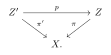
We argue by induction on $n\geq 1$. The case $n=1$ is trivial. Assume that $n\geq 2$ and the case $n-1$ has been solved. Then by (19.3.13), the desired formula (19.3.18) can be reformulated as
By the inductive hypothesis, this is equivalent to
which, thanks to proposition 19.3.14, can be further rewritten as
Indeed, as divisors on $W_1'$,
The desired equality is therefore exactly the additivity of the valuation, proposition 19.3.9. $\square$
Theorem 19.3.19.B00AB5301F7A Let $\pi \colon Z\rightarrow X$ be a proper bimeromorphic morphism from a reduced complex space $Z$. Then there is a modification $W\rightarrow X$ dominating $Z\rightarrow X$ such that $Y_{\bullet }$ admits a lifting to $W$.
Proof. By Hironaka's Chow lemma theorem 9.10.8, we may assume that $\pi $ is a modification.
We begin by setting $W_0=Z$. We will construct $W_ i$ inductively for each $i$. Assume that for $0\leq i<n$ a smooth partial flag $W_0\supseteq \cdots \supseteq W_ i$ has been constructed on a modification $\pi _ i:Z_ i\rightarrow Z$ so that $\pi \circ \pi _ i$ restricts to bimeromorphic morphisms $W_ j\rightarrow Y_ j$ for each $j=0,\ldots ,i$.
By Zariski's main theorem, $W_ i\rightarrow Y_ i$ is an isomorphism outside a codimension $2$ subset of $Y_ i$. We let $W_{i+1}$ be the strict transform of $Y_{i+1}$ in $W_ i$. The problem is that $W_{i+1}$ is not necessarily smooth.
We will further modify $Z_ i$ and lift $W_1,\ldots , W_{i+1}$ in order to make the flag smooth. Take the embedded resolution of $(W_{j},W_{i+1})$, say $W_ j'\rightarrow W_ j$ for each $j=0,\ldots ,i$.
We have canonical embeddings $W_{i}'\hookrightarrow W_{i-1}'\hookrightarrow \cdots \hookrightarrow W_0'$ making the following diagram commutative:
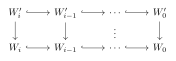
Let $W_{i+1}'$ be the strict transform of $W_{i+1}$ in $W_ i'$. It suffices to define $\pi _{i+1}$ as the morphism $W_0'\rightarrow Z_ i\rightarrow Z$ and replace $W_0\supseteq \cdots \supseteq W_{i+1}$ by $W_0'\supseteq \cdots \supseteq W_{i+1}'$. $\square$
Definition 19.3.20.0887D96E8350 Let $\pi \colon Z\rightarrow X$ be a proper bimeromorphic morphism from a normal compact Kähler space, and let $S$ be a closed positive $(1,1)$-current on $Z$. Choose a proper bimeromorphic morphism $h\colon \widehat Z\rightarrow Z$ from a compact Kähler manifold such that $Y_{\bullet }$ admits a lifting $(W_{\bullet },g)$ to $\widehat Z$ with respect to $\pi \circ h$, where
We define
9DE3455479DE
19.3.21
Lemma 19.3.22.24E66EB949E4 The definition in definition 19.3.20 is independent of the choice of $h$. Moreover, if $p\colon Z'\rightarrow Z$ is a proper bimeromorphic morphism from a normal compact Kähler space, then, with respect to the model $\pi \circ p\colon Z'\rightarrow X$,
Proof. We first prove independence of the choice of $h$. Let $h_ i\colon \widehat Z_ i\rightarrow Z$, $i=1,2$, be two choices, and let $(W^ i_{\bullet },g_ i)$ be the corresponding liftings, with $g_ i=\operatorname{cor}(Y_{\bullet },\pi \circ h_ i)$. Choose a common modification over $Z$, $q_ i\colon U\rightarrow \widehat Z_ i$ such that $Y_{\bullet }$ admits a lifting $W_{\bullet }$ to $U$. Then $W_{\bullet }$ is also the lifting of $W^ i_{\bullet }$ with respect to $q_ i$. Put
By proposition 19.3.14, proposition 19.3.17,
Since $h_1\circ q_1=h_2\circ q_2$, the left-hand side is independent of $i$. This proves that (19.3.21) is well-defined.
For the birational invariance, choose a proper bimeromorphic morphism $q\colon \widehat Z\rightarrow Z'$ from a compact Kähler manifold such that $Y_{\bullet }$ admits a lifting to $\widehat Z$ with respect to $\pi \circ p\circ q$. Computing $\nu _{Y_{\bullet }}(p^*S)$ using $q$, and computing $\nu _{Y_{\bullet }}(S)$ using $p\circ q$, gives the same expression. $\square$
Remark 19.3.23.53FF6E808B22 Suppose that $X$ is a normal projective variety. Consider a rank $n$ (surjective) valuation $\nu \colon \mathbb {C}(X)^{\times }\rightarrow \mathbb {Z}^ n$ and a closed positive $(1,1)$-current $T$ on $X$. Then we can always define $\nu (T)\in \mathbb {R}^ n$ as follows: Take a resolution $\pi \colon Y\rightarrow X$ such that there is a smooth flag $Y_{\bullet }$ on $Y$ and $g\in \operatorname{Aut}(\mathbb {Z}^ n_{\mathrm{lex}})$ such that
Then we define
This definition does not depend on the choice of $\pi $, by passing to a common resolution and applying proposition 19.3.14, proposition 19.3.17.
Comments
Corrections, questions, and mathematical discussion are welcome. Sign in with GitHub to comment. Comments are public.