19.9.26 The Hopf flag and its lower-dimensional body9B3BD06F2362
On a scalar Hopf manifold, the coordinate subspaces give a complete flag ending at a point of an elliptic fiber. Along this flag, a homogeneous section reduces to a nowhere-vanishing section on the elliptic fiber, so the last coordinate of its valuation is zero; the remaining coordinates fill a simplex whose intrinsic volume gives the section growth.
Let $X_ n$ and $L_ k$, with $n\geq 2$ and $k\geq 0$, be as in subsection 19.8.12. In the covering coordinates $z_1,\ldots ,z_ n$, the image of $\{ z_1=\cdots =z_{n-1}=0\} \setminus \{ 0\} $ in $X_ n$ is an elliptic curve; choose a point $p$ on it. Consider the flag $Y_0=X_ n$,
where $/\langle \mathrm e^{-1}\rangle $ denotes the quotient of the punctured linear subspace by the contraction $z\mapsto \mathrm e^{-1}z$. Each member is smooth, compact and connected, and is a prime divisor in the preceding member. Take $W_ m=H^0(X_ n,L_ k^ m)$.
Its $n$-dimensional volume is zero. When $k>0$, its volume in the coordinate hyperplane $x_ n=0$, with the Euclidean measure for which the coordinate lattice has covolume one, is
Proof.
By proposition 19.8.13, sections of $L_ k^ m$ are homogeneous polynomials of degree $km$. Dividing successively by the highest powers of $z_1,\ldots ,z_{n-1}$ that divide the section, and restricting at each step, leaves a nonzero multiple of $z_ n^{km-a_1-\cdots -a_{n-1}}$, where $a_ i$ is the $i$th valuation. This residual section has no zeros on $Y_{n-1}$, so the last valuation is zero, and the preceding ones are nonnegative with sum at most $km$.
Conversely, every such tuple is the valuation of the monomial
The normalized values lie in the displayed simplex and, for $m=1$, include all its vertices, so their closed convex hull is the simplex. For $k>0$, its coordinate-lattice volume is $k^{n-1}/(n-1)!$, the leading coefficient of the binomial count in proposition 19.8.13. For $k=0$, only the constant polynomials remain.
$\square$
555D3252DD7619.9.28 For the Hopf threefold and $k>0$, the body is a triangle in a coordinate plane. Its area gives the quadratic section growth, while its ambient volume vanishes.
Cite this page
Comments
Corrections, questions, and mathematical discussion are welcome. Sign in with GitHub to comment. Comments are public.
 Pome
Pome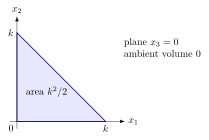
Comments
Corrections, questions, and mathematical discussion are welcome. Sign in with GitHub to comment. Comments are public.