17.17.9 A logarithmic pole on the projective line58086AECC383
Let $X=\mathbb P^1$ and $\varphi =0$. The envelope of a multiple of a logarithmic pole is obtained by replacing part of a convex function by a tangent line. The corresponding ray is smooth, and all its slices are bounded; the pole appears only in the behavior of the ray as $t\to \infty $. In the affine coordinate $z$, take
The form $\theta $ extends to the Fubini–Study form of $\mathbb P^1$, which has integral one. The potential $g$ is $\theta $-plurisubharmonic, has a logarithmic pole at zero, and extends smoothly across infinity, with value zero there.
Put $H(\lambda )=-\lambda \log \lambda -(1-\lambda )\log (1-\lambda )$ for $0<\lambda <1$, with $H(0)=H(1)=0$. For $0<\lambda <1$, define
Set $\Gamma _\lambda =0$ for $\lambda \leq 0$, $\Gamma _1=g$, and $\Gamma _\lambda =-\infty $ for $\lambda >1$.
Proposition 17.17.11.377F0AD20B28 The family $(\Gamma _\lambda )$ is an envelope test curve with initial potential zero and cutoff one. Its forward transform is
At $z=0$ its value is zero, and at infinity its value is $t$.
Proof.
Fix $0<\lambda <1$. For $s=\log |z|^2$, let $q_\lambda (s)=\Gamma _\lambda (z)+\log (1+\mathrm{e}^ s)$. In the first region of (17.17.10) this is the affine function $\lambda s+H(\lambda )$, which is tangent to $\log (1+\mathrm{e}^ s)$ at $s_\lambda =\log (\lambda /(1-\lambda ))$, and in the second region it is $\log (1+\mathrm{e}^ s)$. Its derivative is continuous at the junction and nondecreasing, so $q_\lambda $ is convex. By corollary 5.41.2, $\Gamma _\lambda $ is $\theta $-plurisubharmonic away from zero, and it extends across its logarithmic pole by lemma 5.24.7. It vanishes near infinity and has the ordinary type of $\lambda g$.
To prove $\Gamma _\lambda =P_\theta [\lambda g]$, let $v\leq 0$ be a competitor with $v\preceq \lambda g$. On the punctured disk $0<|z|^2<\lambda /(1-\lambda )$, the function
is subharmonic, since $v+\log (1+|z|^2)$ is subharmonic and $\log |z|^2$ is harmonic there. Since $v\preceq \lambda g$, this difference is bounded above near zero, so it extends subharmonically across zero by lemma 5.24.7. Its upper limits at the boundary circle are at most zero, since $v\leq 0$ and $\Gamma _\lambda =0$ there. The maximum principle gives $v\leq \Gamma _\lambda $ on the disk (at zero both have the value $-\infty $), and outside the disk the same inequality follows from $\Gamma _\lambda =0$. Thus every competitor lies below $\Gamma _\lambda $, which is itself a competitor, so $\Gamma _\lambda =P_\theta [\lambda g]$. Since the envelope depends only on the ordinary type, also $P_\theta [\Gamma _\lambda ]=\Gamma _\lambda $. The zero potential is an envelope fixed point as well.
For a fixed $0<|z|<\infty $, put $p=|z|^2/(1+|z|^2)$. The function $\lambda \mapsto \Gamma _\lambda (z)$ is zero for $\lambda \leq p$. For $p<\lambda <1$ its derivative is
It vanishes at $\lambda =p$ and decreases in $\lambda $, which proves that $\lambda \mapsto \Gamma _\lambda (z)$ is concave and decreasing. At $z=0$, the function is zero for $\lambda \leq 0$ and $-\infty $ for $\lambda >0$; at $z=\infty $, it is zero for $\lambda \leq 1$. These functions are concave and decreasing as well. Finally, $\sup _{\lambda <1}\Gamma _\lambda =0$, and the limit as $\lambda \uparrow 1$ is $g$, so the family is an envelope test curve with cutoff one.
For finite nonzero $z$ and $t>0$, the supremum defining $U_ t(z)$ is attained at a parameter $\lambda >p$, namely at
and substituting this value into the first line of (17.17.10) gives (17.17.12). At $z=0$, only the parameters $\lambda \leq 0$ give finite values, and the supremum is zero; at $z=\infty $, the supremum of $t\lambda $ over $\lambda <1$ is $t$. In the coordinate $w=1/z$, the formula reads $\log ((|w|^2+\mathrm e^ t)/(|w|^2+1))$, so the ray is smooth in both charts.
$\square$
Each slice of this ray is bounded and has envelope zero, whereas its inverse transforms for $0<\lambda \leq 1$ have logarithmic poles. At $z=0$, the parameters $\lambda \leq 0$ determine the transform: omitting them would give the wrong value $U_ t(0)=-\infty $.
FFC4E521CBE117.17.13 The explicit test curve and its ray, at points with $\log |z|^2=-2$ (solid), $0$ (dashed), and $2$ (dotted). The parameter functions on the left are concave; their transforms on the right are convex.
Cite this page
Comments
Corrections, questions, and mathematical discussion are welcome. Sign in with GitHub to comment. Comments are public.
 Pome
Pome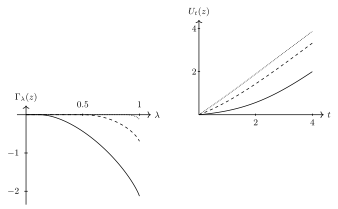
Comments
Corrections, questions, and mathematical discussion are welcome. Sign in with GitHub to comment. Comments are public.