17.10.19 Geodesics in the space of potentialsBE861874FCE4
Let $X$ be a connected compact Kähler manifold of dimension $n$ and $\theta $ be a smooth closed real $(1,1)$-form on $X$ representing a big cohomology class. Fix a model potential $\phi \in \mathrm{PSH}(X,\theta )_{>0}$. See definition 16.3.18 for the definition.
Definition 17.10.20.774DAAE2CF9E Let $\varphi _0, \varphi _1 \in \mathrm{PSH}(X,\theta )$. The geodesic $(\varphi _ t)_{t\in (0,1)}$ from $\varphi _0$ to $\varphi _1$ is the family of potentials $\varphi _ t\in \mathrm{PSH}(X,\theta )\cup \{ -\infty \} $ such that
\begin{equation} \begin{split} \varphi _ t=\operatorname *{sup}_{}{}\! {}^{*}& \left\{ \psi _ t: (\psi _{s})_ s \textup{ is a subgeodesic from }\psi _0\textup{ to }\psi _1,\right.\\ & \psi _0,\psi _1\in \mathrm{PSH}(X,\theta ),\left.\psi _0\leq \varphi _0,\psi _1\leq \varphi _1\right\} . \end{split} \end{equation}
More generally, let $(\varphi _ t)_{t\in [a,b]}$ ($a,b\in \mathbb {R}$, $a\leq b$) be a curve in $\mathrm{PSH}(X,\theta )$. We say $(\varphi _ t)_{t\in [a,b]}$ is a geodesic if the curve $(\varphi _{tb+(1-t)a})_{t\in (0,1)}$ is a geodesic from $\varphi _ a$ to $\varphi _ b$.
We also say $(\varphi _ t)_{t\in (a,b)}$ is a geodesic in $\mathrm{PSH}(X,\theta )$ from $\varphi _ a$ to $\varphi _ b$.
The envelopes of the form (17.10.21) are usually referred to as the Perron envelopes. In general, the geodesic defined by (17.10.21) fails to have the correct limit when $t\to 0+$ or $t\to 1-$. Therefore, a priori it is not a subgeodesic from $\varphi _0$ to $\varphi _1$. In the sequel, we use the word geodesic only in situations where the endpoint behavior has been verified.
Lemma 17.10.22.BDEA4F06B7F1 Let $\varphi _0,\varphi _1\in \mathrm{PSH}(X,\theta )$. Assume that there is a subgeodesic from $\varphi _0$ to $\varphi _1$. Then the geodesic $(\varphi _ t)_{t\in (0,1)}$ from $\varphi _0$ to $\varphi _1$ is a subgeodesic from $\varphi _0$ to $\varphi _1$.
Proof.
This is an immediate consequence of proposition 17.10.13.
$\square$
Example 17.10.23.C16140E8B047 Let $\varphi _0\in \mathrm{PSH}(X,\theta )$ and $C\in \mathbb {R}$. Then the subgeodesic $(\varphi _0+tC)_{t\in [0,1]}$ studied in example 17.10.6 is a geodesic. This follows easily from proposition 17.10.7.
In particular, when $C=0$, we find that the constant subgeodesic at $\varphi _0$ is indeed a geodesic, which we call the constant geodesic at $\varphi _0$.
More generally, suppose that $(\varphi _ t)_{t\in [0,1]}$ is a geodesic and $C_1,C_2\in \mathbb {R}$, then $(\varphi _ t+C_1t+C_2)_{t\in [0,1]}$ is also a geodesic. This follows immediately from example 17.10.6.
Next we want to show that under mild assumptions, there exist subgeodesics between two potentials. The assumption below turns out to be necessary as well, as we shall prove in theorem 16.8.32 later.
Proposition 17.10.24.8AB36536E36D Given $\varphi _0, \varphi _1 \in \mathcal{E}(X,\theta ;\phi )$, the geodesic $(\varphi _ t)_{t\in (0,1)}$ from $\varphi _0$ to $\varphi _1$ defined by (17.10.21) is a subgeodesic from $\varphi _0$ to $\varphi _1$ and $\varphi _ t\in \mathcal{E}(X,\theta ;\phi )$ for each $t\in (0,1)$.
Moreover, for any $0\leq a\leq b\leq 1$, the restriction $(\varphi _ t)_{t\in [a,b]}$ is a geodesic.
If furthermore $\varphi _0,\varphi _1\in \mathcal{E}^1(X,\theta ;\phi )$ (resp. $\mathcal{E}^{\infty }(X,\theta ;\phi )$), then $\varphi _ t\in \mathcal{E}^1(X,\theta ;\phi )$ (resp. $\mathcal{E}^{\infty }(X,\theta ;\phi )$) for all $t\in (0,1)$.
We refer to 16.5 for the definition of $\mathcal{E}(X,\theta ;\phi )$. Our assumption means that $P_{\theta }[\varphi _0]=P_{\theta }[\varphi _1]=\phi $.
As a consequence of this proposition, the restriction $(\varphi _ t)_{t\in [a,b]}$ is also a subgeodesic since $\varphi _ a,\varphi _ b\in \mathcal{E}(X,\theta ;\phi )$ as well.
Proof.
After subtracting suitable constants from $\varphi _0$ and $\varphi _1$ and adding back the corresponding affine function of $t$, we may assume that $\varphi _0,\varphi _1\leq \phi $. It follows from proposition 17.10.7 that $\varphi _ t\leq \phi $ for all $t\in (0,1)$. In fact, we have the stronger estimate
We first observe that when $\varphi _0,\varphi _1\in \mathcal{E}(X,\theta ;\phi )$, so is $\varphi _0\land \varphi _1$, see proposition 16.5.49. In particular, the constant subgeodesic $t\mapsto \varphi _0\land \varphi _1$ is a candidate in the Perron envelope (17.10.21). So
By proposition 17.10.13, $(\varphi _ t)_{t\in (0,1)}$ is a subgeodesic.2 It follows from proposition 16.5.52 that $\varphi _ t\in \mathcal{E}(X,\theta ;\phi )$ for all $t\in (0,1)$.
Next, we show that as $t\to 0+$, we have $\varphi _ t\xrightarrow {L^1}\varphi _0$. The corresponding result at $t=1$ is similar.
We first argue the special case where $\varphi _0\preceq \varphi _1$. Take a constant $C>0$ such that
\[ \varphi _0-C\leq \varphi _1. \]
Then $(\varphi _0-Ct)_{t\in (0,1)}$ is clearly a candidate in (17.10.21), see example 17.10.6. Therefore, for all $t\in (0,1)$,
It follows that $\varphi _ t\xrightarrow {L^1}\varphi _0$ as $t\to 0+$.
Let us come back to the general case. By corollary 17.10.11, $\{ \varphi _ t:t\in (0,1)\} $ is a relatively compact subset of $\mathrm{PSH}(X,\theta )$ with respect to the $L^1$-topology.
Let $\psi $ be an $L^1$-cluster point of $\varphi _ t$ as $t\searrow 0$, and it suffices to show that $\psi =\varphi _0$.
Observe that $\varphi _0^ M\in \mathcal{E}(X,\theta ;\phi )$ by proposition 16.5.49. Let $(\varphi _ t^ M)_{t\in (0,1)}$ be the geodesic from $\varphi _0^ M$ to $\varphi _1$. Since $\varphi _0^ M\preceq \varphi _1$, the special case proved above applies to the geodesic $(\varphi _ t^ M)_ t$, and
Moreover, every candidate for the geodesic from $\varphi _0^ M$ to $\varphi _1$ is also a candidate for the geodesic from $\varphi _0$ to $\varphi _1$, so
as $M\to \infty $, which is shown in proposition 16.5.54.
Now we have shown that $(\varphi _ t)_{t\in [0,1]}$ is a subgeodesic.
Next, take $0\leq a\leq b\leq 1$. We want to show that the restriction $(\varphi _ t)_{t\in [a,b]}$ is the geodesic from $\varphi _ a$ to $\varphi _ b$. We may assume that $a<b$. The argument is the standard balayage argument.
Let $(\psi _ t)_{t\in (a,b)}$ be the geodesic from $\varphi _ a$ to $\varphi _ b$. Since $(\varphi _ t)_{t\in [a,b]}$ is a subgeodesic by proposition 17.10.15, we have $\psi _ t\geq \varphi _ t$ for all $t\in (a,b)$.
Extending it by setting $\psi _ a=\varphi _ a$ and $\psi _ b=\varphi _ b$, the first part of the proof applied to the endpoints $\varphi _ a,\varphi _ b$ shows that $(\psi _ t)_{t\in [a,b]}$ is a subgeodesic from $\varphi _ a$ to $\varphi _ b$. Since $\psi _ t\geq \varphi _ t$ for $t\in (a,b)$, the gluing lemma 17.10.16 shows that $(\eta _ t)_{t\in [0,1]}$ is a subgeodesic from $\varphi _0$ to $\varphi _1$.
In other words, $(\varphi _ t)_{t\in (a,b)}=(\psi _ t)_{t\in (a,b)}$ is the geodesic from $\varphi _ a$ to $\varphi _ b$.
Finally, assume furthermore that $\varphi _0,\varphi _1\in \mathcal{E}^1(X,\theta ;\phi )$ (resp. $\mathcal{E}^{\infty }(X,\theta ;\phi )$). Thanks to (17.10.26), proposition 16.5.49 and proposition 16.5.52, we find $\varphi _ t\in \mathcal{E}^1(X,\theta ;\phi )$ (resp. $\mathcal{E}^{\infty }(X,\theta ;\phi )$) for all $t\in (0,1)$.
$\square$
Lemma 17.10.28.8A0F90757653 Let $\varphi _0,\varphi _1\in \mathrm{PSH}(X,\theta )$ with $\varphi _1\leq \varphi _0$. Let $(\varphi _ t)_{t\in (0,1)}$ be the geodesic from $\varphi _0$ to $\varphi _1$. Assume that $(\varphi _ t)_{t\in [0,1]}$ is also a subgeodesic. Then $\varphi _ t$ is decreasing in $t\in [0,1]$.
Proof.
Fix $0< r<s\leq 1$ and put $\delta =(s-r)/(1-r)$. Then $(\varphi _{\delta +(1-\delta )t})_{t\in [0,1]}$ is a subgeodesic from $\varphi _\delta $ to $\varphi _1$. Since
we have $\varphi _{\delta +(1-\delta )t}\leq \varphi _ t$ for all $t\in (0,1)$ by the definition of geodesic. In particular, $\varphi _ s=\varphi _{\delta +(1-\delta )r}\leq \varphi _ r$.
It remains to prove that for any $t\in (0,1)$, we have $\varphi _ t\leq \varphi _0$, but this is an immediate consequence of proposition 17.10.7:
Proposition 17.10.29.DE479E2BD255 Let $\varphi _1,\varphi _0\in \mathcal{E}(X,\theta ;\phi )$ with $\varphi _1\preceq \varphi _0$. Let $(\varphi _ t)_{t\in (0,1)}$ be the geodesic from $\varphi _0$ to $\varphi _1$. Then
E48DC51BE08D17.10.31 Typical behaviour of $t\mapsto \varphi _ t(x)$
Proof.
The notations in the proof are indicated in 17.10.31.3
We may assume that $s\in (0,1)$ since there is nothing to prove when $s=0$ or $s=1$.
After replacing $\varphi _ t$ by $\varphi _ t-C't$ for some large enough $C'>0$, we may assume that $\varphi _1\leq \varphi _0$. This procedure preserves the geodesic property by example 17.10.23. Then $\varphi _ t$ is decreasing in $t$ by 17.10.28.
By proposition 17.10.24, we have $\varphi _ t\xrightarrow {L^1}\varphi _1$ as $t\to 1-$. Since $\varphi _ t$ is decreasing in $t\in (0,1)$, it follows that $\varphi _1=\inf _{t\in (0,1)}\varphi _ t$. Therefore, we can find a pluripolar set $Z\subseteq X$ such that $\varphi _ t(x)\rightarrow \varphi _1(x)>-\infty $ as $t\to 1-$ for all $x\in X\setminus Z$.
Similarly, since $\varphi _0=\operatorname *{sup}_{t\in (0,1)}{}\! {}^{*} \varphi _ t$, after enlarging $Z$, we may also guarantee that $\varphi _ t(x)\rightarrow \varphi _0(x)>-\infty $ as $t\to 0+$ for all $x\in X\setminus Z$ by proposition 5.14.5.
For any such $x\in X\setminus Z$, the function $t\mapsto \varphi _ t(x)$ is a real-valued continuous convex function on $[0,1]$. In particular, $t\mapsto \varphi _ t(x)$ is absolutely continuous on $[0,1]$. Hence, for any $s\in [0,1)$, we have
Proposition 17.10.37.9335B48D7458 Let $\varphi _1,\varphi _0\in \mathcal{E}^{\infty }(X,\theta ;\phi )$. Let $(\varphi _ t)_{t\in (0,1)}$ be the geodesic from $\varphi _0$ to $\varphi _1$. Then
Definition 17.10.38.2E335019C3A7 Let $\ell =(\ell _ t)_{t\geq 0}$ be a family in $\mathcal{E}(X,\theta ;\phi )$. We say $\ell $ is a geodesic ray in $\mathcal{E}(X,\theta ;\phi )$ emanating from $\ell _0$ if for each $0\leq a\leq b$, the restriction $(\ell _ t)_{t\in [a,b]}$ is a geodesic.
The set of geodesic rays in $\mathcal{E}(X,\theta ;\phi )$ emanating from $\phi $ is denoted by $\mathcal{R}(X,\theta ;\phi )$.
We say a geodesic ray $\ell \in \mathcal{R}(X,\theta ;\phi )$ has finite energy if $\ell _ t\in \mathcal{E}^1(X,\theta ;\phi )$ for all $t>0$. The set of geodesic rays with finite energy is denoted by $\mathcal{R}^1(X,\theta ;\phi )$.
We say a geodesic ray $\ell \in \mathcal{R}(X,\theta ;\phi )$ is bounded if $\ell _ t\in \mathcal{E}^{\infty }(X,\theta ;\phi )$ for all $t\geq 0$. The set of bounded geodesic rays is denoted by $\mathcal{R}^{\infty }(X,\theta ;\phi )$.
Given $\ell ,\ell '\in \mathcal{R}(X,\theta ;\phi )$, we write $\ell \leq \ell '$ if $\ell _ t\leq \ell '_ t$ for each $t\geq 0$.
When $\phi =V_{\theta }$, we usually omit it from the notations and write $\mathcal{R}(X,\theta )$, $\mathcal{R}^1(X,\theta )$ and $\mathcal{R}^{\infty }(X,\theta )$ respectively.
Proposition 17.10.39.FD1B5378AA06 Let $\ell \in \mathcal{R}(X,\theta ;\phi )$. Then there is a constant $C\in \mathbb {R}$ such that
 Pome
Pome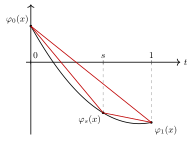
Comments
Corrections, questions, and mathematical discussion are welcome. Sign in with GitHub to comment. Comments are public.