Let $X$ be a connected compact Kähler manifold of dimension $n$ and $\theta ,\theta ',\theta ''$ be closed real smooth $(1,1)$-forms on $X$ representing big cohomology classes.
This section relies heavily on section 17.15. We shall use the notions introduced in that section without further explanations.
Definition 22.1.21.DA2917901B54 Let $\Gamma \in \mathrm{PSH}^{\mathrm{NA}}(X,\theta )$, $\Gamma '\in \mathrm{PSH}^{\mathrm{NA}}(X,\theta ')$. We say $\Gamma \leq \Gamma '$ if for some $\omega \in \textup{Käh}(X)$, we have
\[ \Gamma ^{\theta +\omega } \leq \Gamma '{}^{\theta '+\omega }. \]
This notion is independent of the choice of $\omega $ thanks to 17.15.3.
Moreover, we have the following:
Proposition 22.1.22.8C5A487B9CCC Let $\Gamma ,\Gamma '\in \mathrm{PSH}^{\mathrm{NA}}(X,\theta )$ and $\omega $ be a closed smooth positive $(1,1)$-form on $X$. Then the following are equivalent:
A1B3616B9907
$\Gamma \leq \Gamma '$;
3EAAE9BE6F17
$P_{\theta +\omega }[\Gamma ]_{\mathcal{I}}\leq P_{\theta +\omega }[\Gamma ']_{\mathcal{I}}$.
Proof.
This follows immediately from 17.15.3.
$\square$
Observe that this definition coincides with the corresponding definition in definition 17.15.1 when $\Gamma ,\Gamma '\in \mathrm{PSH}^{\mathrm{NA}}(X,\theta )_{>0}$.
Proposition 22.1.23.F7D709A21AE1 Let $\Gamma ,\Gamma '\in \mathrm{PSH}^{\mathrm{NA}}(X,\theta )$. Assume that $\Gamma \leq \Gamma '$. Then
\[ \operatorname{vol}\Gamma \leq \operatorname{vol}\Gamma '. \]
Proof.
It suffices to show that for any Kähler form $\omega $ on $X$, we have
\[ \operatorname{vol}\Gamma ^{\theta +\omega }_{-\infty }\leq \operatorname{vol}\Gamma '{}^{\theta +\omega }_{-\infty }, \]
which is an immediate consequence of theorem 13.13.11.
$\square$
Definition 22.1.24.93939D1E527C Let $\Gamma \in \mathrm{PSH}^{\mathrm{NA}}(X,\theta )$ and $\Gamma '\in \mathrm{PSH}^{\mathrm{NA}}(X,\theta ')$. Then we define $\Gamma +\Gamma '\in \mathrm{PSH}^{\mathrm{NA}}(X,\theta +\theta ')$ as the unique element such that for any $\omega \in \textup{Käh}(X)$, we have
\[ \left( \Gamma +\Gamma ' \right)^{\theta +\theta '+2\omega }=\Gamma ^{\theta +\omega }+\Gamma '^{\theta '+\omega }. \]
This definition yields an element in $\mathrm{PSH}^{\mathrm{NA}}(X,\theta +\theta ')$ by 17.15.9 and it extends the definition in definition 17.15.4 by 17.15.9 as well.
Proposition 22.1.25.06DFF1DE1519 Let $\Gamma \in \mathrm{PSH}^{\mathrm{NA}}(X,\theta )$ and $\Gamma '\in \mathrm{PSH}^{\mathrm{NA}}(X,\theta ')$. Suppose that $\omega ,\omega '$ are two smooth closed positive $(1,1)$-forms on $X$. Then
\[ P_{\theta +\omega +\theta '+\omega '}[\Gamma +\Gamma ']_{\mathcal{I}}=P_{\theta +\omega }[\Gamma ]_{\mathcal{I}}+P_{\theta '+\omega '}[\Gamma ']_{\mathcal{I}}. \]
Proof.
This is a direct consequence of 17.15.9.
$\square$
Proposition 22.1.26.E9E94041F68D The operation $+$ is commutative and associative: For any $\Gamma \in \mathrm{PSH}^{\mathrm{NA}}(X,\theta )$, $\Gamma '\in \mathrm{PSH}^{\mathrm{NA}}(X,\theta ')$ and $\Gamma ''\in \mathrm{PSH}^{\mathrm{NA}}(X,\theta '')$, we have
\[ \Gamma +\Gamma '=\Gamma '+\Gamma ,\quad (\Gamma +\Gamma ')+\Gamma ''=\Gamma +(\Gamma '+\Gamma ''). \]
Proof.
This is a direct consequence of proposition 17.15.7.
$\square$
Definition 22.1.27.D1E32864F8F0 Let $\Gamma \in \mathrm{PSH}^{\mathrm{NA}}(X,\theta )$ and $C\in \mathbb {R}$. We define $\Gamma +C\in \mathrm{PSH}^{\mathrm{NA}}(X,\theta )$ as the unique element such that for any $\omega \in \textup{Käh}(X)$, we have
\[ \left( \Gamma +C \right)^{\theta +\omega }=\Gamma ^{\theta +\omega }+C. \]
It is obvious from definition 17.15.10 that $\Gamma +C\in \mathrm{PSH}^{\mathrm{NA}}(X,\theta )$. It is also obvious that this definition extends definition 17.15.10.
Proposition 22.1.28.ECFDC5EDD4F2 Let $\Gamma \in \mathrm{PSH}^{\mathrm{NA}}(X,\theta )$ and $C\in \mathbb {R}$. Suppose that $\omega $ is a smooth closed positive $(1,1)$-form on $X$. Then
\[ P_{\theta +\omega }[\Gamma ]_{\mathcal{I}}+C=P_{\theta +\omega }[\Gamma +C]_{\mathcal{I}}. \]
Proof.
This is clear by definition.
$\square$
Proposition 22.1.29.87CB041BFCA3 Let $\Gamma \in \mathrm{PSH}^{\mathrm{NA}}(X,\theta )$, $\Gamma '\in \mathrm{PSH}^{\mathrm{NA}}(X,\theta ')$ and $C,C'\in \mathbb {R}$. Then
80F4957A059F
$(\Gamma +\Gamma ')+C=\Gamma +(\Gamma '+C)=(\Gamma +C)+\Gamma '$;
036FE960D3D0
$\Gamma +(C+C')=(\Gamma +C)+C'$.
Proof.
This is a direct consequence of proposition 17.15.11.
$\square$
Proposition 22.1.30.11099644479B Let $\Gamma \in \mathrm{PSH}^{\mathrm{NA}}(X,\theta )$ and $C\in \mathbb {R}$. Then
\[ \operatorname{vol}\Gamma =\operatorname{vol}(\Gamma +C). \]
Proof.
It suffices to show that for each Kähler form $\omega $ on $X$,
\[ \operatorname{vol}\Gamma ^{\theta +\omega }_{-\infty }=\operatorname{vol}(\Gamma +C)^{\theta +\omega }_{-\infty }, \]
which is obvious.
$\square$
Definition 22.1.31.B819F1A85E09 Let $\Gamma ,\Gamma '\in \mathrm{PSH}^{\mathrm{NA}}(X,\theta )$, we define $\Gamma \lor \Gamma '\in \mathrm{PSH}^{\mathrm{NA}}(X,\theta )$ as the unique element such that for any $\omega \in \textup{Käh}(X)$, we have
\[ \left( \Gamma \lor \Gamma ' \right)^{\theta +\omega }=\Gamma ^{\theta +\omega }\lor \Gamma '^{\theta +\omega }. \]
It follows from 17.15.19 that $\Gamma \lor \Gamma '\in \mathrm{PSH}^{\mathrm{NA}}(X,\theta )$ and this definition extends the corresponding definition in definition 17.15.12.
Proposition 22.1.32.9CACCE9D7690 Let $\Gamma ,\Gamma '\in \mathrm{PSH}^{\mathrm{NA}}(X,\theta )$ and $\omega $ be a closed smooth positive $(1,1)$-form on $X$. Then
\[ P_{\theta +\omega }[\Gamma \lor \Gamma ']_{\mathcal{I}}=P_{\theta +\omega }[\Gamma ]_{\mathcal{I}}\lor P_{\theta +\omega }[\Gamma ']_{\mathcal{I}}. \]
Proof.
This is a direct consequence of 17.15.19.
$\square$
Proposition 22.1.33.04004F65B932 The operation $\lor $ is commutative and associative.
In particular, given a finite non-empty family $(\Gamma ^ i)_{i\in I}$ in $\mathrm{PSH}^{\mathrm{NA}}(X,\theta )$, we then define $\bigvee _{i\in I}\Gamma ^ i$ in the obvious way.
Proof.
This is a direct consequence of corollary 17.15.17.
$\square$
Definition 22.1.34.C172DAF1B3E6 Let $(\Gamma ^ i)_{i\in I}$ be a non-empty family in $\mathrm{PSH}^{\mathrm{NA}}(X,\theta )$. Assume that
AB5F1151338C
22.1.35
\begin{equation} \sup _{i\in I}\Gamma ^ i_{\max }<\infty . \end{equation}
Then we define $\operatorname *{sup}_{i\in I}{}\! {}^{*}\Gamma ^ i\in \mathrm{PSH}^{\mathrm{NA}}(X,\theta )$ as the unique element such that for any $\omega \in \textup{Käh}(X)$, we have
\[ \left( \operatorname *{sup}_{i\in I}{}\! {}^{*}\Gamma ^ i \right)^{\theta +\omega }=\operatorname *{sup}_{i\in I}{}\! {}^{*}\Gamma ^{i,\theta +\omega }. \]
It follows immediately from 17.15.30 that $\operatorname *{sup}_{i\in I}{}\! {}^{*}\Gamma ^ i\in \mathrm{PSH}^{\mathrm{NA}}(X,\theta )$ and this definition extends definition 17.15.25. Moreover, this definition clearly extends definition 22.1.31 as well.
Proposition 22.1.36.74CC0BF97B41 Let $(\Gamma ^ i)_{i\in I}$ be a non-empty family in $\mathrm{PSH}^{\mathrm{NA}}(X,\theta )$ satisfying (22.1.35). Assume that $\omega $ is a closed smooth positive $(1,1)$-form on $X$. Then
\[ P_{\theta +\omega }\left[ \operatorname *{sup}_{i\in I}{}\! {}^{*} \Gamma ^{i} \right]_{\mathcal{I}}= \operatorname *{sup}_{i\in I}{}\! {}^{*} P_{\theta +\omega }\left[ \Gamma ^{i} \right]_{\mathcal{I}}. \]
Proof.
This is a direct consequence of 17.15.30.
$\square$
We also have a non-Archimedean version of Choquet's lemma.
Proposition 22.1.37.21737B0303A5 Let $(\Gamma ^ i)_{i\in I}$ be a non-empty family in $\mathrm{PSH}^{\mathrm{NA}}(X,\theta )$ satisfying (22.1.35). Then there exists a countable subfamily $I'\subseteq I$ such that
\[ \operatorname *{sup}_{i\in I}{}\! {}^{*}\Gamma ^ i=\operatorname *{sup}_{i\in I'}{}\! {}^{*}\Gamma ^ i. \]
Proof.
Fix a Kähler form $\omega _0$ on $X$. For each $m\geq 1$, proposition 17.15.31 gives a countable subfamily $I_ m\subseteq I$ such that
\[ \operatorname *{sup}_{i\in I}{}\! {}^{*}P_{\theta +m^{-1}\omega _0}[\Gamma ^ i]_{\mathcal{I}}=\operatorname *{sup}_{i\in I_ m}{}\! {}^{*}P_{\theta +m^{-1}\omega _0}[\Gamma ^ i]_{\mathcal{I}}. \]
Set $I'=\bigcup _{m\geq 1}I_ m$. This is countable. We claim that it works.
Let $\omega '\in \textup{Käh}(X)$. Choose $m$ so large that $\omega '\geq m^{-1}\omega _0$. By proposition 22.1.36 and the compatibility of the transition maps,
\[ \begin{aligned} \operatorname *{sup}_{i\in I}{}\! {}^{*}P_{\theta +\omega '}[\Gamma ^ i]_{\mathcal{I}} =& P_{\theta +\omega '}\left[\operatorname *{sup}_{i\in I}{}\! {}^{*}P_{\theta +m^{-1}\omega _0}[\Gamma ^ i]_{\mathcal{I}}\right]_{\mathcal{I}}\\ =& P_{\theta +\omega '}\left[\operatorname *{sup}_{i\in I'}{}\! {}^{*}P_{\theta +m^{-1}\omega _0}[\Gamma ^ i]_{\mathcal{I}}\right]_{\mathcal{I}}\\ =& \operatorname *{sup}_{i\in I'}{}\! {}^{*}P_{\theta +\omega '}[\Gamma ^ i]_{\mathcal{I}}. \end{aligned} \]
Thus the two non-Archimedean metrics have the same component in every class $\theta +\omega '$, and the assertion follows.
$\square$
Proposition 22.1.38.938848E420F9 Let $(\Gamma ^ i)_{i\in I}$ be a non-empty family in $\mathrm{PSH}^{\mathrm{NA}}(X,\theta )$ satisfying (22.1.35). Let $C\in \mathbb {R}$. Then
\[ \operatorname *{sup}_{i\in I}{}\! {}^{*} (\Gamma ^ i+C)=\operatorname *{sup}_{i\in I}{}\! {}^{*} \Gamma ^ i+C. \]
Suppose that $(\Gamma '^ i)_{i\in I}$ is another family in $\mathrm{PSH}^{\mathrm{NA}}(X,\theta ')$ satisfying (22.1.35). Suppose that $\Gamma ^ i\leq \Gamma '^ i$ for all $i\in I$. Then
\[ \operatorname *{sup}_{i\in I}{}\! {}^{*}\Gamma ^ i\leq \operatorname *{sup}_{i\in I}{}\! {}^{*}\Gamma '^ i. \]
Proof.
This is an immediate consequence of proposition 17.15.32.
$\square$
Proposition 22.1.39.15E20104530B Let $(\Gamma ^ i)_{i\in I}$ be an increasing net in $\mathrm{PSH}^{\mathrm{NA}}(X,\theta )$ satisfying (22.1.35). Then
AA5696D80091
22.1.40
\begin{equation} \operatorname{vol}\left( \operatorname *{sup}_{i\in I}{}\! {}^{*} \Gamma ^ i \right)=\lim _{i\in I} \operatorname{vol}\Gamma ^ i. \end{equation}
Proof.
The $\geq $ direction in (22.1.40) is a direct consequence of proposition 22.1.23. It remains to prove the reverse inequality.
Note that (22.1.40) holds when $\operatorname{vol}\Gamma ^ i>0$ for each $i\in I$, as a consequence of proposition 17.15.22, corollary 16.9.12 and theorem 16.9.57.
In particular, for each Kähler form $\omega $ on $X$, we have
\[ \operatorname{vol}\left( \operatorname *{sup}_{i\in I}{}\! {}^{*} \Gamma ^{i,\theta +\omega } \right)=\lim _{i\in I} \operatorname{vol}\Gamma ^{i,\theta +\omega }. \]
For our purpose, we need to show that for any $\epsilon >0$, we can find $\omega $ so that
\[ \sup _{i\in I} \operatorname{vol}\Gamma ^{i,\theta +\omega }<\sup _{i\in I} \operatorname{vol}\Gamma ^{i}+\epsilon . \]
We shall show that it is possible to choose $\omega $ so that the stronger statement holds:
\[ \operatorname{vol}\Gamma ^{i,\theta +\omega }<\operatorname{vol}\Gamma ^{i}+\epsilon ,\quad \forall i\in I. \]
Equivalently, we need to choose $\omega $ so that for any Kähler form $\omega '$ on $X$ dominated by $\omega $, we have
\[ \operatorname{vol}\Gamma ^{i,\theta +\omega }_{-\infty }<\operatorname{vol}\Gamma ^{i,\theta +\omega '}_{-\infty }+\epsilon /2,\quad \forall i\in I. \]
Fix a Kähler form $\omega _0$ on $X$ and a Kähler form $\Omega $ such that $\Omega \geq \theta +\omega _0$. It is enough to take $\omega =\delta \omega _0$ for some $\delta \in (0,1)$. If $\omega '$ is dominated by $\omega $, then $\theta +\omega '\leq \Omega $. Set
\[ T_ i\coloneqq \theta +\omega '+\mathrm{dd}^{\mathrm{c}}\Gamma ^{i,\theta +\omega '}_{-\infty }. \]
By the transition compatibility and proposition 17.12.19, the potential $\Gamma ^{i,\theta +\omega }_{-\infty }$ has the same $P$-singularity type in the class $\theta +\omega $ as $\Gamma ^{i,\theta +\omega '}_{-\infty }$. Hence its mass can be computed as
\[ \int _ X\left(\theta +\omega +\mathrm{dd}^{\mathrm{c}}\Gamma ^{i,\theta +\omega '}_{-\infty }\right)^ n=\int _ X \left(T_ i+\omega -\omega '\right)^ n. \]
Therefore,
\[ \begin{aligned} \operatorname{vol}\Gamma ^{i,\theta +\omega }_{-\infty }-\operatorname{vol}\Gamma ^{i,\theta +\omega '}_{-\infty } =& \int _ X \left(T_ i+\omega -\omega '\right)^ n-\int _ X T_ i^ n\\ =& \sum _{a=0}^{n-1} \binom {n}{a} \int _ X T_ i^ a\wedge \left( \omega -\omega '\right)^{n-a}\\ \leq & \sum _{a=0}^{n-1} \binom {n}{a} \int _ X \Omega ^ a\wedge \omega ^{n-a}. \end{aligned} \]
In the last inequality we used the facts that $0\leq \omega -\omega '\leq \omega $ and $\theta +\omega '\leq \Omega $, and the monotonicity theorem theorem 13.13.11. We can choose $\omega $ so that the right-hand side is less than $\epsilon /2$. Our assertion then follows.
$\square$
Definition 22.1.41.65E2E07550F1 Let $(\Gamma ^ i)_{i\in I}$ be a decreasing net in $\mathrm{PSH}^{\mathrm{NA}}(X,\theta )$. Assume that
827FE14EA1A0
22.1.42
\begin{equation} \inf _{i\in I}\Gamma ^ i_{\max }>-\infty , \end{equation}
then we define $\inf _{i\in I}\Gamma ^ i\in \mathrm{PSH}^{\mathrm{NA}}(X,\theta )$ as the unique element such that for each $\omega \in \textup{Käh}(X)$, we have
341067287939
22.1.43
\begin{equation} \left( \inf _{i\in I}\Gamma ^ i \right)^{\theta +\omega }=\inf _{i\in I} \Gamma ^{i,\theta +\omega }. \end{equation}
\[ \left( \inf _{i\in I}\Gamma ^ i \right)^{\theta +\omega }\in \mathrm{PSH}^{\mathrm{NA}}(X,\theta +\omega )_{>0}. \]
This follows from proposition 17.15.40. Moreover, by 17.15.41, we have $\inf _{i\in I}\Gamma ^ i\in \mathrm{PSH}^{\mathrm{NA}}(X,\theta )$, and this definition extends definition 17.15.37.
In general,
\[ \operatorname{vol}\left( \inf _{i\in I}\Gamma ^ i \right)\leq \lim _{i\in I} \operatorname{vol}\Gamma ^ i \]
as a consequence of proposition 22.1.23. But the reverse inequality fails in general.
Proposition 22.1.44.07B251D899EF Let $(\Gamma ^ i)_{i\in I}$ be a decreasing net in $\mathrm{PSH}^{\mathrm{NA}}(X,\theta )$ satisfying (22.1.42). Assume that $\omega $ is a closed smooth positive $(1,1)$-form on $X$. Then
\[ P_{\theta +\omega }\left[ \inf _{i\in I} \Gamma ^{i} \right]_{\mathcal{I}}= \inf _{i\in I} P_{\theta +\omega }\left[ \Gamma ^{i} \right]_{\mathcal{I}}. \]
Proof.
This follows from 17.15.41.
$\square$
Proposition 22.1.45.C8734FD15163 Let $(\Gamma ^ i)_{i\in I}$ be a decreasing net in $\mathrm{PSH}^{\mathrm{NA}}(X,\theta )$ satisfying (22.1.42). Let $C\in \mathbb {R}$. Then
\[ \inf _{i\in I} (\Gamma ^ i+C)=\inf _{i\in I} \Gamma ^ i+C. \]
Suppose that $(\Gamma '^ i)_{i\in I}$ is another decreasing net in $\mathrm{PSH}^{\mathrm{NA}}(X,\theta ')$ satisfying (22.1.42). Suppose that $\Gamma ^ i\leq \Gamma '^ i$ for all $i\in I$. Then
\[ \inf _{i\in I}\Gamma ^ i\leq \inf _{i\in I}\Gamma '^ i. \]
Proof.
This is clear by definition.
$\square$
Definition 22.1.46.EB1311598A32 Let $\Gamma \in \mathrm{PSH}^{\mathrm{NA}}(X,\theta )$ and $\lambda \in \mathbb {R}_{>0}$. Then we define $\lambda \Gamma \in \mathrm{PSH}^{\mathrm{NA}}(X,\lambda \theta )$ as the unique element such that for any $\omega \in \textup{Käh}(X)$, we have
\[ \left( \lambda \Gamma \right)^{\lambda \theta +\omega }=\lambda \Gamma ^{\theta +\lambda ^{-1}\omega }. \]
It follows immediately from 17.15.36 that $\lambda \Gamma \in \mathrm{PSH}^{\mathrm{NA}}(X,\lambda \theta )$ and this definition extends definition 17.15.33.
Proposition 22.1.47.68FB6124EEB2 Let $\Gamma \in \mathrm{PSH}^{\mathrm{NA}}(X,\theta )$ and $\lambda \in \mathbb {R}_{>0}$. Then for any closed smooth positive $(1,1)$-form $\omega $ on $X$, we have
\[ P_{\lambda \theta +\omega }[\lambda \Gamma ]_{\mathcal{I}}=\lambda P_{\theta +\lambda ^{-1}\omega }[\Gamma ]_{\mathcal{I}}. \]
Proof.
This follows immediately from 17.15.36.
$\square$
Proposition 22.1.48.EDFB2682E78E Let $\Gamma \in \mathrm{PSH}^{\mathrm{NA}}(X,\theta )$, $\Gamma '\in \mathrm{PSH}^{\mathrm{NA}}(X,\theta ')$, $C\in \mathbb {R}$ and $\lambda ,\lambda '>0$, we have
\[ \begin{aligned} \lambda (\Gamma +\Gamma ')=& \lambda \Gamma +\lambda \Gamma ',\\ (\lambda \lambda ')\Gamma =& \lambda (\lambda '\Gamma ),\\ \lambda (\Gamma +C)=& \lambda \Gamma +\lambda C. \end{aligned} \]
Suppose that $(\Gamma ^ i)_{i\in I}$ is a non-empty family in $\mathrm{PSH}^{\mathrm{NA}}(X,\theta )$ satisfying (22.1.35). Then
\[ \lambda \left( \operatorname *{sup}_{i\in I}{}\! {}^{*}\Gamma ^ i \right)=\operatorname *{sup}_{i\in I}{}\! {}^{*}(\lambda \Gamma ^ i). \]
If $(\Gamma ^ i)_{i\in I}$ is a decreasing net in $\mathrm{PSH}^{\mathrm{NA}}(X,\theta )$ satisfying (22.1.42), then
\[ \lambda \left( \inf _{i\in I}\Gamma ^ i \right)=\inf _{i\in I}(\lambda \Gamma ^ i). \]
Proof.
Everything except the last assertion follows from proposition 17.15.35. The last assertion follows directly from the definition.
$\square$
Proposition 22.1.49.1743F9AEA475 Let $\Gamma \in \mathrm{PSH}^{\mathrm{NA}}(X,\theta )$ and $\lambda \in \mathbb {R}_{>0}$. Then
\[ \operatorname{vol}\left( \lambda \Gamma \right)=\lambda ^ n \operatorname{vol}\Gamma . \]
Proof.
This is clear by definition.
$\square$
Definition 22.1.50.C0E37055D126 Let $\Gamma \in \mathrm{PSH}^{\mathrm{NA}}(X,\theta )$. Let $Y\subseteq X$ be an irreducible analytic subset. We say that the trace operator of $\Gamma $ along $Y$ is well-defined if
\[ \nu \left(\Gamma _{\tau }^{\theta +\omega },Y\right)=0 \]
for all sufficiently negative $\tau $ and every $\omega \in \textup{Käh}(X)$. We define
\[ \left(\operatorname{Tr}_ Y(\Gamma )\right)_{\max }\coloneqq \sup \left\{ \tau <\Gamma _{\max }: \nu \left(\Gamma _{\tau }^{\theta +\omega },Y\right)=0\right\} . \]
Here $\omega $ is any Kähler form on $X$; this number is independent of the choice of $\omega $ by the compatibility of the transition maps.
In this case, we define $\operatorname{Tr}_ Y(\Gamma )\in \mathrm{PSH}^{\mathrm{NA}}(\widetilde{Y},\theta |_{\widetilde{Y}})$ as the unique element such that for any $\omega \in \textup{Käh}(\widetilde{Y})$, the component
6697E3349082
22.1.51
\begin{equation} \operatorname{Tr}_ Y(\Gamma )^{\theta |_{\widetilde{Y}}+\omega }\in \mathrm{PSH}^{\mathrm{NA}}(\widetilde{Y},\theta |_{\widetilde{Y}}+\omega )_{>0} \end{equation}
is defined as follows:
5517A8C43D97
We let
284D786E2B4E
22.1.52
\begin{equation} \left( \operatorname{Tr}_ Y(\Gamma )^{\theta |_{\widetilde{Y}}+\omega } \right)_{\max }=\left(\operatorname{Tr}_ Y(\Gamma )\right)_{\max }; \end{equation}
E0B260D169B4
for each $\tau \in \mathbb {R}$ less than $\left(\operatorname{Tr}_ Y(\Gamma )\right)_{\max }$, we define
\[ \operatorname{Tr}_ Y(\Gamma )^{\theta |_{\widetilde{Y}}+\omega }_{\tau }\coloneqq P_{\theta |_{\widetilde{Y}}+\omega }\left[ \operatorname{Tr}_ Y^{\theta +\tilde{\omega }}\left(\Gamma ^{\theta +\tilde{\omega }}_{\tau }\right) \right]_{\mathcal{I}}, \]
where $\tilde{\omega }$ is an arbitrary Kähler form on $X$ such that $\omega \geq \tilde{\omega }|_{\widetilde{Y}}$.
It follows from [Proposition 3.6, GK20] that $\widetilde{Y}$ is a normal Kähler space and hence $\tilde{\omega }$ exists. We observe that the choice of the trace operator $\operatorname{Tr}_ Y^{\theta +\tilde{\omega }}\left(\Gamma ^{\theta +\tilde{\omega }}_{\tau }\right)$ is irrelevant since two different choices are $\mathcal{I}$-equivalent. Moreover, (22.1.51) holds as a consequence of proposition 20.2.8 and proposition 20.2.21. It is therefore clear that $\operatorname{Tr}_ Y(\Gamma )\in \mathrm{PSH}^{\mathrm{NA}}(\widetilde{Y},\theta |_{\widetilde{Y}})$. Here when $\widetilde{Y}$ is not smooth, we understand $\mathrm{PSH}^{\mathrm{NA}}(\widetilde{Y},\theta |_{\widetilde{Y}})$ as the set of non-Archimedean metrics on a resolution of $\widetilde{Y}$, which is independent of the choice of the resolution by proposition 20.2.21. See section 9.10 for more details.
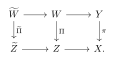
Proposition 22.1.53.E7009D90BCC6 Let $\pi \colon Y\rightarrow X$ be a proper bimeromorphic morphism from a compact Kähler manifold $Y$. Then all definitions in this section are invariant under pullback to $Y$.
The meaning is clear in most cases. In the case of the trace operator, this means the following: Suppose that $Z\subseteq X$ is an analytic subset and $\Gamma \in \mathrm{PSH}^{\mathrm{NA}}(X,\theta )$ has non-trivial restriction to $Z$. Suppose that $Z$ is not contained in the non-isomorphism locus of $\pi $ so that the strict transform $W$ of $Z$ is defined. If we write $\Pi \colon W\rightarrow Z$ for the restriction of $\pi $ and $\widetilde{\Pi }\colon \widetilde{W}\rightarrow \widetilde{Z}$ the strict transform of $\Pi $, then we have
\[ \widetilde{\Pi }^* \operatorname{Tr}_ Z(\Gamma )=\operatorname{Tr}_ W(\pi ^*\Gamma ). \]
The relevant notations are summarized in the following diagram:
Proof.
We only prove the assertion for the trace operator, as the other proofs are similar.
We shall use the notations above. Observe that for any closed positive smooth $(1,1)$-form $\omega $ on $X$ with positive mass, we have
\[ \left(\widetilde{\Pi }^* \operatorname{Tr}_ Z(\Gamma )\right)_{\max }=\left( \operatorname{Tr}_ Z(\Gamma )\right)_{\max }=\sup \left\{ \tau <\Gamma _{\max }: \nu \left(\Gamma ^{\theta +\omega }_{\tau },Z\right)=0 \right\} , \]
and
\[ \begin{aligned} \left(\operatorname{Tr}_ W(\pi ^*\Gamma )\right)_{\max }=& \sup \left\{ \tau <\Gamma _{\max }: \nu \left((\pi ^*\Gamma )^{\pi ^*\theta +\pi ^*\omega }_{\tau },W\right)=0 \right\} \\ =& \sup \left\{ \tau <\Gamma _{\max }: \nu \left(\pi ^*\Gamma ^{\theta +\omega }_{\tau },W\right)=0 \right\} \\ =& \sup \left\{ \tau <\Gamma _{\max }: \nu \left(\Gamma ^{\theta +\omega }_{\tau },Z\right)=0 \right\} . \end{aligned} \]
Here we implicitly used proposition 22.1.17. Therefore,
\[ \left(\widetilde{\Pi }^* \operatorname{Tr}_ Z(\Gamma )\right)_{\max }=\left(\operatorname{Tr}_ W(\pi ^*\Gamma )\right)_{\max }. \]
Let $\tau \in \mathbb {R}$ be less than this common value. Take a Kähler form $\omega _{\widetilde{Z}}$ (resp. $\omega _{\widetilde{W}}$) on $\widetilde{Z}$ (resp. $\widetilde{W}$). Take a Kähler form $\omega _ Y$ on $Y$ (resp. $\omega _ X$ on $X$) such that
\[ \omega _{\widetilde{Z}}\geq \omega _ X|_{\widetilde{Z}},\quad \omega _{\widetilde{W}} \geq \omega _ Y|_{\widetilde{W}},\quad \omega _ Y \geq \pi ^*\omega _ X. \]
We want to show that, after projection to the common background $(\pi ^*\theta )|_{\widetilde{W}}+\omega _{\widetilde{W}}$,
\[ P_{(\pi ^*\theta )|_{\widetilde{W}}+\omega _{\widetilde{W}}}\left[\widetilde{\Pi }^*\left(\operatorname{Tr}_ Z(\Gamma )^{\theta |_{\widetilde{Z}}+\omega _{\widetilde{Z}}}_\tau \right)\right]_{\mathcal I} \sim _ P \left(\operatorname{Tr}_ W(\pi ^*\Gamma )\right)^{(\pi ^*\theta )|_{\widetilde{W}}+\omega _{\widetilde{W}}}_\tau . \]
Unfolding the definitions, we reduce to
\[ \widetilde{\Pi }^* \operatorname{Tr}_ Z^{\theta +\omega _ X}\left( \Gamma ^{\theta +\omega _ X}_{\tau } \right)\sim _ P \operatorname{Tr}_{W}^{\pi ^*\theta +\omega _ Y}\left( \left( \pi ^*\Gamma \right)^{\pi ^*\theta +\omega _ Y}_{\tau }\right). \]
Using proposition 20.2.21, this is equivalent to
\[ \widetilde{\Pi }^* \operatorname{Tr}_ Z\left( \Gamma ^{\theta +\omega _ X}_{\tau } \right)\sim _ P \operatorname{Tr}_{W}\left( \left( \pi ^*\Gamma \right)^{\pi ^*\theta +\pi ^*\omega _ X}_{\tau }\right). \]
This is a consequence of 20.2.24.
$\square$
 Pome
Pome
Comments
Corrections, questions, and mathematical discussion are welcome. Sign in with GitHub to comment. Comments are public.