Definition 20.1.14.165D43352903 Let $T$ be a closed positive $(1,1)$-current on $X$. Given any modification $\pi \colon Y\rightarrow X$, we define
11.3
\begin{equation} \mathbb {D}(T)_ Y\coloneqq \left\{ \operatorname{Reg}\pi ^*T \right\} \in \mathrm{H}^{1,1}(Y,\mathbb {R}). \end{equation}
We call $\mathbb {D}(T)$ the b-divisor of $T$.
This assignment is compatible with push-forwards. Indeed, if $g\colon Z\to Y$ is a modification and $\pi \colon Y\to X$, then
\[ g_*\operatorname{Reg}\bigl (g^*\pi ^*T\bigr )=\operatorname{Reg}(\pi ^*T) \]
by Siu's decomposition and 18.1.38. Hence
\[ g_*\mathbb D(T)_ Z=\mathbb D(T)_ Y. \]
Thus $\mathbb D(T)$ is a Weil b-divisor.
We observe that if $T'$ is another closed positive $(1,1)$-current on $X$ and $\lambda \geq 0$, then
\[ \mathbb {D}(T+T')=\mathbb {D}(T)+\mathbb {D}(T'),\quad \mathbb {D}(\lambda T)=\lambda \mathbb {D}(T). \]
We shall use these identities implicitly in the sequel.
Note that when $T$ has analytic singularities, $\mathbb {D}(T)$ is Cartier.
Theorem 20.1.15.6EB1B4E1D222 Let $T$ be a closed positive $(1,1)$-current on $X$. Then $\mathbb {D}(T)$ is nef. Moreover,
1D610D16E240
20.1.16
\begin{equation} \operatorname{vol}T=\operatorname{vol}\mathbb {D}(T). \end{equation}
Proof.
Let $\omega $ be a Kähler form on $X$.
Step 1. Reduce to the case where $T$ is a Kähler current.
Note that $\mathbb {D}(\omega )$ is the Cartier b-divisor realized by $(X,\{ \omega \} )$. The b-divisors $\mathbb {D}(T+\epsilon \omega )=\mathbb {D}(T)+\epsilon \mathbb {D}(\omega )$ decrease to $\mathbb {D}(T)$ as $\epsilon \searrow 0$. Hence, by 20.1.7 and proposition 18.1.27, it suffices to prove our assertion with $T+\epsilon \omega $ in place of $T$.
Step 2. We prove the assertion under the additional assumption that $T$ has analytic singularities.
Let $\pi \colon Y\rightarrow X$ be a modification so that
\[ \pi ^*T=[D]+R, \]
where $D$ is an effective $\mathbb {Q}$-divisor on $Y$ and $R$ is a closed positive $(1,1)$-current with locally bounded potentials. See theorem 5.18.8 for the existence of $\pi $. Then $\mathbb {D}(T)$ is the nef Cartier b-divisor realized by $(\pi ,\{ R\} )$. Note that (20.1.16) is immediate in this case.
Step 3. We prove the assertion for a general Kähler current $T$. Next, take a closed smooth real $(1,1)$-form $\theta $ in the cohomology class of $T$ and write $T=\theta _{\varphi }$ for some $\varphi \in \mathrm{PSH}(X,\theta )$. Since $T$ is a Kähler current, we choose the quasi-equisingular approximation $(\varphi _ j)_ j$ of $\varphi $ so that, after discarding finitely many terms, each $\theta +\mathrm{dd}^{\mathrm{c}}\varphi _ j$ is a Kähler current. This is possible by Demailly regularization, in the form used in the proof of theorem 18.1.2. We claim that
35EFEAF9683D
20.1.17
\begin{equation} \mathbb {D}(\theta +\mathrm{dd}^{\mathrm{c}}\varphi _ j)\to \mathbb {D}(\theta +\mathrm{dd}^{\mathrm{c}}\varphi ). \end{equation}
By definition of this convergence, we need to establish the following: for every modification $\pi \colon Y\rightarrow X$, we have
\[ \left\{ \operatorname{Reg}\left(\pi ^*(\theta +\mathrm{dd}^{\mathrm{c}}\varphi _ j)\right)\right\} \to \left\{ \operatorname{Reg}\left(\pi ^*(\theta +\mathrm{dd}^{\mathrm{c}}\varphi )\right)\right\} . \]
This follows immediately from theorem 16.9.55 if $\operatorname{Sing}(\pi ^*T)$ has only finitely many components.
Fix a Kähler form $\omega _ Y$ on $Y$. We want to show that for any $\epsilon >0$, we can find $j_0>0$ so that when $j\geq j_0$,
725B7EF61286
20.1.18
\begin{equation} \left\{ \operatorname{Reg}\left(\pi ^*(\theta +\mathrm{dd}^{\mathrm{c}}\varphi _ j)\right)\right\} \leq \left\{ \operatorname{Reg}\left(\pi ^*(\theta +\mathrm{dd}^{\mathrm{c}}\varphi )\right)\right\} +\epsilon \{ \omega _ Y\} . \end{equation}
Write the divisorial part of $\pi ^*\theta +\mathrm{dd}^{\mathrm{c}}\pi ^*\varphi _ j$ and $\pi ^*\theta +\mathrm{dd}^{\mathrm{c}}\pi ^*\varphi $ as
\[ \sum _{i=1}^{\infty }a_ i^ j [E_ i],\quad \sum _{i=1}^{\infty }a_ i [E_ i]. \]
Then $a_ i^ j\leq a_ i$.
We can find an integer $N>0$ large enough so that, in the pseudo-effective order of cohomology classes,
\[ \sum _{i=N+1}^{\infty }a_ i \{ E_ i\} \leq \frac{\epsilon }{2}\{ \omega _ Y\} . \]
By theorem 16.9.55, we can take $j_0$ large enough so that for $j>j_0$,
\[ \sum _{i=1}^{N}(a_ i-a_ i^ j)\{ E_ i\} \leq \frac{\epsilon }{2}\{ \omega _ Y\} . \]
Then (20.1.18) follows, and (20.1.17) is established.
As a consequence, $\mathbb {D}(T)$ is nef and the volume can be computed using 20.1.7:
\[ \operatorname{vol}\mathbb {D}(T)=\lim _{j\to \infty }\operatorname{vol}\mathbb {D}\left( \theta +\mathrm{dd}^{\mathrm{c}}\varphi _ j \right)=\lim _{j\to \infty }\operatorname{vol}\left(\theta +\mathrm{dd}^{\mathrm{c}}\varphi _ j\right)=\operatorname{vol}T. \]
Hence, (20.1.16) follows.
$\square$
Conversely, we want to realize nef b-divisors as $\mathbb {D}(T)$. We first prove a continuity result.
Proposition 20.1.19.87D0CCEB6DF9 Let $\theta $ be a closed real smooth $(1,1)$-form on $X$, let $(\varphi _ i)_{i\in I}$ be a net in $\mathrm{PSH}(X,\theta )$, and let $\varphi \in \mathrm{PSH}(X,\theta )$. If $\varphi _ i\xrightarrow {d_ S}\varphi $, then
64E2A79320D9
20.1.20
\begin{equation} \mathbb {D}\left(\theta _{\varphi _ i}\right)\to \mathbb {D}\left(\theta _{\varphi }\right). \end{equation}
Proof.
Fix a modification $\pi \colon Y\rightarrow X$. Fix a Kähler form $\omega $ on $X$. It suffices to establish the following:
808CB322D92D
20.1.21
\begin{equation} \mathbb {D}\left(\theta _{\varphi _ i}\right)_ Y\to \mathbb {D}\left(\theta _{\varphi }\right)_ Y. \end{equation}
As a map from the pseudometric space $\mathrm{PSH}(X,\theta )$ to the finite-dimensional Euclidean space $\mathrm{H}^{1,1}(Y,\mathbb {R})$, the continuity of $\mathbb {D}(\bullet )_ Y$ can be tested on sequences. Thus, without loss of generality, we may assume that $(\varphi _ i)_ i$ is a sequence and $I=\mathbb {Z}_{>0}$. It is enough to prove that every subsequence has a further subsequence for which (20.1.22) holds.
By corollary 16.9.11, $\pi ^*\varphi _ i\xrightarrow {d_ S}\pi ^*\varphi $. Hence it suffices to prove the claim on $Y$, so we may assume that $\pi $ is the identity. Therefore, we are reduced to the following assertion:
762B9BFFA0ED
20.1.22
\begin{equation} \left\{ \operatorname{Reg}\theta _{\varphi _ i} \right\} \to \left\{ \operatorname{Reg}\theta _{\varphi } \right\} . \end{equation}
After adding a Kähler form to $\theta $, we may also assume that $\theta _{\varphi }$ is a Kähler current. By theorem 16.9.49, replacing all potentials by their $\mathcal{I}$-envelopes does not change the divisorial parts and preserves $d_ S$-convergence. The masses are then bounded from below along a tail, so after passing to a subsequence proposition 16.9.17 supplies increasing and decreasing envelopes $\eta _ i\leq \varphi _ i\leq \psi _ i$ which both converge to $\varphi $ in $d_ S$. Since
\[ \mathbb {D}(\theta _{\eta _ i})_ X\leq \mathbb {D}(\theta _{\varphi _ i})_ X\leq \mathbb {D}(\theta _{\psi _ i})_ X, \]
it is enough to treat the case where $(\varphi _ i)_ i$ is monotone.
Write the divisorial parts of $\theta _{\varphi _ i}$ and $\theta _{\varphi }$ as
\[ \sum _{m=1}^{\infty }a_ m^ i[D_ m],\quad \sum _{m=1}^{\infty }a_ m[D_ m]. \]
By theorem 16.9.55, $a_ m^ i\to a_ m$ for each fixed $m$. If $(\varphi _ i)_ i$ is decreasing, then $a_ m^ i\leq a_ m$ for all $i,m$. The finite-tail argument in the proof of (20.1.18) then gives
\[ \left\{ \operatorname{Reg}\theta _{\varphi }\right\} \leq \left\{ \operatorname{Reg}\theta _{\varphi _ i}\right\} \leq \left\{ \operatorname{Reg}\theta _{\varphi }\right\} +\epsilon \{ \omega \} \]
for all sufficiently large $i$.
If $(\varphi _ i)_ i$ is increasing, then $a_ m\leq a_ m^ i\leq a_ m^1$. We first choose $N$ so that the tails of both $\sum _ m a_ m[D_ m]$ and $\sum _ m a_ m^1[D_ m]$ are at most $(\epsilon /3)\{ \omega \} $ in the pseudo-effective order. The convergence of the finitely many coefficients $a_ m^ i$, $m\leq N$, then gives
\[ \left\{ \operatorname{Reg}\theta _{\varphi _ i}\right\} \leq \left\{ \operatorname{Reg}\theta _{\varphi }\right\} \leq \left\{ \operatorname{Reg}\theta _{\varphi _ i}\right\} +\epsilon \{ \omega \} \]
for all sufficiently large $i$. This proves (20.1.22).
$\square$
Lemma 20.1.23.476687DD2394 Let $\pi \colon X\rightarrow Z$ be a proper bimeromorphic morphism from $X$ to a Kähler manifold $Z$. Consider non-divisorial closed positive $(1,1)$ currents $T,S$ on $X$ in the same cohomology class. If $T\preceq _{\mathcal{I}} S$, then $\pi _*T\preceq _{\mathcal{I}} \pi _*S$.
Proof.
By Hironaka's Chow lemma theorem 9.10.8 and 16.8.26, we may assume that $\pi $ is a modification.
By 18.1.38,
\[ \pi ^*\pi _*T=T+F_ T,\quad \pi ^*\pi _*S=S+F_ S, \]
where $F_ T$ and $F_ S$ are effective $\pi $-exceptional divisors. Since $\{ T\} =\{ S\} $, the exceptional divisors $F_ T$ and $F_ S$ have the same cohomology class. Factoring $\pi $ into blow-ups and using proposition 20.1.2 at each step, the classes of $\pi $-exceptional prime divisors are linearly independent in the relative cohomology; hence $F_ T=F_ S$. It follows that
\[ \pi ^*\pi _*T=T+F_ T\preceq _{\mathcal{I}}S+F_ S=\pi ^*\pi _*S. \]
Our assertion then follows from 16.8.26.
$\square$
Theorem 20.1.24.EA1E72841C6D Each big and nef b-divisor $\mathbb {D}$ over $X$ can be realized as $\mathbb {D}(T)$ for some $T\in \mathbb {D}_ X$. Furthermore, we may always assume that $T$ is $\mathcal{I}$-good.
Note that $T$ is not unique. The current $T$ is necessarily non-divisorial.
Proof.
Fix a big and nef b-divisor $\mathbb {D}$ over $X$.
For each $\pi \colon Y\rightarrow X$, we take a current with minimal singularities $T_ Y$ in $\mathbb {D}_ Y$. We claim that $\mathbb {D}(\pi _*T_ Y)$ coincides with $\mathbb {D}$ up to the level of $Y$: For any modification $\pi '\colon Z\rightarrow X$ dominated by $\pi $ through a morphism $g\colon Y\rightarrow Z$, we have
\[ \mathbb {D}_ Z=\mathbb {D}(\pi _*T_ Y)_ Z. \]
The notations are summarized in the following commutative diagram:
After unfolding the definitions, this means
\[ \operatorname{Reg}(\pi '^*\pi _*T_ Y)\in \mathbb {D}_ Z. \]
Note that
\[ \operatorname{Reg}(\pi '^*\pi _*T_ Y)=\operatorname{Reg}(\pi '^* \pi '_* g_*T_ Y). \]
Due to proposition 5.19.17 and proposition 16.6.17, we know that $\mathbb {D}_ Y$ is modified nef and big. In particular, $T_ Y$ is non-divisorial, hence so is $g_*T_ Y$ by 5.19.18. It follows from 18.1.38 that
\[ \operatorname{Reg}(\pi '^* \pi '_* g_*T_ Y)=\operatorname{Reg}(g_*T_ Y)=g_*T_ Y\in \mathbb {D}_ Z. \]
Note that
6E5120AB2EE3
20.1.26
\begin{equation} \operatorname{vol}T_ Y\geq \operatorname{vol}\mathbb {D}>0. \end{equation}
Next we claim that the $P$-singularity types of the net $(\pi _*T_ Y)_ Y$ form a decreasing net.
To see this, let us fix a diagram as (20.1.25). We need to show that
\[ \pi _*T_ Y\preceq _ P \pi '_*T_ Z. \]
Since $T_ Z$ has minimal singularities, we have $g_*T_ Y\preceq _{\mathcal{I}} T_ Z$. In particular, 20.1.23 guarantees that $\pi _*T_ Y\preceq _{\mathcal{I}} \pi '_*T_ Z$. But by corollary 18.1.41 and example 18.1.11, both $\pi _*T_ Y$ and $\pi '_*T_ Z$ are $\mathcal{I}$-good, so there is no difference between the $P$-preorder and the $\mathcal{I}$-preorder in this case. Our assertion follows.
Next observe that the net $(\pi _*T_ Y)_ Y$ is decreasing with respect to the $P$-preorder and has a $d_ S$-limit as a consequence of (20.1.26) and corollary 16.9.24. Take a closed positive $(1,1)$-current $T\in \mathbb {D}_ X$ such that
\[ \pi _*T_ Y\xrightarrow {d_ S}T. \]
It follows from proposition 20.1.19 that
\[ \mathbb {D}(\pi _*T_ Y)\to \mathbb {D}(T). \]
Therefore, we conclude that
\[ \mathbb {D}(T)=\mathbb {D}. \]
Thanks to theorem 20.1.15, $\operatorname{vol}T>0$. Write $T=\theta +\mathrm{dd}^{\mathrm{c}}\varphi $ for some $\varphi \in \mathrm{PSH}(X,\theta )$, then
\[ T'\coloneqq \theta +\mathrm{dd}^{\mathrm{c}}P_{\theta }[\varphi ]_{\mathcal{I}} \]
is $\mathcal{I}$-good, non-divisorial and $\mathbb {D}(T')=\mathbb {D}(T)$.
$\square$
Corollary 20.1.27.362BC48145F6 Let $\mathbb {D}$ be a b-divisor over $X$. Then the following are equivalent:
8A20F7F86FDD
$\mathbb {D}$ is nef;
DB94EB61358E
for each modification $\pi \colon Y\rightarrow X$, the class $\mathbb {D}_ Y$ is modified nef.
Proof.
1 $\implies $ 2. Suppose that 1 holds. Fix a modification $\pi \colon Y\rightarrow X$. Then we need to show that $\mathbb {D}_ Y$ is modified nef. Since modified nefness is a closed condition, after approximating $\mathbb {D}$ by nef Cartier b-divisors, we may assume that $\mathbb {D}$ itself is a nef Cartier b-divisor. We can then find a modification $\pi '\colon Z\rightarrow X$ dominating $\pi $ so that $\mathbb {D}$ is realized by a nef class $\alpha $ on $Z$. Then $\mathbb {D}_ Y$ is nothing but the pushforward of $\alpha $, and hence modified nef thanks to proposition 5.19.17.
2 $\implies $ 1. Suppose that 2 holds. We need to show that $\mathbb {D}$ is nef. Fix a Kähler form $\omega $ on $X$. It suffices to show that $\mathbb {D}+\epsilon \mathbb {D}(\omega )$ is nef for each $\epsilon >0$. After replacing $\mathbb {D}$ by the latter, we may further assume that $\mathbb {D}_ Y$ is big for each modification $\pi \colon Y\rightarrow X$, and $\operatorname{vol}\mathbb {D}_ Y$ has a uniform positive lower bound. In this case, the argument of theorem 20.1.24 shows that $\mathbb {D}=\mathbb {D}(T)$ for some closed positive $(1,1)$-current in $\mathbb {D}_ X$. Therefore, $\mathbb {D}$ is nef, thanks to theorem 20.1.15.
$\square$
Let $\alpha $ be a modified nef class on $X$. We write $\mathcal{G}(\alpha )$ for the set of closed positive $(1,1)$-currents $T$ on $X$ with $T=\operatorname{Reg}T\in \alpha $ and $\operatorname{vol}T>0$.
Theorem 20.1.28.C3EFB85C68F6 There is a natural bijection from $\mathcal{G}(\alpha )/\sim _{\mathcal{I}}$ to the set of big and nef b-divisors $\mathbb {D}$ over $X$ with $\mathbb {D}_ X=\alpha $.
Proof.
Given $T\in \mathcal{G}(\alpha )$, we associate the b-divisor $\mathbb {D}(T)$. It is big and nef due to theorem 20.1.15. This map clearly descends to $\mathcal{G}(\alpha )/\sim _{\mathcal{I}}$.
This map is surjective by theorem 20.1.24. Now we show that it is injective. Let $T,T'\in \mathcal{G}(\alpha )$. Assume that $\mathbb {D}(T)=\mathbb {D}(T')$, we want to show that $T\sim _{\mathcal{I}} T'$.
Let $E$ be a prime divisor over $X$, it suffices to show that
79F72595C6AE
20.1.29
\begin{equation} \nu (T,E)=\nu (T',E). \end{equation}
We may assume that $E$ is not a prime divisor on $X$, as otherwise both sides vanish.
Choose a sequence of blow-ups with smooth connected centers
\[ Y\coloneqq X_ k\rightarrow X_{k-1}\rightarrow \cdots \rightarrow X_0\coloneqq X \]
so that $E$ is a prime divisor on $Y$, exceptional with respect to $X_ k\rightarrow X_{k-1}$. Denote the composition by $\pi \colon Y\rightarrow X$. Thanks to proposition 20.1.2,
\[ \mathrm{H}^{1,1}(X_ k,\mathbb {R})=\mathrm{H}^{1,1}(X_{k-1},\mathbb {R})\oplus \mathbb {R}\{ E_ k\} , \]
where $E_ k=E$ is the exceptional divisor of $X_ k\rightarrow X_{k-1}$.
By induction,
\[ \mathrm{H}^{1,1}(Y,\mathbb {R})=\mathrm{H}^{1,1}(X,\mathbb {R})\oplus \bigoplus _{i=1}^{k} \mathbb {R} \{ E_ i\} , \]
where $E_ i$ is the exceptional divisor of $X_ i\rightarrow X_{i-1}$. Now by 18.1.38,
F7913C6F4559
20.1.30
\begin{equation} \operatorname{Reg}\pi ^*T=\pi ^*T-\sum _{i=1}^ k \nu (T,E_ i)[E_ i]. \end{equation}
In particular, the cohomology class of $\operatorname{Reg}\pi ^*T$ determines $\nu (T,E)$. Hence, (20.1.29) follows.
$\square$
Corollary 20.1.31.1D8C494FD558 The set of nef b-divisors over $X$ with root $\alpha $ can be naturally identified with
\[ \varprojlim _{\omega } \left( \mathcal{G}(\alpha +\omega )/\sim _{\mathcal{I}} \right), \]
where $\omega $ runs over the directed set of Kähler forms on $X$ (with respect to the preorder of reverse domination), and given two Kähler forms $\omega \leq \omega '$ the transition map
\[ \mathcal{G}(\alpha +\omega )/\sim _{\mathcal{I}}\rightarrow \mathcal{G}(\alpha +\omega ')/\sim _{\mathcal{I}} \]
is induced by the map $\mathcal{G}(\alpha +\omega )\rightarrow \mathcal{G}(\alpha +\omega ')$ sending $T$ to $T+\omega '-\omega $.
Proof.
For each Kähler form $\omega $, theorem 20.1.28 identifies $\mathcal G(\alpha +\omega )/\sim _{\mathcal I}$ with the set of big and nef b-divisors whose root on $X$ is $\alpha +\{ \omega \} $. The transition map is exactly addition of $\mathbb D(\omega '-\omega )$. Passing to the inverse limit gives precisely nef b-divisors with root $\alpha $.
$\square$
It is tempting to extend these results to more general currents, not necessarily non-divisorial ones. For this purpose, we introduce the following definition:
Definition 20.1.32.AB54064E3778 An augmented nef b-divisor over $X$ is a pair $(\mathbb {D},D)$, where
581F18AC54FD
$\mathbb {D}$ is a nef b-divisor over $X$;
96DE0B4EFD35
$D$ is a formal sum
\[ D=\sum _{E} c_ E E,\quad c_ E\in \mathbb {R}_{\geq 0}, \]
where $E$ runs over the set of prime divisors on $X$,
such that the following condition is satisfied:
\[ \sum _{E}c_ E \{ E\} \]
is convergent as a sum in $\mathrm{H}^{1,1}(X,\mathbb {R})$.
The cohomology class of $(\mathbb {D},D)$ is defined as
\[ \mathbb {D}_ X+\sum _{E}c_ E \{ E\} \in \mathrm{H}^{1,1}(X,\mathbb {R}). \]
The volume of $(\mathbb {D},D)$ is defined as
\[ \operatorname{vol}(\mathbb {D},D)=\operatorname{vol}\mathbb {D}. \]
Recall that we defined $\mathcal{Z}_+(X,\alpha )$ as the set of closed positive $(1,1)$-currents $T\in \alpha $ in definition 5.19.3. We introduce a further notation here:
\[ \mathcal{Z}_+(X,\alpha )_{>0}\coloneqq \left\{ T\in \mathcal{Z}_+(X,\alpha ): \operatorname{vol}T>0\right\} . \]
Corollary 20.1.33.F249270AD497 There is a canonical bijection between the following sets:
3563A85C2134
The set $\mathcal{Z}_+(X,\alpha )_{>0}/\sim _{\mathcal{I}}$;
B8F46AEB80BF
the set of augmented nef b-divisors over $X$ with positive volume with cohomology class $\alpha $.
More precisely, given a current $T\in \mathcal{Z}_+(X,\alpha )_{>0}$, we associate $(\mathbb {D},D)$ as follows:
\[ \mathbb {D}=\mathbb {D}(T),\quad D=\sum _ E \nu (T,E)E, \]
where $E$ runs over the set of prime divisors on $X$.
Proof.
This is a direct consequence of theorem 20.1.28 and Siu's decomposition 5.19.12.
$\square$
In fact, corollary 20.1.33 can also be reformulated in an elementary manner, without referring to b-divisors at all. Suppose that we are given a big cohomology class $\alpha $ on $X$ and a non-negative real number $c_ E$ for each prime divisor $E$ over $X$. A natural question is: When is there a closed positive $(1,1)$-current $T\in \alpha $ with positive volume such that $\nu (T,E)=c_ E$ for every $E$? Then corollary 20.1.33 says that $T$ exists if and only if the following two conditions hold:
D223F2001058
\[ \lim _{\pi \colon Y\rightarrow X} \operatorname{vol}\left( \pi ^*\alpha -\sum _{E\subseteq Y} c_ E \{ E\} \right)>0{}^{\href{#sgpt-a0000097338}{1}}, \]
where $\pi $ runs over all modifications of $X$;
5A99823F6D1A
for each modification $\pi \colon Y\rightarrow X$, the class $ \pi ^*\alpha -\sum _{E\subseteq Y} c_ E \{ E\} $ is modified nef.
Similarly, we have the following generalization of corollary 20.1.31.
Corollary 20.1.34.5108D6DF4DAE There is a canonical bijection between the following two sets:
43F5185C6427
The set of
\[ \varprojlim _{\omega } \left( \mathcal{Z}_+(X,\alpha +\omega )_{>0}/\sim _{\mathcal{I}} \right), \]
where $\omega $ runs over the directed set of Kähler forms on $X$;
11B8881EEBEC
the set of augmented nef b-divisors over $X$ with cohomology class $\alpha $.
Proof.
Apply corollary 20.1.31 to the non-divisorial parts and use Siu's decomposition on $X$ to record the divisorial part. The convergence condition in definition 20.1.32 is exactly the condition that the roots of the non-divisorial parts converge to the prescribed cohomology class $\alpha $.
$\square$
Corollary 20.1.35.DF4E1BF96D34 Let $\mathbb {D}$ be a Cartier b-divisor over $X$. Then $\mathbb {D}$ is nef in the sense of definition 20.1.11 if and only if it is nef in the sense of definition 20.1.12.
Proof.
We only handle the nontrivial implication. Assume that $\mathbb {D}$ is nef in the sense of definition 20.1.12. We want to show that $\mathbb {D}$ is nef in the sense of definition 20.1.11. After replacing $X$ by a realization of $\mathbb {D}$, we may assume that $\mathbb {D}$ is realized by $(X,\alpha )$ for some cohomology class $\alpha \in \mathrm{H}^{1,1}(X,\mathbb {R})$.
We first assume that $\mathbb {D}$ is big. Choose a non-divisorial closed positive $(1,1)$-current $T$ on $X$ such that $\mathbb {D}=\mathbb {D}(T)$. Now $\mathbb {D}=\mathbb {D}(T)$ means that for each modification $\pi \colon Y\rightarrow X$, the current $\pi ^*T$ is non-divisorial. In particular, $T$ has vanishing generic Lelong number along each prime divisor over $X$, see (20.1.30). Equivalently, $T$ has vanishing Lelong number everywhere. By Demailly's regularization theorem, a pseudo-effective class carrying a positive current with vanishing Lelong number at every point is nef. Hence $\alpha =\{ T\} $ is nef.
In the general case, fix a Kähler form $\omega $ on the realization of $\mathbb {D}$. For every $\epsilon >0$, the Cartier b-divisor $\mathbb {D}+\epsilon \mathbb {D}(\omega )$ is big and nef in the sense of definition 20.1.12, hence is nef in the sense of definition 20.1.11 by the big case. Thus $\alpha +\epsilon \{ \omega \} $ is nef for all $\epsilon >0$, and the closedness of the nef cone shows that $\alpha $ is nef.
$\square$
Corollary 20.1.36.BF517753D33B Let $T$ and $T'$ be non-divisorial closed positive $(1,1)$-currents on $X$. Suppose that $\{ T\} =\{ T'\} $. Then the following are equivalent:
5014A568828A
$\mathbb {D}(T)\leq \mathbb {D}(T')$;
16D6081BA03D
$T\preceq _{\mathcal{I}}T'$.
Proof.
Let $E$ be a prime divisor over $X$. Choose a sequence of blow-ups with smooth connected centers as in the proof of theorem 20.1.28, so that $E$ appears as one of the exceptional prime divisors on the resulting model $\pi \colon Y\rightarrow X$. By (20.1.30), the difference
\[ \mathbb {D}(T')_ Y-\mathbb {D}(T)_ Y \]
is represented in the relative cohomology by
\[ \sum _ i\left(\nu (T,E_ i)-\nu (T',E_ i)\right)\{ E_ i\} . \]
Using proposition 20.1.2 inductively, or equivalently the negativity lemma for exceptional classes, pseudo-effectivity of this exceptional class is equivalent to the non-negativity of all coefficients. Hence $\mathbb {D}(T)\leq \mathbb {D}(T')$ is equivalent to
\[ \nu (T,E)\geq \nu (T',E) \]
for every prime divisor $E$ over $X$, which is exactly $T\preceq _{\mathcal{I}}T'$ by proposition 16.8.9.
$\square$
Corollary 20.1.37.926F05B89741 Let $\mathbb {D}$ be a nef b-divisor over $X$. Then there is a decreasing sequence of nef and big Cartier b-divisors $\mathbb {D}_ i$ over $X$ with limit $\mathbb {D}$.
Proof.
Take a Kähler form $\omega $ on $X$. By theorem 20.1.24, for each $i>0$, we can find a non-divisorial Kähler current $T_ i\in \mathbb {D}_ X+i^{-1}\{ \omega \} $ such that
\[ \mathbb {D}(T_ i)=\mathbb {D}+i^{-1}\mathbb {D}(\omega ). \]
We observe that $T_ i$ and $T_{i+1}$ have the same $\mathcal{I}$-singularity type. Indeed, applying corollary 20.1.36 to $T_ i$ and $T_{i+1}+(i^{-1}-(i+1)^{-1})\omega $ shows that these two currents are $\mathcal{I}$-equivalent; adding the smooth form does not change the singularity type. Let $(T_ i^ j)_ j$ be quasi-equisingular approximations of $T_ i$ such that
7B39195D3D69
$T_ i^ j$ is a Kähler current in $\mathbb {D}_ X+i^{-1}\{ \omega \} $ for $j\geq j_0(i)$, and
CD8709C3E97A
for each fixed $j$, the singularity type of $T_ i^ j$ is independent of $i$.
Note that 2 is possible by using the Bergman kernel construction of the quasi-equisingular approximations, since the $T_ i$'s have the same multiplier ideals.
For fixed $j$, the b-divisor
\[ \mathbb {B}_ j\coloneqq \mathbb {D}(T_ i^ j)-i^{-1}\mathbb {D}(\omega ) \]
is independent of $i$. Since the quasi-equisingular approximations are decreasing in $j$, the sequence $(\mathbb {B}_ j)_ j$ is decreasing, and proposition 20.1.19 gives $\mathbb {B}_ j\to \mathbb {D}$. It suffices to take $\mathbb {D}_ i=\mathbb {B}_{j_ i}+i^{-1}\mathbb {D}(\omega )=\mathbb {D}(T_ i^{j_ i})$, where $j_ i$ is chosen to be a sufficiently fast increasing sequence of positive integers with $j_ i\geq j_0(i)$.
$\square$
 Pome
Pome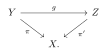
Comments
Corrections, questions, and mathematical discussion are welcome. Sign in with GitHub to comment. Comments are public.