We will fix $n\in \mathbb {N}$ and a domain $\Omega $ (a connected open subset) in $\mathbb {C}^ n$.
Definition 5.8.1.6070D2D83EC6 When $n\geq 1$, a plurisubharmonic function on $\Omega $ is a function $\varphi \colon \Omega \rightarrow [-\infty ,\infty )$ satisfying the following three conditions:
1E4DADA74A2A
$\varphi \not\equiv -\infty $;
62EDD3578A72
$\varphi $ is upper semicontinuous;
B250529A16B9
for any complex line $L\subseteq \mathbb {C}^ n$ and any connected component $U$ of $L\cap \Omega $, the restriction $\varphi |_ U$ is either subharmonic or constantly $-\infty $.1
When $n=0$, the only domain $\Omega $ is the singleton. In this case, a plurisubharmonic function on $\Omega $ is a real-valued function on $\Omega $.
The set of plurisubharmonic functions on $\Omega $ is denoted by $\mathrm{PSH}(\Omega )$.
A plurisubharmonic function is also called a psh function for short. The relevant notations are indicated in 5.13.5.2
B2EF8B3CC1DB5.13.5 A domain $\Omega $ cut by a complex line $L$.
Example 5.13.6.DD77B8A4B7A7 When $n=0$, we have a canonical bijection $\mathrm{PSH}(\Omega )\cong \mathbb {R}$.
Example 5.13.7.1C9711BBE591When $n=1$, we have $\mathrm{PSH}(\Omega )=\mathrm{SH}(\Omega )$.
Similar to theorem 5.13.3, we have a rigidity theorem for plurisubharmonic functions as well.
Theorem 5.13.8.2CB6F65A67EE Let $\varphi \colon \Omega \rightarrow [-\infty ,\infty )$ be a measurable function. Then the following are equivalent:
AD9F1D874ACA
$\varphi $ is locally integrable and $\mathrm{dd}^{\mathrm{c}}\varphi \geq 0$;
B21823D3C183
$\varphi $ coincides almost everywhere with a plurisubharmonic function $\psi $ on $\Omega $.
Moreover, the plurisubharmonic function $\psi $ is unique.
Proof. In positive dimension, regard a locally integrable $\varphi$ as a real distribution. If $\mathrm{dd}^{\mathrm c}\varphi\geq0$, the plurisubharmonic representative theorem supplies a plurisubharmonic function $\psi$ representing this distribution, hence equal to $\varphi$ almost everywhere. Conversely, that theorem proves local integrability and positivity of $\mathrm{dd}^{\mathrm c}\psi$ for every plurisubharmonic $\psi$; these properties are unchanged by almost-everywhere equality.
Uniqueness follows from the shrinking-ball formula for the subharmonic representative. This is essential: an arbitrary pointwise representative of a positive distribution need not itself be plurisubharmonic. In dimension zero the domain is a point, with its counting measure; local integrability is finiteness, so both conditions simply say that the value is finite.
Here, the operator $\mathrm{dd}^{\mathrm{c}}$ is normalized so that
For the proof, we refer to [Proposition 1.43, GZ17].
Plurisubharmonic functions have nice functorialities:
Proposition 5.13.9.5DCB508EA9AD Let $n'\in \mathbb {N}$ and $\Omega '\subseteq \mathbb {C}^{n'}$ be a domain. Given any holomorphic map $f\colon \Omega \rightarrow \Omega '$ and any $\varphi \in \mathrm{PSH}(\Omega ')$, exactly one of the following cases occurs:
11DBE4FA0035
$f^*\varphi \equiv -\infty $;
EEDAC90E09ED
$f^*\varphi \in \mathrm{PSH}(\Omega )$.
Proof. For positive source and target dimensions, apply the holomorphic pullback theorem. Its conclusion is precisely that $\varphi\circ f$ is plurisubharmonic or identically $-\infty$ on each connected component. Here the source is connected, so there is just one alternative to consider. They are disjoint because the definition of plurisubharmonicity excludes the function identically $-\infty$.
If the source has dimension zero, it is a point: the pullback is either a finite number or $-\infty$. If the target has dimension zero, $\varphi$ is finite and constant, and so is its pullback. Thus these cases satisfy the same assertion.
We refer to [Proposition 1.44, GZ17] for the proof3.
For each $n\in \mathbb {N}$, $a\in \mathbb {C}^ n$ and $r>0$, we write
Proof. Write $M(r)=\sup_{B_n(a,r)}\varphi$. This is finite: upper semicontinuity bounds $\varphi$ above on the closure of each smaller ball, and a plurisubharmonic function not identically $-\infty$ cannot equal $-\infty$ on a ball. It is increasing by inclusion of balls. In dimension zero it is constant.
Assume $n\geq1$ and fix $0<r_1<r_2<r_0$. Let $A\log r+B$ interpolate $M(r_1)$ and $M(r_2)$. On every complex line through $a$, comparison with this harmonic function on the annulus gives
\[\varphi(z)\leq A\log|z-a|+B\qquad(r_1\leq|z-a|\leq r_2).\]
The boundary bounds also hold on the spheres: if its value at a sphere point exceeded the interior supremum by $\delta>0$, upper semicontinuity would bound nearby values by that value plus $\delta/4$. A sufficiently small centered circle has at least one third of its length on the interior side, so its average would be strictly below the center value, contradicting the submean inequality. For $|z-a|<r_1$, the bound $\varphi(z)\leq M(r_1)$ suffices, because $A\geq0$. Taking the supremum over $|z-a|<r$, where $r_1<r<r_2$, yields
\[M(r)\leq \frac{\log r_2-\log r}{\log r_2-\log r_1}M(r_1)+\frac{\log r-\log r_1}{\log r_2-\log r_1}M(r_2).\]
This is convexity in $\log r$.
See [Theorem 4.1.13, Hor07] for the case $n>1$ and [Corollary 2.4, Bou17] for the general case.
Proposition 5.13.12.D8BC10548372 Let $a<b$ be two real numbers. Let $f\colon (a,b)\rightarrow [-\infty ,\infty )$ be a function. Define
Suppose that $g$ is subharmonic. Then $f$ is convex. In particular, $f$ takes real values only.
Proof. Convolve $g$ on smaller strips with a nonnegative smooth radial approximate identity. The regularizations $g_\varepsilon$ are smooth and subharmonic and decrease pointwise to $g$ by subharmonic regularization. They are still invariant under imaginary translations, hence have the form $g_\varepsilon(z)=f_\varepsilon(\operatorname{Re}z)$. Therefore $f_\varepsilon''=\Delta g_\varepsilon\geq0$, and each $f_\varepsilon$ is convex on its interval of definition.
Passing to the decreasing limit in the convexity inequality proves convexity of $f$ in the extended sense. This limit is finite everywhere: it is bounded above locally because $g$ is subharmonic, and if it were $-\infty$ at an interior point, convexity with a point beyond any other given point would force it to be $-\infty$ throughout $(a,b)$. That would make $g\equiv-\infty$, which is excluded. Thus $f$ is a real-valued convex function.
Cite this page
Comments
Corrections, questions, and mathematical discussion are welcome. Sign in with GitHub to comment. Comments are public.
 Pome
Pome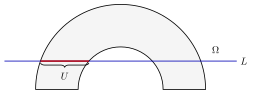
Comments
Corrections, questions, and mathematical discussion are welcome. Sign in with GitHub to comment. Comments are public.